

Issue:October 2026
SILICONE CHEMISTRY - Modification of Silicone Chemistry & Its Influence on Release Rates of APIs
Key Points
- Silicone is highly tunable because its polymer structure, substituent groups, crosslink density, porosity, cure chemistry, and other properties can be adjusted.
- Changes that improved API elution sometimes made the silicone too tacky, difficult to process, or mechanically weaker.
- Controlled-release silicone systems generally require systematic experimentation to balance drug release and manufacturing requirements.
By: Matthew Kihara
Introduction
Silicones are used for a variety of applications, given their biological compatibility and chemical stability.1 Among the most researched polymers to date, silicones have been a trusted component of medical device applications since the 1950s, found in cochlear implants, structural cardiology, birth control devices, and pacemakers – to name a few applications. One of the most advantageous features of silicone is its tunability, allowing it to be engineered to achieve specific performance, process, or therapeutic requirements. Implantable silicones are so versatile that their properties can vary greatly from one formulation to the next. For instance, while basic polydimethylsiloxane (PDMS) silicone is inherently insulative at approximately 1015 Ω·cm, its properties can be systematically tuned for drug delivery applications by varying parameters such as cross-link density, porosity, cure chemistry, solubility, and steric environment to control API release and transport.
This versatile, synthetic material is also used for the controlled release of drugs, or active pharmaceutical ingredients (APIs).2 Commercial drug delivery devices that incorporate silicone are commonly manufactured for contraception, hormonal replacement, infection mitigation with antibiotics, and emerging uses in oncology and anti-inflammatory therapies.
Integrating APIs into a silicone system requires consideration of multiple factors, such as compatibility of the silicone with the API and, more generally, achievement of the prescribed dose delivery rate over the prescribed amount of time. Because APIs and silicone matrices can influence each other’s properties, deliberate modification of silicone chemistry presents an opportunity to optimize system performance and drug release behavior.3
Silicone Chemistry
Repeating helical silicon oxygen bonds (Si-O), with substituent, or R’, groups attached to the open valences of the silicon atom comprise the siloxane polymer backbone of a silicone. Compared to epoxies and other organic-based rubbers with Carbon-Carbon (C-C) bonds, the Si-O bonds of silicones provide larger bond angles (Figure 1).1 These bond angles yield large amounts of free volume, leaving space for design or, more specifically, for managing the amount and type of substituent groups and fillers, including APIs, that go into a silicone system. This ability for formulation flexibility is largely what enables silicone to be so versatile.
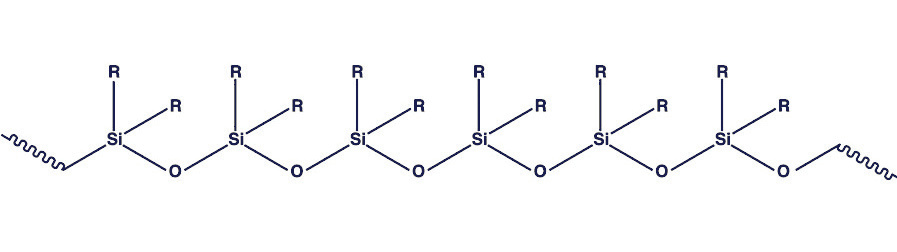
Figure 1: Basic structure of polysiloxane chain.
Varying the substituent groups on the polymer chain can help optimize silicones for very specific needs. These components interact with the Si-O-Si units to cause the resulting silicone material to exhibit certain properties. Common R’ groups that enable the use of silicone in the medical field are methyl, phenyl, and trifluoropropyl (fluoro) groups, along with polarity-enhancing groups such as poly(ethylene glycol) (PEG) that improve hydrophilicity and drug compatibility.
Methyl, formative of polydimethylsiloxane polymers (PDMS), is most known for its water resistance and desirable surface properties, which aid in moisture retention and contribute to lubricity and gentleness in topical or more intrusive applications. This is one of the most common substituent group found in biomedical applications.
As in the case of wound care dressings, external prosthetic devices, and contact lenses, silicone often needs to be permeable in order to act as a membrane through which water can be transmitted to surrounding tissue, and optical clarity is frequently required of protective encapsulants for assessment of components. Moreover, phenyl groups can be employed in resulting diphenyldimethylpolysiloxane polymers to increase or decrease a silicone’s permeability to moisture as needed, as well as to adjust its refractive index, or RI. Fluoro imparts swell resistance to silicone materials, which can be susceptible to size increase when in contact with common hydrocarbons, or other acidic fluids such as stomach acids.
In addition to rendering the substituent groups on the polymer interchangeable, allowing for control of mechanical and physical properties, free volume is also one of the reasons silicone is so often made a conduit for the delivery of various actives to particular parts of the body. The other reason is silicone’s chemical stability for its role in preserving the active’s effectiveness at no cost to the silicone’s material integrity or properties. Drug delivery applications and combination devices are some of the most complex in the medical world; chemical stability depends upon the goals and parameters at hand. Thus, marrying a silicone formulation to a drug profile virtually always involves trial and error. To demonstrate this point, a study was conducted in which two common APIs were incorporated into a silicone matrix with a goal of complete release in equal portions at a steady rate by the end of 14 days.
Evaluating a Range of Silicones for API Release
For the medical device simulation, two common APIs were eluted through a silicone molded component. As the interaction of the APIs with silicone chemistry was a potential concern, the appropriate silicone system needed to be identified. The appropriate system would also be one that accommodated ease in processing and molding, key for effectiveness in its final form as a vehicle for eluting the APIs. Among the most common silicone types in the healthcare field are gels and elastomers.
Silicone gels are made of reactive silicone polymers and reactive silicone crosslinkers in a two-part system that yields little to no elastomeric strength. When cured, these low-viscosity materials are designed to have a soft, compliant feel which, combined with silicone’s low modulus, allows them to mimic human tissue. They range from very soft for prosthetic applications to very tacky (sticky) for topical and transdermal wound care applications. Encapsulation of electronics such as for use in certain implantable sensors is also a common application for using silicone gels.
Silicone elastomers are similar in composition to gels but exhibit increased physical and mechanical properties due to reinforcing fillers and longer polymer chains. For instance, elastomers have higher uncured viscosities than gels and fluids. High consistency rubbers (HCRs) are ideal for extruded tubing because their silica-reinforced, high molecular weight polymers enable them to maintain a shape when uncured; low viscosity elastomers (LVEs), by contrast, are flowable and more ideal for coatings, encapsulants, and molded parts requiring optical clarity. Compared to HCRs and liquid silicone rubbers (LSRs), the high clarity and low viscosity associated with LVEs are primarily attributed to their unique base formulations, which may incorporate phenyl or unique reinforcing fillers. Of intermediate viscosity, LSRs are used to mold high precision parts such as gaskets, valves, O-rings, and seals. HCRs, LVEs, and LSRs are moldable materials that can be cast or injected into molds of various configurations.
Different silicone rubbers, with varying chemical makeup and consistency, were used in this study. The chosen system was modified throughout the trials to yield the elution results desired without compromising the mechanical strength of the silicone.
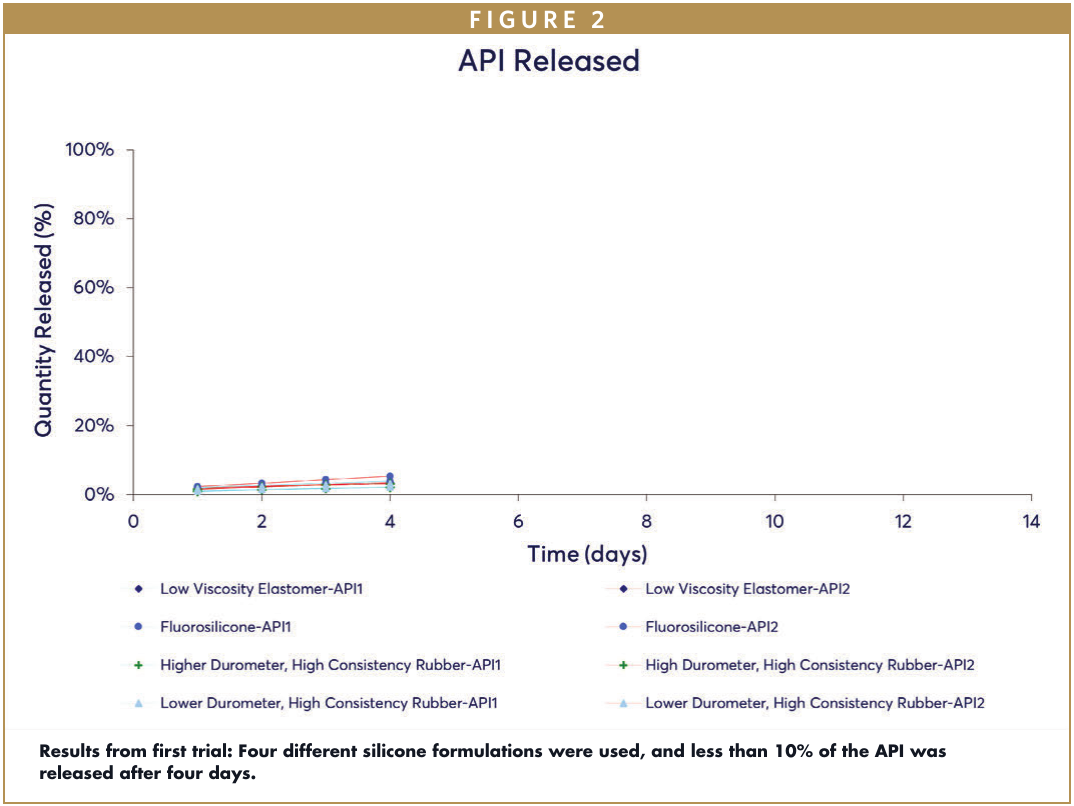
Figure 2: Results from first trial: Four different silicone formulations were used, and less than 10% of the API was released after four days.
Results of Iterative Study Using Different Silicones
Before the release rates of two common APIs were measured, a screening test was conducted to ensure the silicone would cure after incorporation of the APIs. This is a vital first step when incorporating any new API into a silicone system. The result may determine if additional formulating is necessary to counteract the effects caused by the API’s interaction with the silicone, or if a different cure chemistry is required due to compatibility concerns. In addition, an exhaustive extraction test verified the APIs were not chemically bonding with the silicone matrix. Via elution testing, the release rates of APIs were tested with comprehensive evaluation a total of four times.
An LVE, a liquid fluorosilicone rubber, a high durometer HCR and a low durometer HCR were selected for the first elution test. The first elution test showed that per each formulation, the APIs were not released at a sufficient rate to yield full elution after 14 days (Figure 2). Of the silicone materials tested, the fluorosilicone released the highest amounts of both APIs. Further testing on the silicones and the APIs revealed that high processing temperatures made the actives no longer antimicrobial. To equalize the release rates and maintain the integrity of the actives, three low durometer HCRs were developed for a second elution test. To enable cure at a lower temperature, a fugitive inhibitor in the original fluorosilicone formulation was replaced with a competitive inhibitor. Inhibitors are formulary ingredients utilized to control and regulate working times (pot life) of the blended elastomer as well as their cure profiles (rate of cure at a specified temperature).
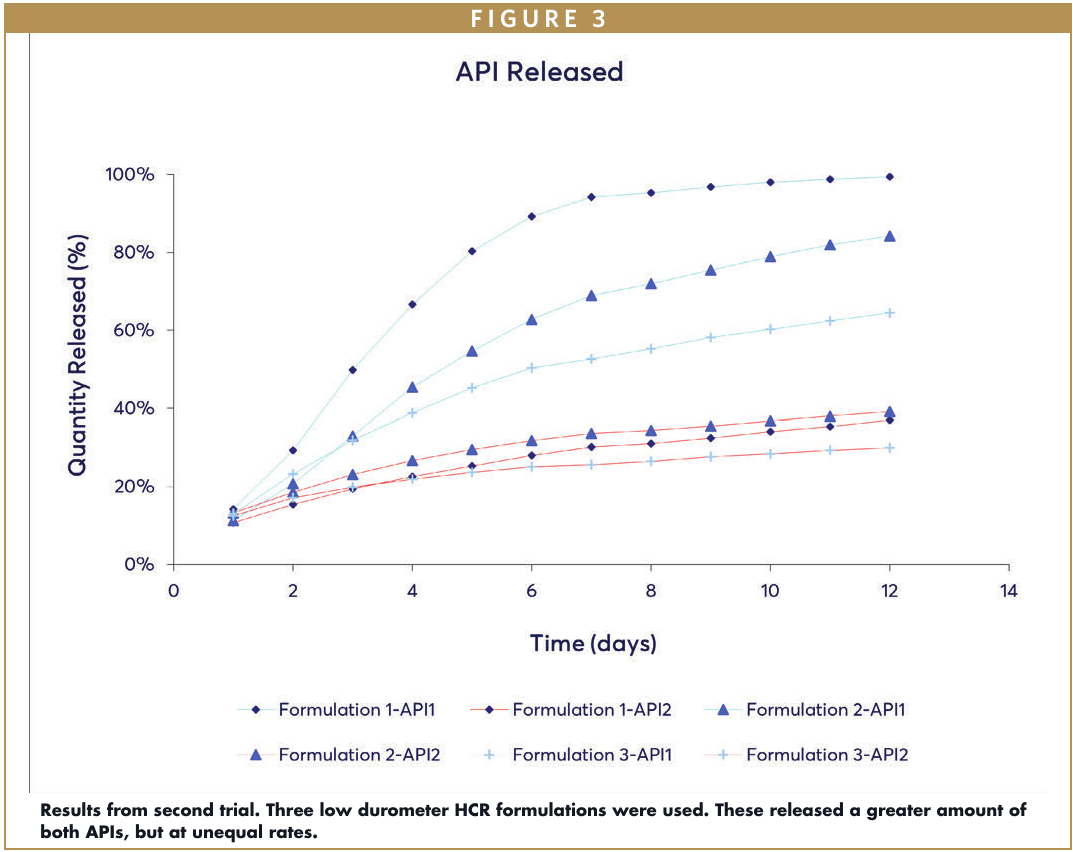
Figure 3: Results from second trial. Three low durometer HCR formulations were used. These released a greater amount of both APIs, but at unequal rates.
After some formulary adjustments were made to the silicones used in the first attempt, three new formulations of the low durometer HCR were used for the second elution test.
Release rates of the second trial showed greater elution of the actives, a noticeable improvement over the first trial (Figure 3). However, the pharma-grade excipients intended to maximize elution diminished the physical properties of the system and produced a product difficult to process. The adjusted silicone systems were either too tacky or not tacky enough for processing on the two-roll mill. Formulary changes made after these results anticipated process-friendly material and retention of uniform release rates.
Additional formulary adjustments were made in an attempt to produce better elution results. Six new formulations of the low durometer HCR were developed for the third elution test.
Results showed that the silicone matrix could be more easily processed, and that some combinations promoted equivalent release of both APIs – though no formulations fully eluted the drugs in 14 days (Figure 4). For some of the formulations, additional optimization was required to achieve full release degraded the cured properties of the silicone. Adjustments made for the next formulation were designed to maintain the processing performance achieved in the third trial, preserve the mechanical properties of the silicone, and elude the APIs equally in 14 days.
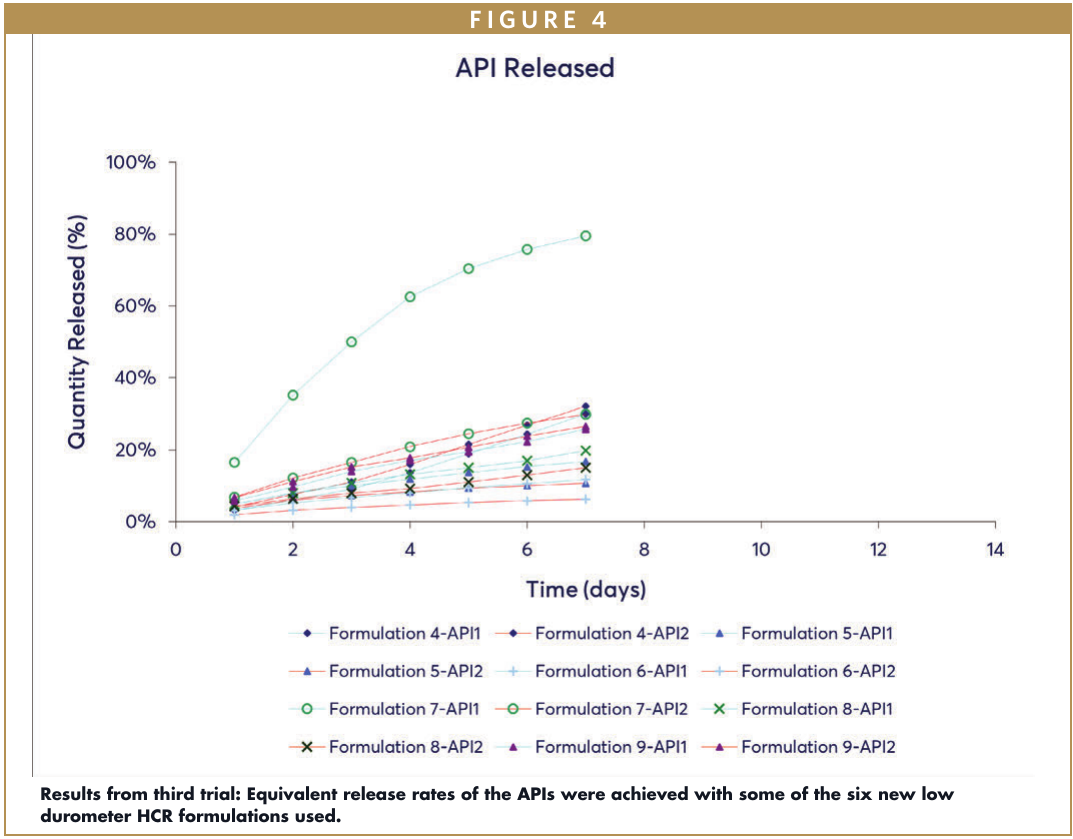
Figure 4: Results from third trial: Equivalent release rates of the APIs were achieved with some of the six new low durometer HCR formulations used.
Formulation 7 from the third attempt was redeveloped and optimized for what would be the last elution. The parameters of the study were met on the fourth trial. As is evident from Figure 5, release of the actives was uniform and occurred within the desired time frame of 14 days. Further testing showed that the cure profile for the silicone matrix was met, its mechanical integrity maintained, and its consistency compatible for two-roll mill processing.
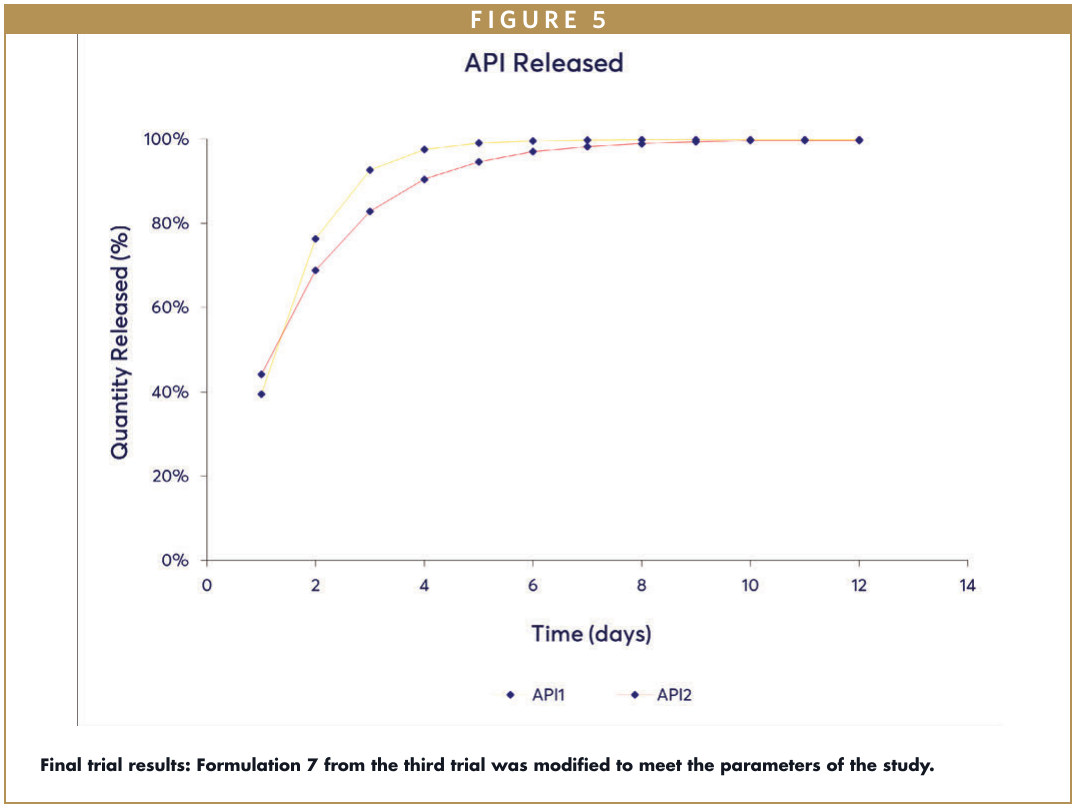
Figure 5: Final trial results: Formulation 7 from the third trial was modified to meet the parameters of the study.
Conclusion
This study demonstrated that silicone chemistry lends itself to optimization and that formulation modification influences the release of actives and process requirements. The modifications needed for the success of drug delivery applications are dependent upon the application’s parameters and goals, and include:
- Temperature limitations
- Inhibition concerns
- Cure profile
- Desired rheology
- Meeting of elution profiles
- Maintenance of the physical integrity of the vulcanized silicone system
The increase in the number and kind of drug delivery applications has furthered silicone technology for the controlled incorporation and elution of APIs such as antibiotics. When evaluating the release of APIs through a silicone matrix, a large number of elution studies should be executed in order to evaluate the materials involved for mechanical, elution, and processing performance.
Advancements in silicone technology are anchored in studies such as the one described above. This approach enables customization of silicone components to meet and sustain the needs of a wide range of drug delivery applications.
The authors acknowledge the foundational contributions of Brian Reilly and Nathan Wolfe to the original whitepaper that informed this article.
References
- Abbasi F, Mirzadeh H, Katbab A. Modification of polysiloxane polymers for biomedical applications: a review. Polymer International. 50:1279-1287; 2001.
- Kurnellas A, Wolfe N. Understanding the Role of Silicones in Controlled Release Applications. Medical Design Technology. June 17, 2010. Website visited: http://www.mdtmag.com/articles/2010/06/understanding-role-silicones-controlled-release-applications.
- Leonard S. Injecting New Ideas into Active Drug Delivery Systems. Qmed. April, 2008. Website visited: http://www.qmed.com/mpmn/article/silicones-show-its-okay-be-passive.

Matthew Kihara is Senior Manager, Medtech Global Market Strategy and Development at NuSil, a leading manufacturer of high-purity, specialty silicone materials designed for extreme environments, including medical implants, healthcare devices, and aerospace applications. Prior to joining NuSil, Matthew worked at Elkem, a company focused on the manufacture of silicones, silicon and carbon-based materials. He has extensive experience the silicones industry. Matthew holds a Master of Science in Materials Science and Engineering from the University of Oregon and an MBA from Southern Utah University.
Total Page Views: 327