

Issue:May 2026
SELF ADMINISTRATION - Smarter, Kinder, Simpler: EcoSafe Sets a New Standard for Sustainable Self-Administration
INTRODUCTION
In the well-established, tightly regulated medical device industry, innovation can be constrained. But that is not to say it is impossible. Healthcare providers and payers are continually looking for more economic solutions, that also strengthen inclusivity and adherence, and that minimize environmental impact.
In drug delivery, patient self-administration supports these objectives, and the market for self-administration devices is growing. However, among patients who deliver their own medication, there remains a group (around a fifth), who struggle to self-administer on their own. These patients, deemed ‘sensitive’, suffer from needle-phobia or lack of dexterity – among other physical, emotional and/or cognitive constraints.
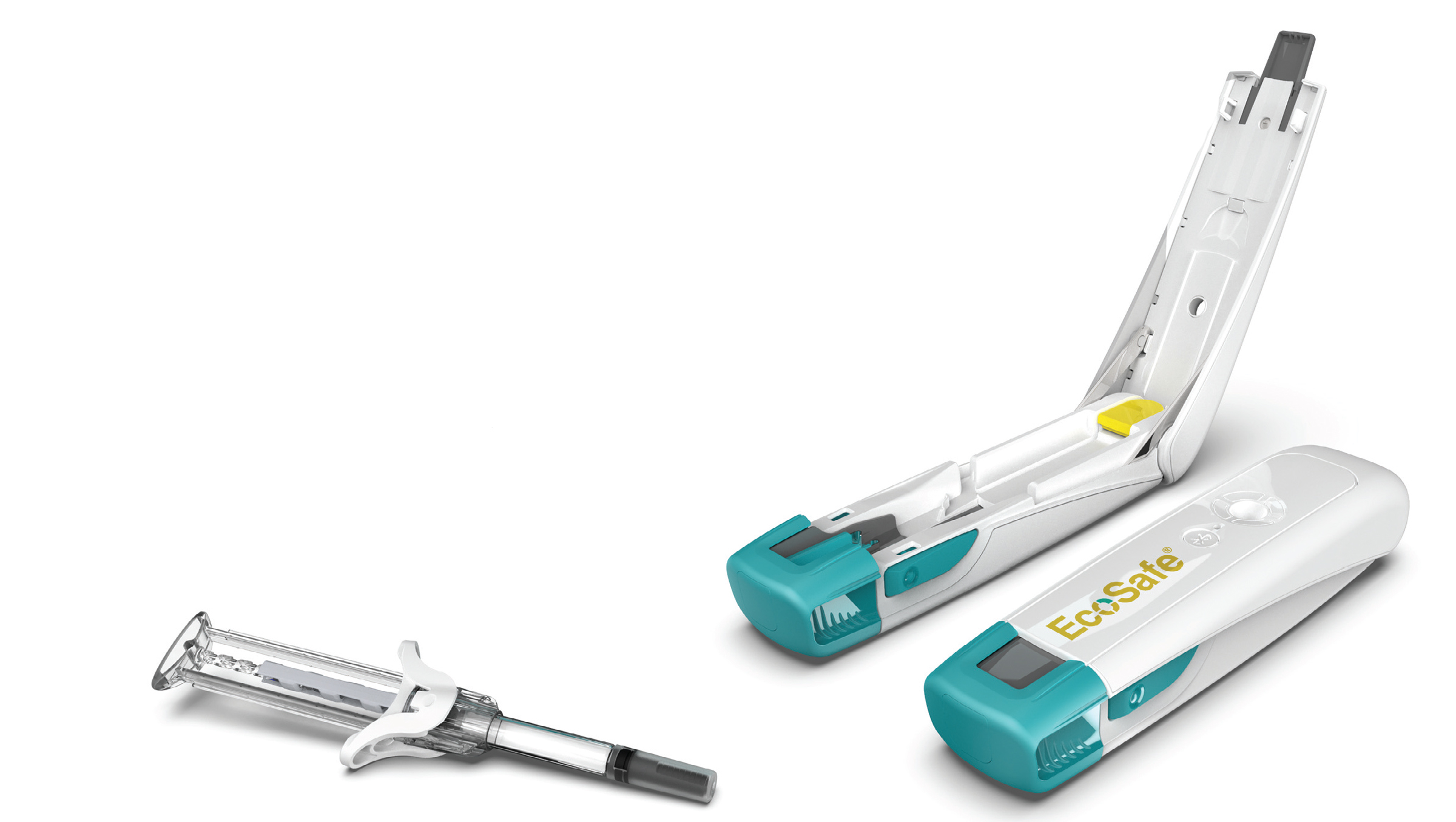
These patients tend to be prescribed a separate solution. While the majority of patients successfully self-administer using a safety syringe, sensitive patients may use an autoinjector or may need a healthcare professional to administer their medication. Sourcing a suitable autoinjector adds to the procurement burden, while the latter option drives up the cost of resources (e.g., home visit by a nurse), potentially introduces travel requirements (e.g., journey to a clinic for administration), and overall increases carbon footprint.
The Owen Mumford team took a novel approach to serve this patient group, with the ambitious aims of increasing the in inclusivity of its existing 1mL safety syringe, simplifying procurement, reducing cost, and reducing carbon footprint.
CONFIDENCE IN EVERY DOSE
The team’s design breakthrough was to offer a single product solution for both able and sensitive patients. Able patients are already using the EcoSafe® 1mL safety syringe. For patients with obstacles to manual injection, healthcare providers can simply add the accompanying EcoSafe reusable autoinjector, rather than prescribing a distinct solution. The safety syringe acts as the ‘cartridge’ for the autoinjector, slotting in and out for each injection. The needs of all patients are thus covered in one product family.
SMARTER FOR BUDGETS
For drug companies, this integrated safety syringe platform simplifies the commercial proposition for healthcare customers, since there are no gaps or complications. There is no need to offer different drug delivery products across a single therapy. From the manufacturing perspective, filling lines are simplified, given the safety syringe doubles as a cartridge, and there are no variations for sensitive patients. Production economies of scale also come into play.
Eliminating the need for healthcare professionals to administer medication significantly lowers cost-per-dose for sensitive patients. The reusable autoinjector further reduces cost and carbon footprint – though savings achieved depend on frequency of use.
KINDER TO THE PLANET: REDUCED CARBON FOOTPRINT
For claims around carbon footprint to be credible, it is important to consider the duration and frequency of usage. Limited use may not justify the additional resource and energy needed to create a durable reusable autoinjector. This is complicated by the fact that chronic conditions may require daily, weekly or fortnightly injections. Furthermore, devices themselves have a limit on usage.
The Life Cycle Analysis (LCA) for Owen Mumford’s autoinjector therefore assessed footprint per injection, creating a starting point for a range of usage calculations, and for comparisons with similar products. The peer-reviewed ISO LCA assessed the following: The injecting of a single dose of pharmaceutical using a 1mL EcoSafe safety syringe with minimum and maximum fill volumes of 0.1mL, with an EcoSafe reusable autoinjector.
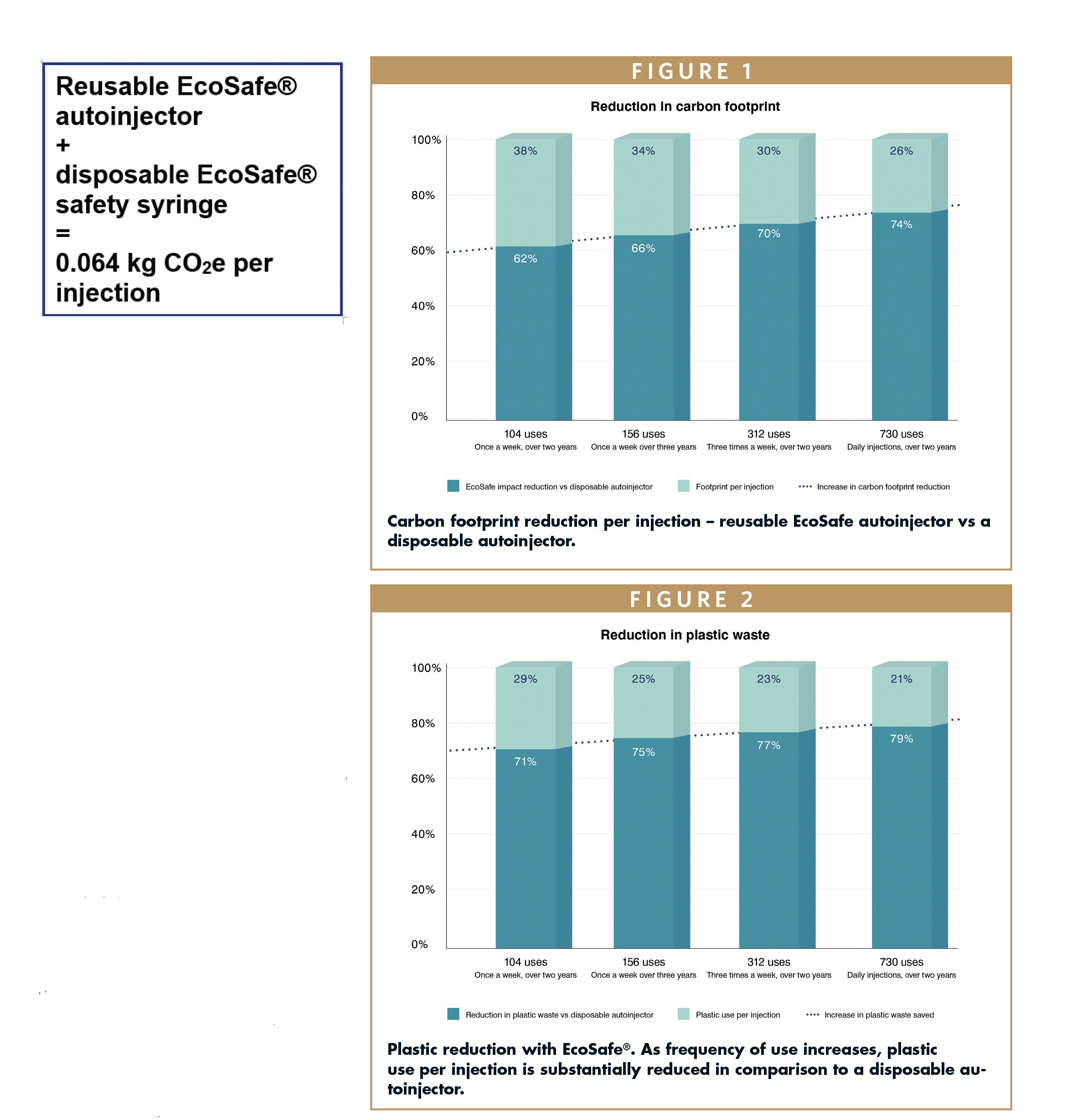
The objective was to achieve less than 0.1kg CO2e per injection. The LCA revealed that the combination of the reusable autoinjector with the disposable safety syringe produces only 0.064kg CO2e per injection. This stands true even if the device is used just 100 times (the autoinjector was tested to last for over 1,000 uses).
As the number of uses increases, so does the reduction in carbon footprint (Figure 1). For instance, 156 uses (ie, a weekly injection over three years) produces 0.082kg CO2e. To put this in context, a similar reusable device on the market (which has published LCA data), produces 0.2kg CO2e for the same frequency and duration of use. The findings of the LCA and the achievements of the platform therefore mark a new milestone in absolute carbon footprint reduction for reusable autoinjectors.
KINDER TO THE PLANET: REDUCED WASTE
Opting for the reusable autoinjector also cuts plastic waste, with this reduction increasing over time (Figure 2). The disposable safety syringe minimizes plastic waste through a lightweight design (just 5g) and a minimal number of parts, even eliminating the spring which is commonly used in safety syringes. This has the added benefit of aiding disassembly at the end of life and simplifying manufacturing.
Replacing fossil fuel derived plastics with more sustainable materials is clearly desirable, but not at all straightforward. Sourcing materials that are free of harmful effects to people and the planet is an ongoing endeavor in the industry.
INCLUSIVE, SUSTAINABLE & ECONOMICAL
Owen Mumford set out to resolve a longstanding conundrum: how to serve sensitive patient groups efficiently and economically. The resulting safety syringe platform simplifies decision-making for pharmaceutical companies and healthcare providers, uniting solutions for both able and sensitive patients in one product family.
In recent years, the preservation of our planet has become a growing priority, making sustainability a necessary fixture in device design. Reusable autoinjectors already inherently reduce footprint and waste; the EcoSafe offering aimed to cut its contribution to an absolute minimum, succeeding in setting a new benchmark for drug delivery devices.
Mark Glass, Director, Owen Mumford Pharmaceutical Services, With a strong scientific background and over 20 years of experience in the pharmaceutical sector, Mark Glass has delivered innovative solutions to drug developers across the globe. His career spans the full product lifecycle, from clinical development through to commercialisation, navigating complex regulatory environments. He has worked with a diverse range of customers, from single-product innovators to multinational pharmaceutical giants, equipping him with the insight and agility to foster long-term, mutually beneficial partnerships.
Total Page Views: 3276