

Issue:September 2026
REGULATORY COMPLIANCE - Navigating ISO 23908:2024 & EN ISO 23908:2025 Harmonization: What It Means for Your Combination Product Strategy
Key Points
- ISO 23908:2024/EN ISO 23908:2025 raises the bar for sharps safety, is becoming increasingly important for regulatory submissions
- For products such as prefilled syringes with exposed needles, incorporating a compliant sharps injury protection mechanism (SIPM) can be a practical way to meet evolving expectations without redesigning the entire drug/container system.
- Early evaluation of compliance strategies can help reduce regulatory risk, support successful regulatory submissions.
By: Murtaza Rana and Aurélie Rebuffet
INTRODUCTION
Sharps injury prevention remains an important consideration for needle-based medical devices and drug-device combination products. With the publication of ISO 23908:2024,1 expectations for sharps injury protection mechanisms have been updated to reflect a broader scope, stronger risk-management principles, and more explicit usability and performance testing requirements. For pharmaceutical and device manufacturers, the revised standard is an opportunity to reassess how sharps injury risks are addressed across product development, regulatory submissions, and lifecycle management.
WHAT IS THE ISO 23908 STANDARD?
ISO 23908 is an international standard published by the International Organization for Standardization (ISO) that defines requirements and test methods for evaluating the performance and usability of sharps injury protection mechanisms (SIPMs). SIPMs are used with devices containing a needle or other single-use sharp intended for the administration and/or extraction of blood, body fluids or medicinal substances.
The standard aims to minimize the risk of accidental sharps injuries from contaminated sharps after intended use, including during handling, disposal, and, where applicable, recovery. SIPMs may be integrated into the device or provided as standalone components that are assembled with the device prior to use.
They may also be categorized as either active, requiring a specific user action to engage the protection mechanism, or passive, activating automatically without additional user intervention.
ISO 23908 provides a framework for assessing the effectiveness of SIPMs. Specifically, it evaluates whether the mechanism:
- Activates as intended
- Achieves and maintains a safe state
- Prevents accidental access to the sharp following intended use
- Minimizes exposure risk during disposal or recovery
Importantly, ISO 23908 is focused on the performance and usability of the sharps injury protection mechanism itself. Compliance with the standard does not replace the need to evaluate the overall safety, performance, effectiveness, or applicable regulatory requirements of the medical device or drug-device combination product in which the SIPM is incorporated.
WHAT IS NEW IN THE 2024 VERSION?
ISO 23908:2024 supersedes the 2011 edition, but is not a complete departure from the original standard. The 2011 version established key principles for sharps injury prevention, including risk-based design, simulated use testing, and active or passive SIPMs. Building on this foundation, the 2024 revision expands the scope of the standard and provides greater clarity regarding performance expectations, testing methodologies, usability considerations, foreseeable misuse, and product lifecycle aspects.
Key enhancements introduced in the ISO 23908:2024 include:
- Broadened scope to explicitly include medical substance administration;
- Stronger alignment with current risk management and usability engineering standards (ISO 14971:2019 and IEC 62366-1:2015+Amd1:2020, respectively);
- More explicit consideration of foreseeable misuse for active protection mechanisms;
- Introduction of a free-fall test to assess protection following accidental dropping;
- Addition of a 5N challenge to assess access to the sharp in safe mode;
- Updates to certain statistical and test-method expectations;
- Consideration of recovery, where applicable, as an element of product lifecycle.
In practical terms, the 2024 revision reinforces the expectation that SIPMs not only activate as intended but also maintain their protective function throughout post-use handling, transport, disposal, and, where relevant, recovery processes. This evolution is particularly relevant for drug-device combination products, where safety, usability, risk management, and regulatory expectations are increasingly interconnected and must be addressed holistically throughout the product lifecycle.
US REGULATORY CONTEXT
The FDA has recognized ISO 23908:2024 and will continue to accept declarations of conformity to ISO 23908:2011 until July 4, 2027. After that date, declarations to the 2011 edition will no longer be accepted for relevant premarket submissions.2
FDA’s 2005 guidance on medical devices with sharps injury prevention3 features emphasizes the importance of design controls, risk analysis, bench testing, simulated clinical use testing, sterilization, biocompatibility and labelling. The guidance further clarifies that it applies to the sharps injury prevention feature and does not replace device-specific guidance applicable to the underlying device.
For manufacturers, ISO 23908:2024 should therefore be applied as part of a broader regulatory strategy that also considers relevant FDA guidance, recognized consensus standards and product-specific regulatory requirements.
EU HARMONIZATION: STATUS AND IMPACT
ISO 23908:2024 was adopted by the European Standards Organization (CEN) as EN ISO 23908:2025 in August 2025 and subsequently published by national standards bodies across Europe (e.g. BSI, DIN, DS, and NEN). On June 11, 2026, EN ISO 23908:20254 was cited in the Official Journal of the EU (OJEU), thereby becoming a harmonized standard under the EU Medical Device Regulation (EU MDR – Regulation (EU) 2017/745).
In Europe, harmonized standards play an important role in demonstrating conformity with EU directives or regulations. Annex ZA of a harmonized European standard serves as the link between the technical requirements of the standard and the General Safety and Performance Requirements (GSPRs) of the EU MDR. It demonstrates that compliance with the standard provides a “presumption of conformity” with the corresponding legal requirements. i.e. Compliance with a harmonized standard indicates that requirements of the applicable EU directive or regulation are met.
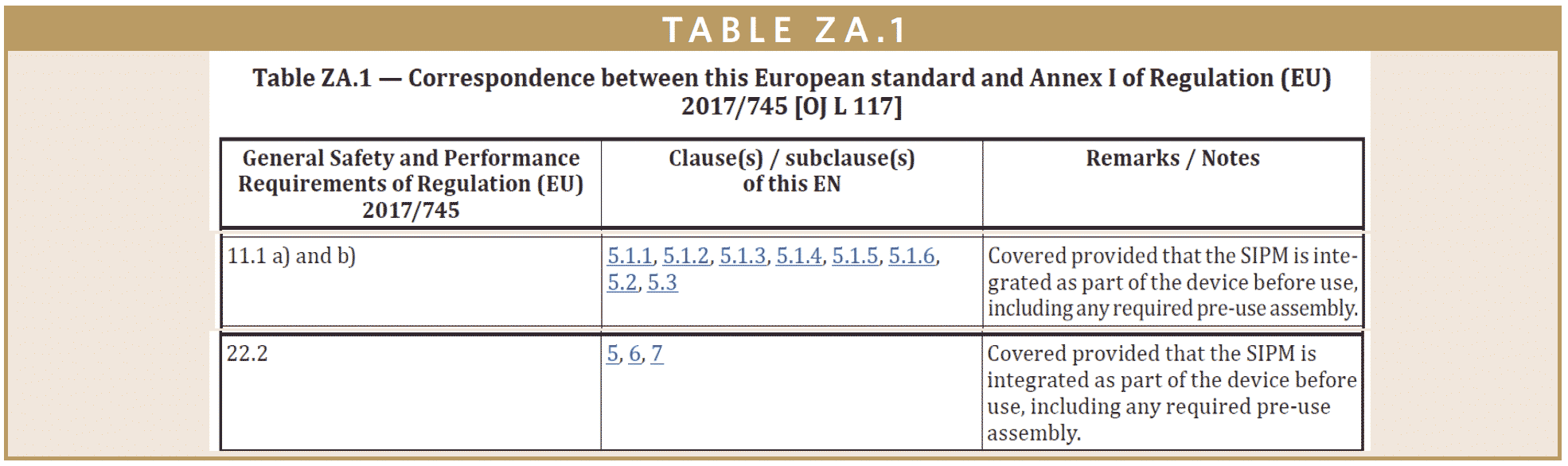
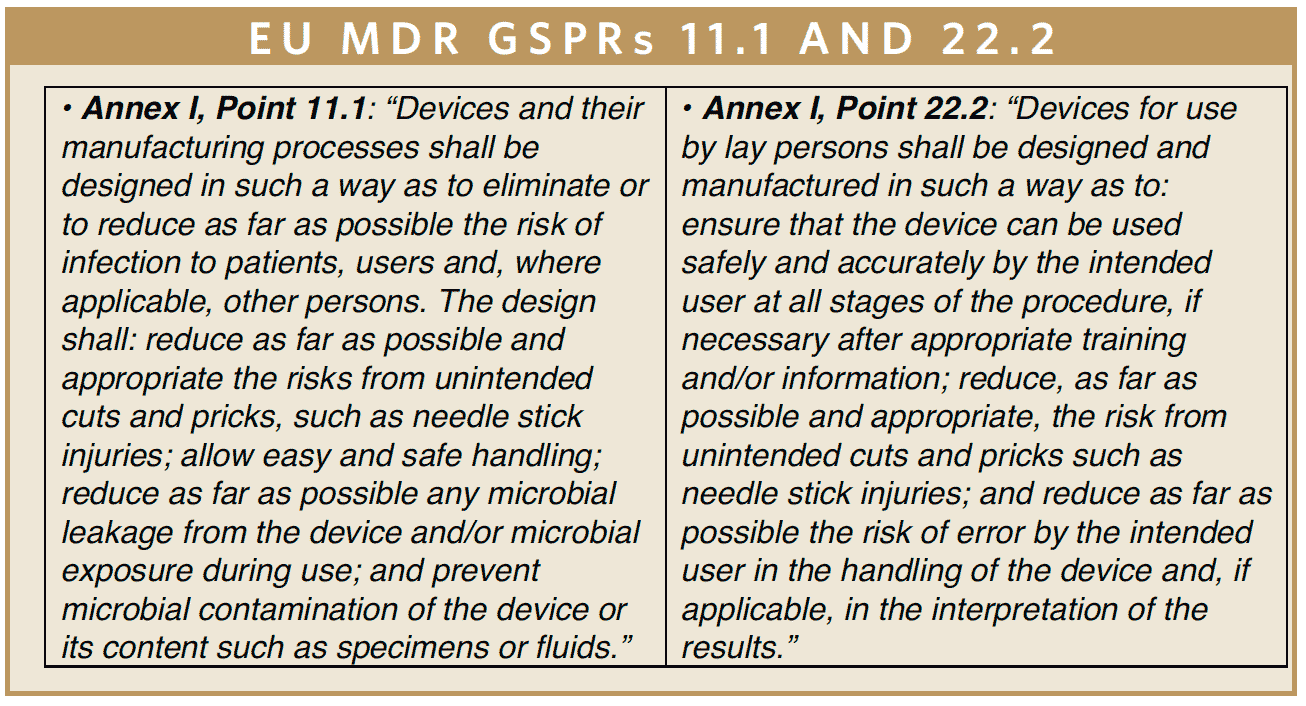
For EN ISO 23908:2025, Annex ZA5 identifies a relationship with GSPRs 11.1 and 22.2 of the EU MDR, both of which include requirements to reduce, as far as possible and appropriate, the risks associated with needle-stick injuries.
The harmonization of EN ISO 23908:2025 may therefore increase scrutiny of devices that incorporate exposed sharps without a sharps injury protection mechanism (SIPM). Manufacturers should be prepared to justify how such devices satisfy the applicable GSPRs and achieve an equivalent level of safety.
The implications extend beyond CE-marked medical devices. Through Article 117 of Regulation (EU) 2017/745, manufacturers of integral drug-device combination products (iDDCs) must obtain a Notified Body opinion for certain new marketing applications and significant product changes. In performing these assessments, Notified Bodies are expected to consider relevant harmonized standards as part of their evaluation, regardless of whether compliance is explicitly claimed by the manufacturer.
It is important to note that the use of harmonized standards remains voluntary. However, when a manufacturer elects not to apply a harmonized standard, it must demonstrate – through a robust scientific and technical justification – that its alternative approach satisfies the applicable MDR requirements and provides an equivalent level of safety and performance.
As a result, manufacturers of iDDCs containing exposed sharps, such as prefilled syringes with staked needles and no integrated SIPM, should carefully assess the impact of EN ISO 23908:2025 on future submissions and lifecycle changes. In the absence of compliance with the standard, additional justification may be required to demonstrate conformity with MDR requirements related to sharps injury prevention.
HOW CAN MANUFACTURERS ACHIEVE COMPLIANCE?
One approach to addressing the requirements of the revised standard is to incorporate a sharps injury protection mechanism (SIPM) that complies with ISO 23908:2024/EN ISO 23908:2025 into the existing prefilled syringe presentation. BD offers the BD UltraSafe Plus Passive Needle Guard, an integrated SIPM designed to meet the requirements of ISO 23908:2024 and EN ISO 23908:2025.
Because the primary container and drug-contacting components of the prefilled syringe remain unchanged, the regulatory and development impact can be significantly reduced compared with the introduction of a new primary container system. This may reduce the extent of new supporting data required for primary packaging materials. As a result, implementation timelines can be substantially shortened.
To support development activities, BD can provide compatibility data demonstrating the use of BD UltraSafe Plus™ with compatible ISO 11040-4:20246 glass syringe barrels. In addition, human factors and usability data are available to help demonstrate the safe and effective use of this widely adopted device platform.
WHAT IS THE REGULATORY IMPACT OF ADDING A SECONDARY DEVICE?
The addition of an integrated needle safety device to an approved drug-device combination product is typically considered a significant change and therefore requires regulatory assessment. For products marketed in Europe, the addition of a SIPM would generally require:
- A new or updated Notified Body Opinion (NBOp) under Article 117, reflecting the modified device constituent part; and
- Submission of a Type II variation (Q.IV.2(a)) to obtain approval of the revised product presentation.
While actual review timelines vary depending on the product, regulatory pathway, and health authority workload, manufacturers should anticipate that the combined approval process may take approximately 12 months from submission to implementation.
Despite these regulatory requirements, adding a compliant SIPM can provide a practical pathway to addressing evolving sharps injury prevention expectations while leveraging the existing drug product, primary container, and supporting data package.
CONCLUSION
The publication of ISO 23908:2024 and its subsequent adoption as EN ISO 23908:2025 represent an evolution in the regulatory and technical expectations for sharps injury protection. While the 2024 revision builds upon the well-established principles of the 2011 edition, it introduces more robust requirements related to risk management, usability, foreseeable misuse, performance verification, and lifecycle considerations. New expectations, including free-fall testing, a 5N access-to-sharp challenge, and updated statistical evaluation methods, reflect an increased focus on demonstrating protection under realistic use conditions throughout the product lifecycle.
From a regulatory perspective, the significance of the standard extends beyond technical compliance. In the United States, FDA recognition of ISO 23908:2024 reinforces its relevance within regulatory submission strategies. In Europe, the harmonization of EN ISO 23908:2025 under the EU MDR provides a presumption of conformity with key GSPRs related to needle-stick injury prevention, making the standard an important consideration during Notified Body assessments of both medical devices and integral drug-device combination products.
Although compliance with harmonized standards remains voluntary, manufacturers choosing not to apply EN ISO 23908:2025 should be prepared to provide a robust scientific and technical justification demonstrating an equivalent level of safety and performance. This may present increasing challenges for products that incorporate exposed sharps without an integrated sharps injury protection mechanism.
For manufacturers seeking a practical path forward, the integration of a compliant SIPM – such as the BD UltraSafe Plus Passive Needle Guard – can help address evolving regulatory expectations while minimizing the impact on the drug product and primary container system. By leveraging existing packaging configurations and available compatibility and usability data, implementation may be achieved with substantially less development effort than a complete container redesign.
Ultimately, manufacturers should proactively assess the implications of ISO 23908:2024 and EN ISO 23908:2025 on both existing products and future development programs. Early evaluation of compliance strategies can help reduce regulatory risk, support successful regulatory submissions, and enhance protection for healthcare professionals, patients, and other users who interact with sharps throughout the healthcare ecosystem.
REFERENCES
- International Organization for Standardization. ISO 23908:2024. Sharps injury protection — Sharps protection mechanisms for single-use needles, introducers for catheters and needles used for blood testing, monitoring, sampling and medical substance administration — Requirements and test methods.
- SIS (safety information sheet); FR Recognition Number 6-507. http://www.accessdata.fda.gov/scripts/cdrh/cfdocs/cfstandards/detail.cfm?standard__identification_no=46182.
- FDA. Medical Devices with Sharps Injury Prevention Features: Guidance for Industry and FDA Staff. August 9, 2005.
- European Commission. Commission Implementing Decision (EU) 2026/1231 of 11 June 2026 amending Implementing Decision (EU) 2021/1182 as regards harmonised standards for biological evaluation of medical devices, symbols to be used with information to be supplied by the manufacturer, medical electrical equipment, transfusion equipment for medical use, ophthalmic optics, non-active surgical implants, washer-disinfectors, prosthetics and sharps injury protection. Official Journal of the European Union. OJ L 2026/1231, 17 June 2026.
- British Standards Institute. EN ISO 23908:2025; Sharps injury protection — Sharps protection mechanisms for single-use needles, introducers for catheters and needles used for blood testing, monitoring, sampling and medical substance administration — Requirements and test methods.”
- ISO 11040-4:2024. Prefilled Syringes – Part 4: Glass barrels for injectables and sterilized subassembled syringes ready for filling; June 2024.
BIOGRAPHIES

Murtaza Rana is a Senior Regulatory Affairs Manager at BD Medical – Pharmaceutical Systems, where he leads the regulatory affairs team managing syringe safety, pen injector, and autoinjector platforms. With more than 18 years of experience in medical devices, in vitro diagnostics, and combination products, he has extensive expertise in global regulatory submissions, product development, lifecycle management, and international market access. In his prior role, he was actively involved in regulatory standards initiatives through industry associations and standards committees. He holds Bachelor’s and Master’s degrees in Biomedical Engineering from the New Jersey Institute of Technology.

Aurélie Rebuffet is a Senior Staff Specialist in Regulatory Affairs at BD Medical – Pharmaceutical Systems. In her role, she defines and implements regulatory strategies, leads complex cross-functional initiatives and represents Regulatory Affairs in strategic projects and international forums. Her work ensures compliance excellence while creating value-driven solutions for clients and the organization. Dr Rebuffet began her career in Regulatory Affairs at Sanofi Pasteur, before joining BD in 2016. She holds a Doctorate in Pharmacy from Grenoble Pharmacy University (France), a Civil Engineering degree from École des Mines de Saint-Étienne (France), and a Master’s degree in Regulatory Affairs from Paris-Sud Pharmacy University (France).
Total Page Views: 519