

Issue:March/April 2026
RADIOLIGAND THERAPIES - Affibody Molecules: A Versatile Approach to Radiopharma
Key Points
- Radiopharmaceuticals are therapeutic compounds that contain a radioactive isotope used for the diagnosis, imaging, or treatment of diseases. The role of radiotherapy in precision oncology is already well established in tumor types, such as prostate cancer and neuroendocrine tumors. There are now emerging studies on the application of radiopharma in other cancer types, including metastatic breast cancer.
INTRODUCTION
Radiopharmaceuticals are therapeutic compounds that contain a radioactive isotope used for the diagnosis, imaging, or treatment of diseases. The role of radiotherapy in precision oncology is already well established in tumor types, such as prostate cancer and neuroendocrine tumors. There are now emerging studies on the application of radiopharma in other cancer types, including metastatic breast cancer.
Following initial attempts to address radiopharma using full-size monoclonal antibodies (mAbs), recent advances in the radiopharma field have predominantly focused on peptides. These significantly smaller molecules can penetrate deep into solid tumors and allow more efficient internalization into cells. They also offer lower immunogenicity, easier chemical modification, speedier diagnostics, and changed non-target toxicity.
However, with these advances have come challenges, such as difficulty generating potent binders to a broader range of targets and the rapid excretion rate that requires very high amounts of radioactivity to be used since most of it misses the tumor and is excreted directly via the kidney. Affibody molecules (first described in 1997) are versatile molecules significantly smaller than MAbs that offer increased stability compared to peptides. They are also highly customizable, allowing increased specificity in a range of applications.
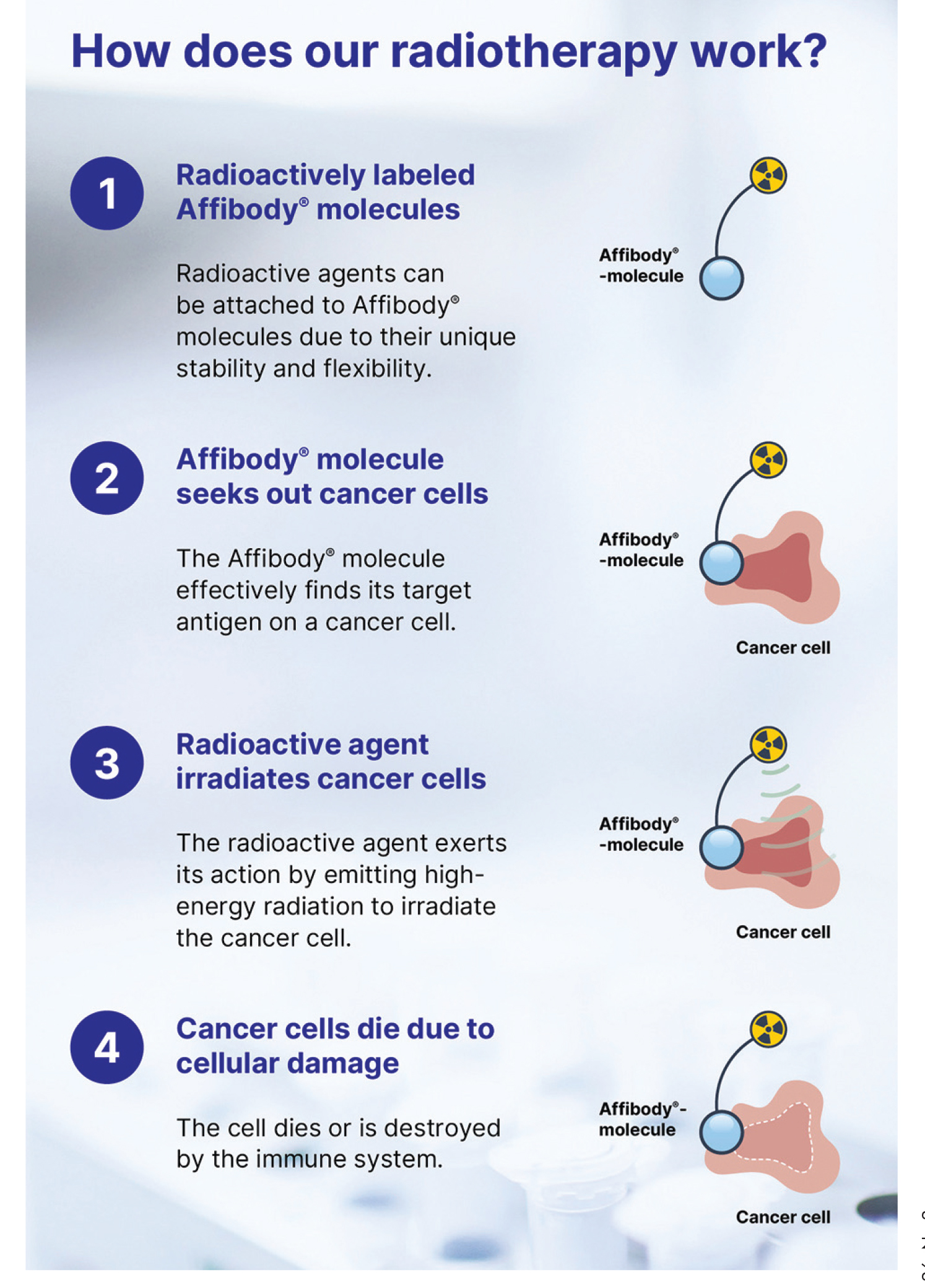
Swedish biotech Affibody AB is a pioneer in the field with decades of innovation in Affibody molecule discovery and engineering. It is developing next- generation Radioligand Therapies (RLTs) designed to deliver highly selective tumor targeting across a wide range of cancers and is advancing a novel pipeline focused on oncology indications with high unmet medical need.
Affibody’s lead RLT candidate, ABY-271, is currently being evaluated in a first-in-human clinical study in HER2 positive metastatic breast cancer. This targets a novel epitope (a specific small region on an antigen) compared to concurrent therapies. Additional key areas of interest for Affibody’s RLT pipeline are advanced gastroesophageal adenocarcinoma (GEAC), non-small cell lung cancer, triple negative breast cancer, and pancreatic ductal adenocarcinoma.
THE DEVELOPMENT OF RADIOPHARMA & THERANOSTICS
Theranostics combines therapy and diagnostics, typically combining targeted radioactive agents that first locate cancers with imaging and then delivering treatment directly to the site. It has been described as a “smart missile” that finds specific cells with a diagnostic tracer, then uses a therapeutic isotope to destroy them.
Throughout the past few years, the use of radiotherapy and theranostics in precision oncology has received significant renewed interest. Modern radiotherapy has changed from a “one-size-fits-all” treatment, into highly personalized therapy targeting specific biological mechanisms, pathways, or molecules. It can also integrate advanced imaging, AI, and systemic therapies. This allows radiation to be delivered with extreme accuracy, reducing damage to healthy tissue while increasing the effective dose to the tumor.
THE USE OF RLTS FOR THE TREATMENT OF METASTATIC BREAST CANCER
Breast cancers are responsible for the deaths of over 40,000 women each year, and this figure has not changed significantly in 20 years. HER2 is a growth receptor involved in many breast cancers. There is an obvious need for continued exploration to discover effective treatments, highlighting a clear pathway for the application of other tumor therapies.
Radioligand therapy (RLT) is a targeted, systemic cancer treatment combining a radioisotope with a molecule (ligand) that binds to specific cancer cells to destroy them with radiation from within. It is regularly used in conjunction with radioligand imaging to form a theranostic approach – where metastatic cancers can be developed and treated with the same targeting molecule, often with PET or SPECT scanners.
While some radioligand therapies have already received regulatory approval for the treatment of neuroendocrine and prostatic tumors, none have yet been approved for HER2 cancers. Here, other compounds, such as antibody drug conjugates (ADCs), are currently used; for example, Kadcyla (trastuzumab emtasine) and Enhertu (trastuzumab deruxtecan) with dozens more in development.1
The RLTs available for use in other tumors have shown blockbuster successes, emphasizing the opportunity for development across the board. These include Novartis’ peptide bound Lutathera (lutetium Lu 177 dotatate) and Pluvicto (lutetium Lu 177 vipivotide tetraxetan), which are expected to have achieved a growth rate of over 10 times by 2031 to more than $6 billion. This is driven by strong clinical evidence, as Lutathera has demonstrated a reduced risk of disease progression or death in 72% in certain patients as a first line therapy.2
THE DISCOVERY OF AFFIBODY MOLECULES
Affibody molecules were first described in 1997 in Nature Biotechnology as small (6.5 kilodaltons) robust three-helical protein scaffolds. By substituting different amino acids on two of the three helixes, researchers at Sweden’s KTH Royal Institute of Technology created a large library consisting of more than 10 billion Affibody® molecules, all with unique binding sites, from which binders to given targets are selected. Using Affibody’s patented platform technology, the molecules can be engineered for specific properties, such as resilience, or for specific uses, including conjugation to toxic molecules and fusion to protein modules.
These molecules immediately made themselves known as incredibly robust, lending their use to all areas of biotech; for instance, in a hot start PCR kit, where they can withstand multiple heat cycles.3 Compared to antibodies, they are also more practical and less costly to produce as there is no need for antigen immunization and lengthy mammalian cell line engineering and production.4
The proprietary Affibody platform has now been clinically validated with more than 1,300 subjects and has demonstrated safety and efficacy for more than 3 years of continuous dosing.
ADVANTAGES OF AFFIBODY MOLECULES OVER ANTIBODIES & PEPTIDES
Affibody molecules are known as a class of antibody mimetics – sitting between antibodies and peptides, Affibody molecules are engineered to co-opt the advantages of both. Having a structured target binding surface area at the same size as a typical antibody, the ability for very high affinity and selectivity binding is much greater than that of most peptides that have a more limited target space. The small size of Affibody molecules (1/20th that of antibodies) allows similar tissue penetration to peptides and enables rapid clearance through the bloodstream, which minimizes non-target organ uptake and rapidly produce high tumor to non-target tissue contrast, which is a major limitation of antibodies. Increased speed due to the small size allows faster imaging; following administration, images can be obtained in mere hours as opposed to days, quickly identifying patients who are likely to respond to treatment.
The structure of Affibody molecules allows for significant modification, and Affibody has created a library of tens of billions of molecules with unique binding sites enabling a broad target space. The flexibility they have created means alterations can be made for specific applications and radioisotopes. The molecules are also more predictable than peptides with behaviors remaining consistent between different molecules allowing for systematic optimization. Rather than trying to make an existing structure work, Affibody can create their own molecule specifically.
The leading Affibody radioligand has been engineered to target a different epitope compared to traditional HER2 treatments. This enables a multimodal approach that can detect and treat patients with low target-expression in collaboration with diagnostic companion tools, or those that have become resistant to more conventional therapies and makes it possible for combination with approved HER2 products.
COMPANY MANUFACTURE & FACILITIES
Affibody has more than 2 decades of experience in the sector. There have been more than 1,000 publications of which more than 400 have been specific to radiopharmaceuticals.
Affibody’s pipeline also includes immunology partnership programs in addition to its RLT work. Its leading drug candidate in this field is izokibep, which is currently in Phase 3. With wide applications for indications, such as psoriatic arthritis and hidradenitis suppurativa, izokibep addresses autoimmune diseases driven by the protein IL-17 and is best-in-class with superior selectivity and blocking affinity 10 to 100 times stronger than current leading equivalents.
Affibody has a wealth of expertise, with more than 60 full-time employees forming a team of multidisciplinary experts to create a strong driving force. It also has a long-standing collaboration with Uppsala University, which provides unique access to world-class RLT laboratories, animal facilities, and radiochemistry expertise.
CURRENT DIRECTION
Taking an active approach to challenges of regulatory duality as both radioactive substances and drugs, Affibody has been in discussion with regulators across Europe and the US and engaged in extensive pre-clinical work.
Other traditionally significant practical hurdles, such as manufacturing and transport, are diminished by the stability of their molecules, and existing networks are being utilized to create efficient pathways. The reversible albumin binding has multiple uses and is well validated in other areas within the field; using an endogenous protein carrier, which is widely distributed within the body allows an extended half-life and greater tumor exposure, while promoting reduced renal clearance, an approach comparatively underutilized within radiopharmaceuticals.
Potential risks to human health have been major factors in the commercial poor-performance of early RLTs.5 Concerns over radiation-induced myelodysplasia (MDS) and acute myeloid leukemia (AML) have been cited, despite these not being found to be significantly different to standard chemotherapeutic agents at the time. The recent successes of peptide bound RLTs exemplify the appreciation of alternatives that can offer improved tissue distribution and therefore reduced cumulative doses of radiation.
Despite early concerns over radiation, there are unique benefits that cannot be ignored. As treatment progresses, its potential to destroy tumor sites remains strong and resistance against treatment is unlikely to develop due to direct DNA damage. This coupled with the unique epitope paves the way for an independent position within the clinical pathway without displacing concomitant treatments.
SIGNIFICANT CLINICAL EVIDENCE
These critical advantages are not just in the scientific model, but have also been demonstrated in preclinical trials, with biodistribution studies using mice bearing HER2-expressing SKOV-3 xenografts.
Affibody’s leading asset, ABY-271, showed accumulation in tumors exceeding that in all other organs and with balanced clearance to provide an increased safety profile. Histopathological evaluation cemented this supporting progression to first-in-human trials.
Therapeutic effects were likewise promising. Median survival was extended compared to both controls or trastuzumab (a standard HER2-targeted therapy) with just a single dose of 21 MBq ABY-271, and combination with trastuzumab increased the rate of complete tumor remissions even further.
Furthermore, preclinical results allow us to predict that doses received at the tumor sites being both within the approved therapeutic range and clinically meaningful is achievable based off human dosimetry estimates and comparable to existing products.
In October 2025, Affibody announced it had dosed the first human patient in the first part of their open-label, two-part randomized Phase 1 clinical study with ABY-271 in HER2-positive metastatic breast cancer. In December 2025, promising initial results from the first cohort of patients was announced, demonstrating tumor targeting and a favorable safety profile with low uptake in kidneys and other critical organs.
KEY DEVELOPMENTS & A FUTURISTIC OUTLOOK
With successes in its early Phase 1 trial, Affibody decided in December 2025 to advance the Phase 1 clinical study to its second part, in which higher radioactivity levels will be evaluated. Advances and testing will allow the identification of ideal configurations and further safety evaluation to inform dose selections for future trials.
Developments, such as these aren’t only relevant in the world of HER2 cancers or breast cancers but demonstrate and strengthen the promise of the Affibody molecule as a powerful technology for developing next-generation targeted radiotherapeutics.
The relative successes of recent RLTs compared to historical radioantibodies highlight the increased understanding and uptake of these therapies across the medical fields. As antibody therapies continue to excel in medical trials and prove their use, the sector is growing to support their development.
With its place within the treatment pathway where HER2-positive metastatic breast cancers may have become resistant to or are responding to other treatment options, ABY-271 is an encouraging avenue and may change outcomes significantly, offering new hope to patients.
REFERENCES
- Mühlegger M, FDA approved antibody drug conjugates (adcs), Single Use Support. (May 2024) Available at: https://www.susupport.com/blogs/biopharmaceutical-products/fda-approved-antibody-drug-conjugates-adcs (Accessed: January 2026).
- Novartis Lutathera® significantly reduced risk of disease progression or death by 72% as first-line treatment for patients with advanced gastroenteropancreatic neuroendocrine tumors (2024) Novartis. Available at: https://www.novartis.com/news/media-releases/novartis-lutathera-significantly-reduced-risk-disease-progression-or-death-72-first-line-treatment-patients-advanced-gastroenteropancreatic-neuroendocrine-tumors.
- Frejd, F.Y. and Kim, K.-T. (2017) Affibody molecules as engineered protein drugs, Nature News. Available at: https://www.nature.com/articles/emm201735.
- Zhang, L. & Zhang, H., 2024. Recent advances of affibody molecules in biomedical applications. Bioorganic & Medicinal Chemistry, 113, p.117923. doi:10.1016/j.bmc.2024.117923.
- Green DJ, Press OW. Whither Radioimmunotherapy: To Be or Not To Be? Cancer Res. 2017 May 1;77(9):2191-2196. doi: 10.1158/0008-5472.CAN-16-2523. Epub 2017 Apr 20. PMID: 28428282; PMCID: PMC5413412.

Fredrik Frejd is Chief Scientific Officer at Affibody. He has more than 20 years of experience in biomedical research with expertise in tumor biology, biotechnological phage display, and therapeutic protein technique with antibody fragments, as well as artificial scaffold proteins. He is an adjunct Professor at the Department of Cancer Precision Medicine at Uppsala University. He is a Board Director of Mergus development AB, Akiram Therapeutics AB, Immuneed AB, and Deputy Board Director of Amylonix AB. He is also a member of Technische Universität Dresden Center for Molecular Bioengineering’s scientific council.
Total Page Views: 3429