


Orbital™: Advancing High-Payload Pulmonary Delivery Through Precision, Usability, & System Level Design
Enabling Consistent Delivery of Complex Therapies in an Evolving DPI Landscape
By: Jonathan Mulpas
Pulmonary drug development is increasingly shaped by the need to deliver more complex and higher-dose therapies to patients with variable – and often compromised – lung function. In indications such as cystic fibrosis, bronchiectasis, pulmonary infections, or inhaled oncology, the therapeutic effect can depend on delivering large quantities of the active pharmaceutical ingredient directly to the lungs. In practice, that often means moving beyond the payload range that many conventional dry powder inhalers were originally built to handle. That is where the limitations of traditional DPI formats become more visible.
Established systems can work well for familiar applications, but they often become less practical as dose requirements rise. Many rely on single-breath aerosolization, repeated capsule reloading, or inspiratory effort that can be challenging for patients with impaired lung function to maintain. The result is not only a technical constraint; it can also become a usability issue, increasing the administration burden and making consistent delivery harder to achieve.
From Inhalation to a High Payload Delivery Challenge
As pulmonary therapies evolve toward greater complexity, the challenge extends beyond simply delivering powder to the lungs; it increasingly lies in achieving consistent high-payload delivery while maintaining usability under real-world conditions. In this context, inhalation becomes less a discrete actuation event and more a system-level process shaped by the interaction between formulation behavior, aerosolization performance, and patient handling across the full dosing sequence.
It is within this system-level context, where formulation, device performance, and patient use must be considered together, that Aptar Pharma’s Orbital™ Dry Powder Inhaler (DPI) platform was developed. Aptar Pharma positions the Orbital™ system as a high-payload inhalation platform intended for complex and high-value therapies, with an emphasis on reliable dosing, intuitive use, and flexibility from preclinical development through to commercialization.
A Clear Performance Objective: High Payloads, Delivered Differently
The Orbital™ DPI platform is built around a clear objective: enable controlled pulmonary delivery of high-dose formulations, typically in the range of 100 to 400 mg or more, while limiting the drawbacks traditionally associated with large-dose inhalation. That payload capability is a meaningful point of differentiation in itself. Equally important, however, is how the Orbital™ system from Aptar Pharma is designed to deliver that dose in practice.
Instead of asking the patient to generate a single strong inhalation to receive a full powder bolus, Orbital™ uses a progressive multi-breath delivery approach in which the dose is released over several gentle inhalations. This helps reduce dependence on peak inspiratory flow, makes the administration sequence easier to manage, and can lessen the risk of triggering a cough response associated with abrupt, high-mass delivery. For high-value therapies, that distinction can materially influence tolerability and adherence.
Platform Architecture Designed for Progressive Aerosolization
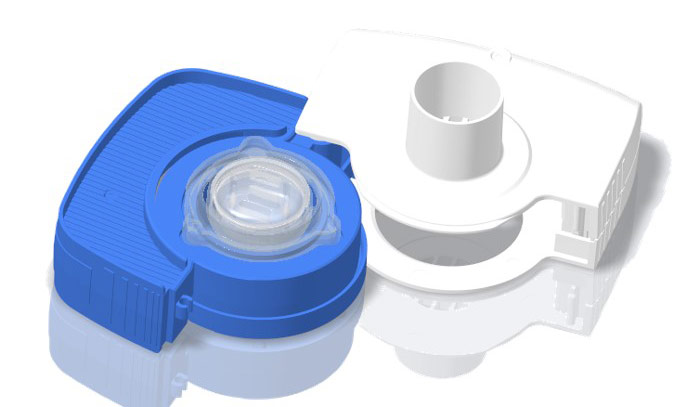
At the center of Aptar Pharma’s Orbital™ system is a powder dispersion mechanism designed to progressively de-agglomerate and release the formulation during inhalation. The Orbital™ DPI platform is also characterized by low inhalation resistance and by flexible configuration options that include single-use and reloadable formats. Taken together, these elements support a delivery profile intended to balance aerosolization performance with a more manageable and predictable patient experience.
Rethinking DPI Delivery: Beyond Single-Breath Systems
The distinction becomes clearer when compared with conventional DPI architectures. Traditional systems often depend on manually loaded capsules or multiple-dose units, high inspiratory effort to achieve adequate aerosolization, and single-event delivery of large powder quantities. By contrast, the Orbital™ DPI is designed to support high payloads without repeated loading steps and to distribute dose delivery across multiple inhalations rather than concentrate it into a single inhalation event. This represents a shift away from a single-actuation paradigm toward a more controlled and patient-adapted delivery process.
Key Performance Takeaways
Orbital™ — What the Platform Delivers
- High-payload pulmonary delivery capability
Enables controlled delivery of 100–400 mg+ formulations, addressing the limitations of conventional DPI systems for high-dose therapies. - Progressive multi-breath administration
Distributes dose delivery over several inhalations, reducing reliance on peak inspiratory flow and avoiding single-bolus delivery. - Improved delivery consistency under real-world conditions
Designed to support reproducible performance across patients with varying lung function and inhalation profiles. - Reduced administration burden for high-dose regimens
Eliminates repeated capsule loading steps and simplifies the dosing sequence. - Aligned with complex formulation and development requirements
Supports a broad range of programs, including high-dose small molecules, repurposed drugs, and emerging biologic therapies.
Evaluating Performance Across the Full Dosing Sequence
In high-payload pulmonary delivery, performance cannot be reduced to a single event; it must be evaluated across the entire administration cycle. This reflects a system-level view of performance, where delivery outcomes are determined by the combined interaction of formulation properties, device behavior, and patient use across the full dosing sequence. Relevant questions include how consistently the formulation disperses, how reproducibly the dose is transferred across successive breaths, and how device behavior interacts with formulation under realistic conditions.
Within this context, Orbital™ is positioned as a platform capable of supporting controlled, repeatable delivery across the full dosing event, helping to reduce variability associated with both formulation complexity and patient handling.
Supporting Complex Formulations & Development Pathways
The Orbital™ platform from Aptar Pharma is designed to support a broad range of formulation and program requirements, including high-dose small molecules, repurposed drug programs, and emerging biologic therapies. Flexibility extends across development stages, from early clinical evaluation through to commercialization, and compatibility with both single-use and reusable configurations further strengthens the platform’s adaptability to program needs.
An Integrated, System-Level Development Approach
Effective pulmonary delivery at this level rarely depends on hardware alone. The Orbital™ DPI platform is positioned within Aptar Pharma’s broader development ecosystem, bringing together formulation expertise, inhalation performance characterization, and human factors engineering. This enables a system-level co-development approach, where formulation behavior, delivery performance, and patient interaction can be aligned early in development. By addressing these elements together rather than sequentially, developers can better understand delivery outcomes, improve predictability, and reduce late-stage development risk.
In this context, Aptar Pharma acts not only as a delivery technology partner but as a strategic development partner, supporting a more informed and integrated approach to pulmonary drug delivery.
Conclusion
The pulmonary landscape is placing new demands on inhalation platforms – demands that extend well beyond what legacy DPIs were designed to address. Orbital™ responds to these demands through a combination of high-payload capability, progressive multi-breath delivery, and usability-driven design. By enabling controlled delivery of 100-400 mg+ formulations in a patient-adapted manner, and by embedding that capability within a coordinated development approach, the Orbital™ system from Aptar Pharma offers a structured and scalable route built on a system-level design that aligns formulation, delivery performance, and patient use.

Jonathan Mulpas is Business Development Director for the Pulmonary Category Team at Aptar Pharma. Mr. Mulpas holds an engineering degree from École Centrale Paris (France) and a master’s degree in Aeronautics from Beihang University in Beijing (China). Having previously worked at Airbus (Toulouse, France), Mr. Mulpas joined Aptar Pharma in 2018 where he spent six years in the R&D team, holding various roles in the development of pulmonary products. In his current business development position in Aptar Pharma’s Pulmonary Category Team, Mr. Mulpas is responsible for Aptar’s DPI and NPLI programs.
Total Page Views: 13