


NeuroSpray™: A High-Precision Multi-Dose Nasal Pump Platform Engineered for Nose-to-Brain Performance
Quantified Upper Nasal Targeting, Reduced Technique Sensitivity, & Development Grade Reproducibility

By: Reenal Gandhi
CNS drug development is accelerating, and the delivery strategy is increasingly central to program success. Across CNS pipelines, developers continue to face constraints tied to the speed of onset, invasiveness, and limited CNS exposure via conventional routes. At the same time, healthcare systems and patients place rising value on non-invasive, fast, self-administered options, especially where real-world usability can influence outcomes.
At the same time, scientific understanding of olfactory and trigeminal transport pathways has matured, reframing intranasal delivery from “local/systemic” into a potential route for CNS-relevant access. This has shifted the conversation from an academic concept to a platform-and-evidence discussion, where developers increasingly evaluate not only the molecule but the delivery system’s ability to generate reliable deposition and consistent administration.
This evolution is also unfolding in a market environment that is becoming crowded and noisy, with limited differentiation between general nasal devices and solutions truly engineered for nose-to-brain requirements. In parallel, developers and regulators increasingly expect evidence that links device use, deposition, and clinical outcome interpretation, driving demand for platforms designed to reduce patient-use variability and support clinical reproducibility.
From Nasal Delivery to a Targeting & Reproducibility Challenge
Nose-to-brain (N2B) drug delivery is no longer just a “nasal spray discussion.” It is a challenge of targeting and reproducibility, and success depends on engineering the delivery system to consistently reach uppernasal regions linked to the olfactory and trigeminal pathways.
NeuroSpray™ was developed specifically for this reality: a purpose-built, multi-dose N2B configuration designed exclusively for CNS-focused applications, rather than for general nasal indications. It is positioned to support more precise and reproducible administration conditions, enabling clearer interpretation of CNS outcomes across development stages.
A Clear Performance Objective: Maximize Upper-Nasal/Olfactory Deposition Under Realistic Use Conditions
NeuroSpray™ is positioned around a direct and measurable goal: maximize deposition to the olfactory region – a critical target for N2B delivery – while maintaining reproducibility when administration conditions vary.
The platform is engineered to achieve up to 50% deposition under varied spray angles, compared with 1-5% for standard pumps. This defines a clear competitive posture: not “N2B-capable,” but quantitatively targeted delivery designed to remain effective even when angle and technique are not perfect.
Beyond targeting performance alone, the platform is built and assessed through a combination of performance characterization, preclinical evaluation, and human-factors studies, supporting its positioning as a development-ready solution grounded in measurable delivery behavior.
Device Architecture Built for Controlled Trajectory & Reduced Technique Dependence
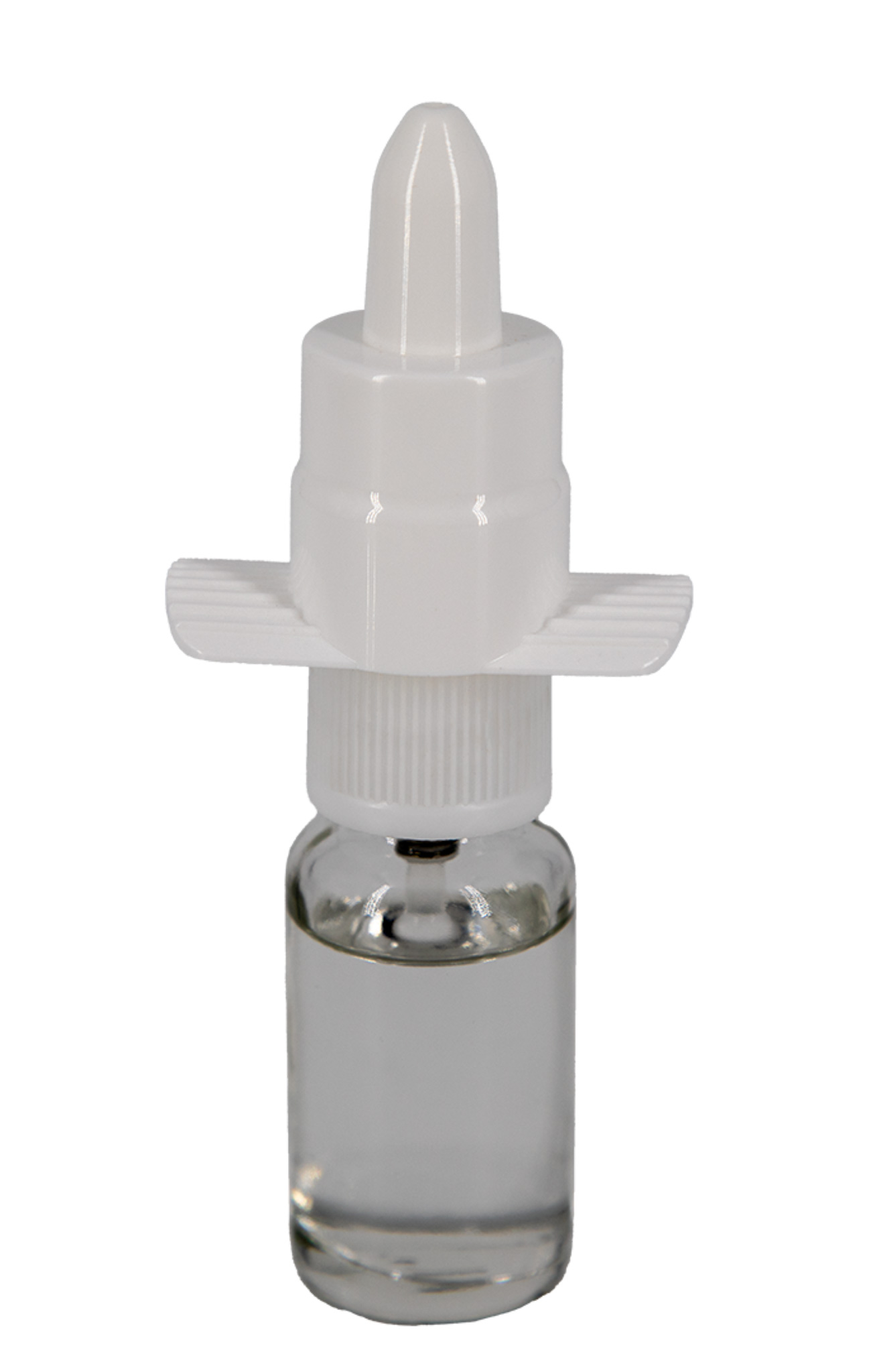
NeuroSpray™ combines multiple design levers to control where the dose goes and reduce user-driven variance:
- Optimized spray geometry to support upper-nasal and olfactory targeting
- A narrower, more concentrated plume aligned with upper-nasal deposition objectives
- Ergonomic nostril stop and adapted nozzle geometry to reduce variability in insertion depth and orientation
- Pre-compression actuation and one-hand operation to support controlled, repeatable dosing
- Metered dose volume of 100-110 µL per actuation (flexible)
- Bottle formats (3.5 mL, 5 mL, 10 mL) suitable for Phase I-II clinical supply
Design intent: constrain the degrees of freedom that typically undermine N2B delivery.
Performance Must Be Measured, Not Assumed
NeuroSpray™ is positioned in line with the parameters that matter in N2B development: spray pattern, plume geometry, droplet size distribution, shot weight, reliability, and regional deposition.
By anchoring positioning to measurable performance dimensions, the platform supports a development-grade logic that links device use, deposition behavior, and clinical interpretation. This reflects a broader shift toward evidence-driven N2B development, where delivery performance is evaluated alongside therapeutic effect.
Key Performance Takeaways NeuroSpray™, What the Design Delivers
- Upper-nasal targeting as a reproducible outcome
Developed to support consistent engagement of olfactory and trigeminal-associated regions, not broad nasal distribution. - Targeting performance expressed quantitatively
Capability to reach up to 50% olfactory deposition under varied spray angles, versus ~1-5% for standard pumps. - Lower sensitivity to real-world handling variability
Designed to reduce the impact of angle and insertion depth deviations, improving consistency across users and dosing events. - Aligned with CNS repeat-dose development needs
Supports controlled, repeatable administration where confidence across doses is critical. - Grounded in development-grade evaluation metrics
Framed around spray pattern, plume geometry, dose uniformity, reliability, and regional deposition, enabling evidence-based interpretation.
Independent Proof That Delivery Method Shapes N2B Outcomes
Independent imaging studies from Wake Forest using radiolabelled intranasal insulin demonstrate that the delivery approach and administration rigor directly influence measurable brain uptake. These findings reinforce that CNS outcomes depend not only on the molecule, but on how consistently and precisely delivery engages CNS-relevant regions.
This evidence dimension aligns with the broader development approach behind NeuroSpray™, where delivery conditions, formulation behavior, and user handling are considered together to reduce uncertainty and strengthen interpretation.
Why Multi-Dose Matters for CNS Programs
NeuroSpray™ is deliberately multi-dose, reflecting the reality that many CNS and neuro-active therapies require repeat dosing, where consistency across administrations directly impacts clinical confidence. The platform is designed to support a broad range of formulation and program requirements, including solutions and suspensions, repeat-dose regimens and preservative-free strategies, enabling alignment with safety, tolerability and regulatory expectations.
An Integrated, System-Level Approach to N2B Development
Effective N2B development extends beyond device mechanics. NeuroSpray™ is positioned within a broader Aptar Pharma ecosystem, integrating formulation support, usability engineering, performance characterization, and clinical development capabilities.
This enables a co-development approach, where device performance and formulation behavior are aligned early, helping developers:
- better understand deposition outcomes;
- optimize administration conditions; and
- reduce late-stage program risk.
In this context, Aptar Pharma acts not only as a delivery solution provider but as a strategic development partner, supporting a more informed and system-level approach to CNS delivery.
Conclusion
In an increasingly complex and competitive N2B landscape, NeuroSpray™ brings together quantified upper-nasal targeting, reduced technique sensitivity, and validated, system-level development support in a single purpose-built platform.
Rather than presenting nose-to-brain delivery as a solved challenge, it provides a structured, evidence-driven framework for advancing CNS programs while supporting reproducibility, interpretability, and development confidence as this therapeutic field continues to evolve.

Reenal Gandhi is Global Business Development Director at Aptar Pharma’s Prescription division, focused on assessing new technologies. With over 15 years in drug delivery and pharma, she is passionate about developing combination products that balance formulation, device technology, and commercial potential. Prior to joining Aptar in 2020, she held roles in licensing and acquisitions at global pharma and device companies.
Total Page Views: 17