

FROM ASSESSMENT TO SUSTAINABLE ACTION - Circular Economy Strategies & Practical Routes to Lower-Impact Medical Devices
By: Morwenna Maunder and Kiara Taylor
Introduction
Single-use design has long been the default in medical devices, driven by infection control requirements, the difficulty of validating decontamination, and the relative simplicity of regulatory compliance for a device with one fixed use. That default must change. The healthcare sector is accountable for approximately 4.4% of global emissions.1
The British NHS became the first national health system in the world to commit to a net-zero health service, with legally binding targets for 2040 and 2045.2 Pharmaceutical companies are moving in the same direction. AstraZeneca and Novo Nordisk have both committed to science-based net-zero across their full value chains by 2045.3, 4 However, decarbonizing manufacturing alone leaves most of the footprint untouched. Meeting these net-zero targets requires changes to the products themselves, the devices that deliver them, and the systems built around them, including the reprocessing and reuse networks. The route to a more sustainable device is not the same for every product, and the single biggest determinant of what is achievable is where a device sits in its product development lifecycle when sustainability is first considered.
 A device still in early-stage development has the widest scope. Sustainability can be treated as a concept-selection criterion alongside function, cost, and usability. Therefore, influencing material selection, manufacturing location, packaging format, and end-of-life strategy before any of those decisions are locked into a regulatory submission. A device already on the market has far less room. Its materials, geometry, and sterilization route are validated, and any change substantial enough to affect safety or effectiveness can trigger a new regulatory submission, carrying a cost that may outweigh the environmental benefit.
Answering the Decisive Question
For these products the question is “what can be changed without triggering a new submission, and which of these changes would have the greatest impact?” Answering it reliably requires two things: a method to measure where impact actually lies, and a structured view of the interventions available. The first is provided by ISO 14040,5 the international standard for life cycle assessment (LCA). It structures an assessment into goal and scope definition, inventory analysis, impact assessment, and interpretation. Defining the scope forces a boundary to be set for the assessment. In a cradle-to-grave assessment, the scope covers the full lifecycle of a product, from raw material extraction through to end of life, so no stage is excluded based on assumptions about where the impact lies.
The second is the 9R framework (rethink, reduce, reuse, repair, refurbish, remanufacture, repurpose, recycle, recover), an established circular economy structure recently applied to medical device sustainability research.1 The strategies range from earlier Rs, which influence how a product is designed and used, to later Rs, which recover end-of-life value. The framework is relevant across the entire product lifecycle, but its practicality differs depending on regulatory status. For devices which are already on the market, opportunities are more limited to measures such as reducing material use, improving packaging or, in some cases, implementing a reprocessing system can enable these devices to be reused.
The following two examples sit at different points in the framework. The first is a project carried out on an existing, validated device, where the only interventions available fell within the reduce strategy. The second is sharps containers, a device category where a transition into reuse is slowly occurring.

Case Study 1: Injector Device
The project involved finding ways to reduce the environmental impact of an existing handheld, single-use, adjustable-dose injection device for a client working towards a net-zero commitment across their product portfolio. The device included a prefilled glass syringe and minimal plastic components, packaged in a blister tray and outer carton. The drug required refrigerated storage throughout, keeping the device in cold chain from manufacture to administration.
An LCA was carried out in accordance with ISO 14040 and ISO 14044,5, 6 across the full cradle-to-grave scope. All emissions figures below refer to global warming potential (GWP), the standard measure of a product’s greenhouse gas impact. The LCA results showed that storage and distribution accounted for roughly 80% of total emissions, compared with 15% for manufacture, 4% for disposal, and just 1% for use. The refrigerated storage and air freight were the biggest emissions contributors.
Refrigeration itself was not open to redesign. The requirement was set by the drug rather than the device and altering it would have meant altering the product’s stability profile. Transport, however, could be switched from air freight to sea, rail, and land. Doing so removed 90% of the transport burden, but total emissions fell by only 30%. This is because slower routes mean longer transit, and every additional day in transit is another day of refrigeration. Reducing transport emissions therefore raises storage emissions, offsetting part of the gain. Even so, a 30% reduction is still substantial and worth pursuing where the supply chain can absorb the extra transit time.
The wider lesson is that life cycle stages cannot be optimized in isolation. An intervention that looks decisive when assessed against a single stage may deliver a fraction of the expected benefit once the whole system is re-modelled, which is why the interpretation phase of ISO 14040 should be revisited after each proposed change.
A second intervention proved similarly effective. Reducing the outer packaging so that its dimensions more closely matched the product’s actual footprint allowed more devices to be packed into the same transport and storage space, cutting emissions by up to 35% per device – with no material substitution, no change to the device, no change in transportation method, and no regulatory hurdle to clear. This intervention provides greater GWP reductions than the transport change (35% vs 30%), while still allowing fast delivery options when demand requires a quick response.
A third intervention sat further down the life cycle, at disposal. The device is discarded after use into a sharps container, which is itself disposed of once full. Modelling the switch from a disposable to a reusable container substantially reduced disposal emissions. With disposal only accounting for 4% of the total emissions, the difference is marginal against a single device. But a container is shared by many devices, so what looks negligible per product becomes significant across a health system. This is made clear in the second case study.

Case Study 2: Sharps Containers
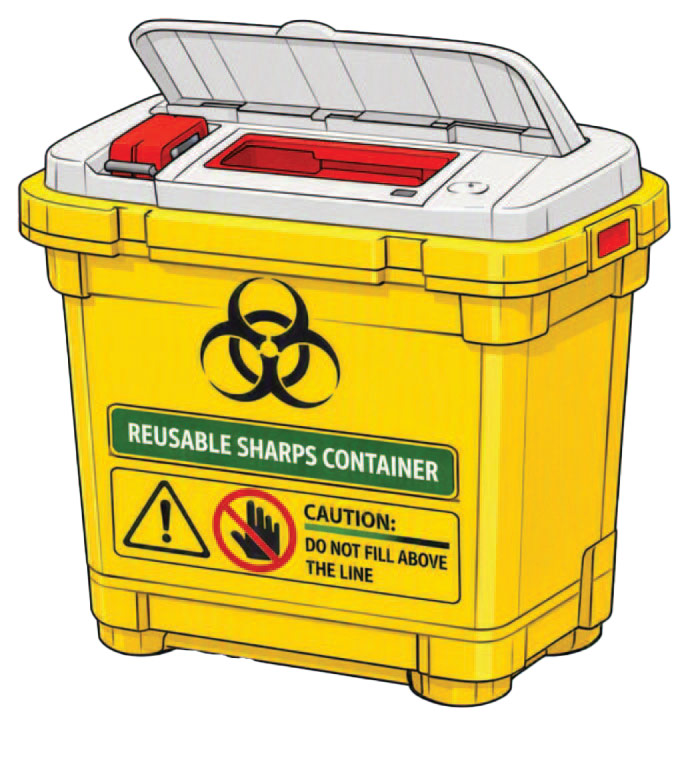
Sharps containers are class II medical devices, and until recently were almost always single-use. Once filled with used needles, blades and devices with integrated sharps, the safest assumption was that the container should be disposed of intact. Reusing them meant handling contaminated waste, which was a genuine infection-control risk. However, the sheer number of sharps containers in circulation made them an obvious candidate for redesign. U.S. hospitals alone use around 35 million annually,7 and the volume was enough to justify pursuing a reusable model despite the infection-control objection. A study at a large U.S. hospital provided the proof of concept, finding that robotically decontaminated containers certified for 500 uses cut sharps waste GWP by 83.5% against single-use equivalents.7
Despite the clear GWP reduction benefits, adoption of reusable products to replace their single-use predecessors remains limited. This is often due to higher upfront costs, poor reprocessing infrastructure, and varying perceptions of infection risk. However, meeting net-zero targets will require faster adoption, and overcoming these barriers begins with a practical understanding of what changing to a more sustainable product actually entails.
What a Reduce/Reuse-Tier Transition Demands
Switching to lower-impact devices is usually quickest when it starts with small changes to the existing system. However, several key factors must be considered before making them.
Regulatory implications
Regulatory implications is what separated the interventions available in the injector case study. The transport change and the packaging redesign left the device’s materials, geometry, and sterilization route untouched, so neither change triggered a new regulatory submission. That mattered more than it would for a standalone device, since a prefilled injector is a drug-device combination product, and a change to any of those three areas can require a supplement to the underlying drug application rather than a more straightforward resubmission through the device pathway alone.
For standalone devices which are not combined with a drug, the regulatory burden of a design change scales with device class. A class I device carries minimal regulatory control, so changes are comparatively easy to make, while a class III device requires premarket approval, so even a modest design change can mean a lengthy and expensive resubmission. Sharps containers are class II devices cleared through FDA’s 510(k) process, which requires a manufacturer to show substantial equivalence to a legally marketed predicate rather than to generate new clinical evidence. The reusable bin changed the material and geometry and added a decontamination step, but because a suitable predicate existed and bench testing showed these differences raised no new questions of safety or effectiveness, the device was cleared via 510(k) rather than needing a De Novo submission.
Reprocessing & decontamination validation
The environmental case for reuse only holds if the reprocessing step is set up properly and can be relied on. Reprocessing is a defined sequence of collection, decontamination and cleaning, inspection and functional testing, repair where needed, disinfection and/or sterilization, typically using the same validated method and standard the original manufacturer used. Each device is then released individually, with the entire process tracked so that failure at any stage is traceable.8 Published studies containing LCAs of reprocessed devices report greenhouse gas reductions of 23–60% against newly manufactured equivalents, with no difference in infection rates from original devices,8 indicating reprocessing is a promising option when the system is properly validated.
Systems thinking
Any change to a device must be assessed against the whole system it sits within, since an intervention that looks impactful in isolation can lose much of its value once the surrounding stages are re-modelled. This was highlighted in the injector device case study with the transport and storage trade-off. Systems thinking must also apply when moving from single-use to reuse. A disposable device’s environmental burden ends at disposal, while a reusable device’s burden continues through each stage of reprocessing, with every stage carrying its own energy and transport cost.
A reusable device also often carries a higher manufacturing burden up front, so it only starts to win once that initial environmental cost, plus the recurring cost of each cycle, has been spread across enough uses to fall below the disposable equivalent. This is known as the crossover point and locating it early before committing to a switch is essential to confirm a genuine benefit exists for your specific use case. The sharps bin is a case where the switch is clearly worth making. Certified for 500 uses, it cut annual sharps container emissions by over 80%, a scale of saving that suggests the crossover point falls within the first handful of uses.
Other Considerations
The three factors above are not exhaustive, but they are some of the factors likely to determine the success of a reduce or reuse change. A design change should also consider material selection since a material substitution can shift sterilization, recyclability, shelf life, or compatibility elsewhere in the system. Thorough material equivalence assessments should be carried out when considering changes to an existing design. These assessments should address mechanical characteristics, thermal behavior, chemical composition, processing conditions, and sterilization compatibility.
Design for disassembly matters too, since a device that is simple to take apart reduces the labor and time cost of reprocessing or repair. Finally, the practical constraints at the point of use should be understood, such as decontamination capacity and clinical confidence in a returned product.
Conclusion
In an ideal world, every device would be designed from the outset against the 9R framework, utilizing LCAs to aid design choices by quantifying the impact of different materials, manufacturing processes, packaging, distribution, and end-of-life choices before any of them are locked into a regulatory submission. However, most devices in circulation today were never designed with sustainability in mind and cannot be replaced overnight with new designs. For these, the work focuses on the reduce strategy where the validated design cannot be changed, and the reuse strategy wherever the case is strong enough to justify the switch.
Reusable sharps containers show how the reuse transition can work in practice, and similar opportunities are emerging for other high-volume devices that have traditionally defaulted to single-use. The injector example shows that rather than being constrained by the existing product, engineers can use LCA findings to look beyond the device and optimize the system as a whole. This approach can turn environmental hotspots into focused, achievable improvements that deliver meaningful sustainability gains while limiting regulatory and commercial disruption.
References
- MDPI Sustainability, Volume 16, Issue 4, Article 1433
- NHS England – Greener NHS: National Ambition
- AstraZeneca – Climate Change
- Novo Nordisk – Climate Change Position
- ISO 14040
- ISO 14044
- Impact on Carbon Footprint: A Life Cycle Assessment of Disposable Versus Reusable Sharps Containers in a Large US Hospital
- Medical Device Guide – Single-Use Reprocessing, Circular Economy, Sustainability & Carbon Footprint Guide
Biographies

Morwenna Maunder is a Mechanical Engineer at Sanner,
passionate about driving sustainability in the MedTech sector. She has
hands-on experience conducting LCAs and translating the results into
strategic guidance for medical devices in development.

Kiara Taylor is a Design Engineer at Sanner with a keen
interest in sustainability and user-centered design. Drawing from a broad
understanding of engineering, design, human factors and manufacturing
principles, Kiara enjoys working with clients to develop innovative solutions.
Total Page Views: 314