

Issue:May 2026
EXECUTIVE INTERVIEW - Vetter Pharma: Why Fill-Finish Matters More Than Ever – & the Trends Behind It
Key Points
- Successful programs are built on early, informed decisions, specifically in early phases, where timelines and technical constraints can make or break a molecule’s trajectory.
 Every new therapy begins with a promise – but bringing that promise to patients has never been more demanding. Regulations shift, technologies leap forward, and supply chain volatility forces biopharma companies to rethink long-held assumptions.
Amid this uncertainty, one question becomes pivotal: Who can you trust to guide a product safely from molecule to market? The answer increasingly lies in CDMOs that combine quality, expertise, reliability, innovation, and strategic foresight across all phases of life cycle.
A strong manufacturing partner has become more than an operational necessity – it is a stabilizing force in a market that refuses to stand still. The right service provider not only maintains quality and speed but helps anticipate bottlenecks and translate emerging trends into practical, future-ready approaches across clinical and commercial services.
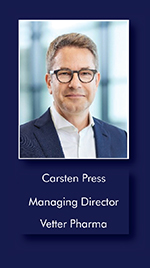
Drug Development & Delivery recently interviewed Carsten Press, one of Vetter’s Managing Directors, to discuss the key trends shaping CDMO innovation in today’s dynamic market — and how the family-owned company is integrating these trends into its forward-looking strategy to support consistent quality and seamless drug delivery.
Q: What are the biggest challenges for companies in today’s life science community?
A: Life science companies face accelerating change: evolving regulatory expectations, expanding modality complexity, and persistent supply-chain uncertainty. Smaller biotechs, in particular, need partners who can translate these pressures into clear, executable plans. Reliable fill and finish service providers help by aligning early on device and primary/secondary packaging choices, stress-testing timelines, and coordinating value-chain stakeholders to keep programs moving.
Q: How do you maintain quality services in an evolving market? What trends are you seeing?
A: We focus on four trends that consistently create impact. Strategic partnerships are becoming essential as companies seek stability amid regulatory shifts and modality complexity. Early alignment across the value chain helps prevent delays and strengthens resilience.
Technology, especially artificial intelligence (AI) evolves into a true enabler, supporting smarter decision making, quality, and efficiency when applied responsibly and guided by human expertise.
Talent is emerging as critical infrastructure, with cross functional skills and digital fluency becoming decisive for operational stability and future readiness.
Last but not least, fill-finish capabilities continue to be a strategic differentiator, particularly as advanced biologics require flexible, high precision manufacturing to maintain speed and compliance.
Practically, that means earlier cross-functional planning with customers, close alignment with suppliers and device partners, and disciplined execution across clinical and commercial phases so we can deliver with appropriate speed, reliability, and traceable quality.
Q: AI is taking the world by storm. How does Vetter responsibly incorporate AI into drug manufacturing operations?
A: We use AI where it demonstrably adds value, and we keep people accountable at the center. Our approach follows three layers: AI for Everyday Efficiency (such as summarization and planning), AI for Process Transformation (like Robotic Process Automation to streamline quality and controlling processes), and AI for Strategic Differentiation (including initiatives that strengthen our operating model long term). We clearly distinguish AI from robotics/automation and implement both in a concrete, transparent, and secure way. Looking ahead, we see high potential in predictive maintenance, remote services, and intelligent assistance systems.
Q: Excellence in clinical and commercial services is often cited as a differentiator. How do your capabilities support biopharma companies?
A: Successful programs are built on early, informed decisions, specifically in early phases, where timelines and technical constraints can make or break a molecule’s trajectory. We start by aligning early with customers on the appropriate delivery system and on packaging and component strategy, because these choices influence manufacturability, lead times, and long-term feasibility. This early alignment helps avoid downstream bottlenecks, which are becoming more common as modalities grow more complex.
In the clinical phase, we support customers with the production of clinical trial materials for in-human use, manage material readiness and supplier timelines, and conduct analytical studies and stability testing to support regulatory requirements and enable smooth transfer toward later stages. These steps reflect the structured, proactive approach required in today’s volatile early development environment.
As programs advance, we plan for robust tech transfer, enabling that processes, documentation, and quality expectations are aligned well before scaleup begins. Our goal is to create a seamless bridge from early clinical batches into commercial supply, backed by flexible capacity, deep injectable filling expertise, and consistent high-quality performance.
Ultimately, excellence in fill-finish today means connecting the dots early, maintaining technical agility, and protecting the path from molecule to market with reliability at every step.
Q: Talent shortage in the workforce is impacting drug delivery worldwide. Why are efforts to retain talent important and how does your company invest in it?
A: Talent is core infrastructure, and preparing our teams for the industry’s trends and future requirements is fundamental to maintaining quality. We invest in cross-functional, digital-skills training and hands-on programs that equip employees for new modalities, automation, and data-driven operations. To strengthen this even further, we have expanded our internal training landscape: alongside our Technical Training Center, we established a dedicated Training Center for scientific professionals featuring state-of-the-art laboratories, classrooms, and modern pharmaceutical equipment. These facilities enable real-world practice, structured onboarding, and continuous upskilling across production-relevant roles.
Both centers also include collaborative learning spaces and further education rooms, supporting self-organized learning and team development. In the near future, we will integrate VR/AR-supported training modules to enhance digital learning experiences and accelerate proficiency building. These in-house initiatives give our workforce the cross functional expertise, digital fluency, and practical capabilities needed to operate confidently in updated production environments.
This approach keeps our teams resilient and adaptable as the industry evolves, and it directly strengthens operational reliability for our partners. From skill development to well-being, we foster a dynamic culture supported by technology, including automation, digital tools, and AI-enabled systems that streamline onboarding and process optimization. Ultimately, our operational success is rooted in the skills, agility, and dedication of our people, and in our commitment to continuously preparing them for the roles of tomorrow.
Q: Let’s talk about partnerships, why are long–term, trusted partnerships so important?
A: Because volatility rewards alignment. Most relationships begin with a specific need and expand over time as both sides build trust. By listening closely, co-planning across the value chain, and being transparent about risks and options, we help customers anticipate hurdles and stay on schedule. That shared discipline is what keeps therapies moving.
Q: Looking ahead, what should companies expect from a reliable manufacturing partner?
A: Expect quality, clarity, speed, and calm execution under pressure. Partners who unite strategic foresight with disciplined operations – supported by responsible technology and skilled teams – will help drug owners navigate future complexity and deliver reliably from molecule to market.
Total Page Views: 3313