

Issue:September 2026
EXECUTIVE INTERVIEW - Portal Instruments: Beyond Springs – Portal Prime Nexus™ Autoinjector is a Versatile Solution for Biologics
Key Points
- Drug delivery is shifting from fixed mechanical devices to intelligent, software-controlled systems.
- GLP-1s and increasingly complex biologics are accelerating the need for better at-home delivery.
- Sustainability and economics are becoming important advantages for reusable smart devices.
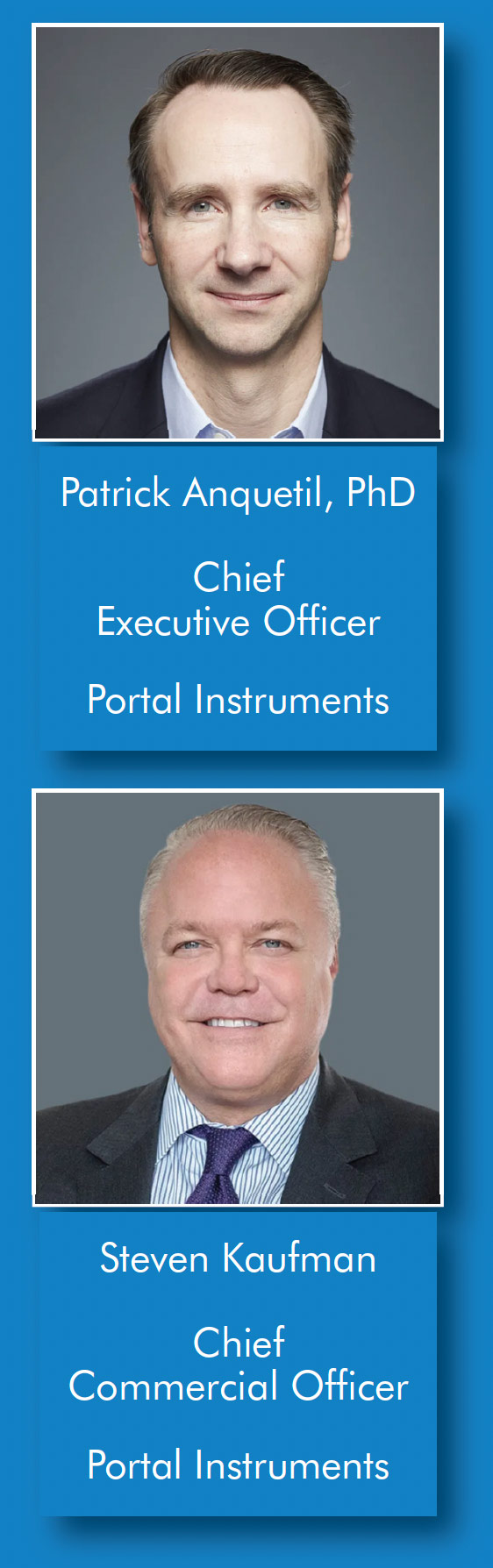 Portal is hoping to redefine how biologic medicines are delivered. As therapies become larger, more viscous and more complex, the company believes drug delivery must evolve from fixed mechanical systems to intelligent software-controlled platforms. Patrick Anquetil, PhD, Chief Executive Officer, and Steven Kaufman, Chief Commercial Officer, Portal Instruments, tell Drug Development & Delivery that the future of drug delivery is software-defined. As biologics become larger, more viscous and more complex, software offers a fundamentally better way to control and optimize delivery. Prime Nexus™ was built around that philosophy.
Q: How has your business evolved and adapted to the growth of at-home injections?
PA: Actually, the success of GLP-1 devices really helped Portal for a number of reasons. In the past, globally, we were looking at hundreds of thousands to up to tens of millions of devices in terms of devices used by patients for one therapy in a typical year. GLP-1 therapies fundamentally changed expectations around self-injection. They normalized at-home biologic delivery, dramatically increased device volumes, and brought sustainability into the spotlight. First, this created broader awareness about how to use autoinjectors and pen injectors safely at home or when on the go and improved patient compliance. However, when people started to do the math and realized we were disposing of a significant number of used devices, many started to ask for solutions that had less of an environmental impact. We fully support the use of disposable devices for their convenience. As new therapies move toward higher volumes, longer dosing intervals and more viscous formulations, the limitations of conventional spring-powered devices become more apparent. Further, we have seen more interest from therapies beyond GLP-1 for 2.25mL PFS and 5.5mL PFS-based devices. By using our extensive software and hardware experience we were able to move quickly to provide solutions.
Q: Why is injection time a challenge for some devices and why is the range of primary containers, volumes and viscosities such an issue?
SK: In the past, most injectables had a viscosity measured in cP value that was low or much like water. Many traditional autoinjectors start to see potential issues once you go above 20cP due to the nature of using springs as the power source in mechanical devices. There are exceptions which are clever but for many that is the reality. Now, we see volumes of 5-10mL that need to be injected and many of those injectables are also viscous. This is an interesting challenge for the industry in terms of timing. One way is to go with an on-body delivery system (OBDS) and some device companies are already promoting spring-based autoinjector systems for the higher volumes. At Portal, we believe that our device allows for tighter control of the injection times and can help to adjust to these higher volumes and viscosities. My concern is maintaining an allowable hold time for patients when using an autoinjector as we are hearing from biotech/pharma about issues with spring-force profiles: maintaining consistent delivery performance becomes increasingly challenging as force requirements rise. Precise time control is a distinct advantage in the technology we are preparing for our upcoming clinical study with a biotech partner in early 2027 using a well-known 5.5mL PFS.
Q: How does Prime Nexus™, Portal’s latest device offering, fit in with the trend towards sustainability?
PA: For us, it is a logical fit. Sustainability is becoming an important design criterion, not just for patients, but also for healthcare systems and pharmaceutical companies. With a reusable device such as Prime Nexus™ having a usable lifetime of up to three years we see advantages over traditional spring-based devices and OBDS for a number of reasons. First, the Prime Nexus™ cassettes which hold our primary containers are made with minimal components and no metal parts vs some autoinjectors and pen injectors that have up to 15 components. Second, it is the cost per injection. By utilizing a reasonably priced reusable autoinjector and a lower cost cassette we are seeing the economics work for the first time. We can compete with the pricing of other device therapies on a per patient injection after a number of months, and be as effective, or even more effective, in delivering the injection and with the added benefit of being more sustainable.
Q: How has your company addressed the challenge of introducing your new technologies to a conservative industry?
SK: The industry is appropriately cautious because patient safety comes first. However, when a new technology clearly solves an unmet need, adoption can happen remarkably quickly. Over the years, we have seen the move from 1mL to 2.25mL PFS autoinjector, the introduction of OBDS and more. Now, we are seeing a stronger move towards 5 and even 10mL PFS autoinjectors. The typical route for us is to target speaking with key biotech/pharma companies that are facing challenges with their injectables and to spend time with their knowledgeable device landscaping and formulation teams. If there is a potential fit we move to feasibility studies using their primary containers with placebo or drug product to prove out the suitability of Prime Nexus™ to overcome these challenges.
Total Page Views: 423