

Issue:March/April 2026
BIOAVAILABILITY & SOLUBILITY - Formulation Strategies for Tackling Poor Oral Bioavailability
INTRODUCTION
Modern drug discovery techniques often lead to more complex and hydrophobic molecules that have difficulty dissolving and being absorbed by the body. As a result, oral bioavailability has emerged as one of the biggest hurdles in drug development. Indeed, many new chemical entities, (NCEs) fail in the development process not because they are suitable candidates to interact with the intended drug target, but because they cannot get absorbed when given orally.
Poor oral bioavailability usually results in insufficient systemic exposure and ultimately clinical failure – often in early phase trials where time, money, and resources are tight. Indeed, current figures suggest values of up to 90% of NCEs suffer from issues of poor solubility with concomitant poor bioavailability This often forces program termination despite promising preclinical activity.
Understanding the dissolution properties and subsequent bioavailability profile of an NCE is critical, and issues need to be addressed during preclinical or early formulation development. Relying on standard formulations without evaluating solubility and absorption challenges can result in program delay or potentially good drug candidates being abandoned. Both scenarios can be very costly.
Better characterization of NCEs in the early stages of development and identifying solubility issues early offers the opportunity to address poor bioavailability using formulation techniques that deliver enhanced drug exposure – reducing risk, conserving resources, and increasing the chances of clinical success.
CATEGORIZING NCES BASED ON THEIR SOLUBILITY & PERMEABILITY: THE BIOPHARMACEUTICAL CLASSIFICATION SYSTEM (BCS)
Understanding and categorizing an NCE based on its likely solubility and subsequent permeability properties is an important part of drug product development. Indeed, overcoming poor solubility and permeability (with subsequent improved bioavailability) will ultimately improve the chances of success in the clinic.
Typically, formulation scientists will turn to the established Biopharmaceutical Classification System (BCS) in the earliest stages of formulation development to help determine whether an NCE is likely to require enhanced formulation strategies to improve bioavailability.
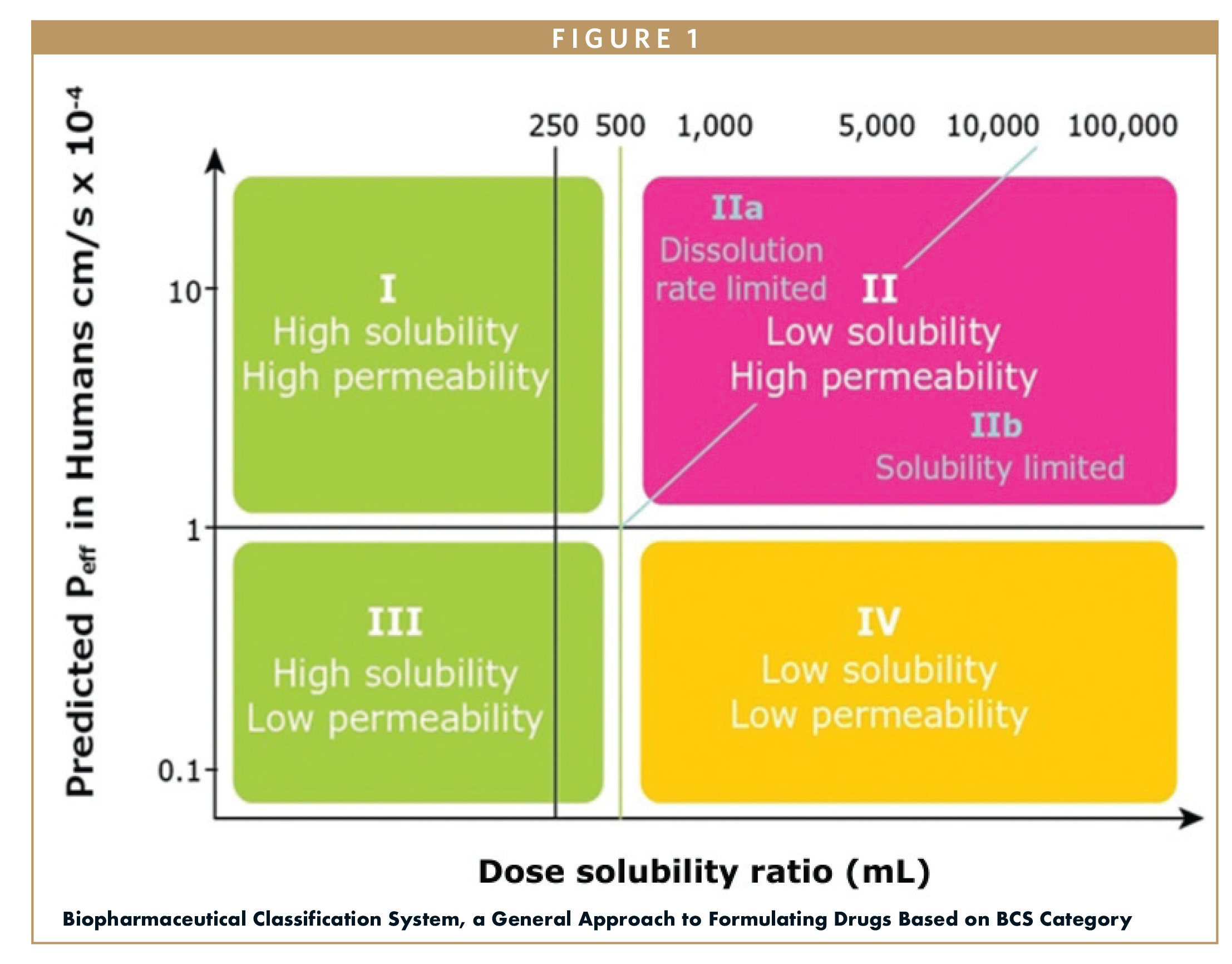
The BCS places a given drug into one of four categories depending on its oral dosing solubility and permeability (Figure 1). A drug substance is considered “highly soluble” when the highest clinical dose strength is soluble in 250 mL or less of aqueous media over a pH range of 1-7.5 at 37°C. A drug substance is considered to be “highly permeable” when the extent of the absorption (parent drug plus metabolites) in humans is determined to be I90% of an administered dose, based on a mass balance determination or in comparison to an intravenous reference dose.
Clearly, solubility of an NCE is relatively easy to characterize using a standard dissolution testing apparatus in which the NCE can be added in increasing quantities until maximum solubility is reached.
Measuring membrane permeability is less straight forward. It can be determined a number of ways but is most often done using Caco-2 cell lines. In this test system, a monolayer of cells is grown, and drug permeation from the drug donor (apical side) to the acceptor (basolateral side) compartments is assessed, usually by direct UV or LC-MS assay. Figure 1 shows a summary of the main classes in which NC’s are categorized in the BCS system.
In its simplest form, an ideal NCE should show high solubility and permeability, meaning either a simple formulation or even the unformulated crystalline drug can be used to assess the drug in the clinical setting.
An important factor to remember with the BCS is that it accounts for potency in that solubility and permeability are relative to clinical dose. Again, oral dosing is assumed in the testing design. So, for example, a compound that has poor absolute solubility might paradoxically be classified as “highly soluble” if it were a highly potent compound and the whole clinical dose was soluble in 250 mL.
A closer look at the four categories shows that ideal drug would fall into the BCS I category whilst the most challenging drugs are in the BCS class IV category.
Once the BCS class has been determined, formulation screening can begin. However, this is a complex process with multiple variables. With this in mind, it is important to take a systematic approach using the solubility and permeability data obtained to take the most appropriate formulation approach needed for successful development. Taking a systematic approach ensures the following:
- Data-led Selection: In vitro and in vivo studies guide formulation choice.
- Time Savings: Testing several strategies in parallel, not in sequence.
- API Efficiency: Keeping API usage to a minimum to explore options.
- Risk Reduction: Taking the most appropriate approach to focus on what works.
Formulating BCS 1 APIs Into Oral Dosage Forms
Drugs that are freely soluble and show good permeability are more straight forward to formulate as they can be presented in simple tablet or capsules formulations with no need for solubility enhancement. In early clinical studies, the API can be delivered in its basic crystalline form in a simple capsule fill (quick approach) or as a basic/standard tablet presentation that is suitable for scale up at a later date.
Formulating BCS II APIs Into Oral Dosage Forms
Drugs that fall into the BCS II category exhibit low aqueous solubility despite the fact that permeability of the soluble drug is relatively high. Because of this low solubility, the drug will show lower bioavailability because in oral dosing, the drug will tend to pass through the digestive tract with less than 100% less solubility, meaning it will be eliminated from the digestive tract before it can be absorbed.
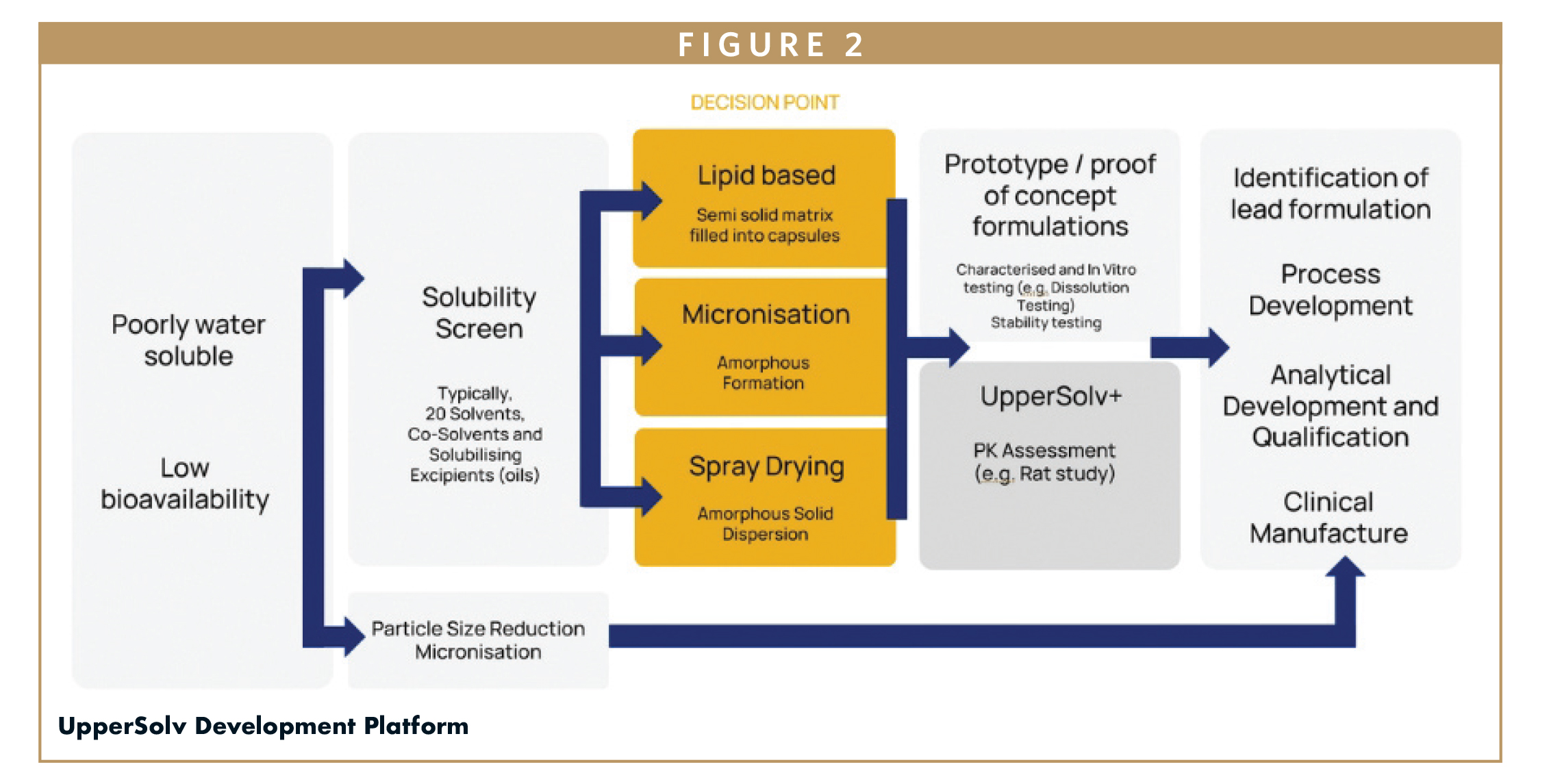
For BCS II drugs, formulation solutions will be focussed on enhancing solubility of the API. However, to overcome the solubility issue, it is important to understand the root cause of API insolubility, which generally is of two types, which in turn can be overcome using the following different strategies:
Dissolution-Rate Limited (BCS Class IIa): APIs that fall into this category may dissolve poorly primarily due to the drug crystal size being too large or wetting is slow, which in turn will result in slower than required dissolution. Physical adjustment of particle size using micronization techniques can increases surface area and speed up dissolution.
Solubility-Rate Limited (BCS Class IIb): In this case, the chemical nature of the API itself limits how much can dissolve, regardless of particle size. Formulation strategies for this class of API will involve using enabling technologies, such as lipid systems, to dissolve the API into a lipidic carrier or creating amorphous solid dispersions (ASDs) to increase solubility.
Formulating BCS III APIs Into Oral Dosage Forms
This class of API exhibits satisfactory aqueous solubility, but its permeability is low. To overcome this, the API should be formulated with permeation enhancers to improve epithelial membrane transport.
Formulating BCS IV APIs Into Oral Dosage Forms
This class of API provides the most significant challenge because it exhibits satisfactory aqueous solubility, but its permeability is low. To overcome these issues will require the addition of solubility-enhancement (lipidic or ASDs) and the addition of excipients that can enhance permeability.
ENABLING TECHNOLOGIES DESIGNED TO ENHANCE SOLUBILITY
As explained earlier, enabling technologies that can overcome the barriers created by low solubility can eventually generate good bioavailability. Typical solubility-enhancement techniques that can be used to enhance the solubility of BCS class IIa/IIb and class IV APIs are summarized below.
Micronization
- Using high-energy particle size reduction techniques (such as jet milling) to reduce particle size to increase wettability and dissolution.
- Proven, low-risk technique, and often sufficient for dissolution-limited APIs.
Lipid-Based Systems (SMEDDS, SEDDS)
- Formulating lipophilic APIs by dissolving or suspending lipophilic drugs in oils, surfactants, and co-solvents.
- Improving dispersion and solubility in the digestive tract and improving solubility and absorption via lymphatic transport.
Amorphous Solid Dispersions (ASDs)
- Incorporate APIs into polymers via spray drying (or by co-milling with amorphous excipients).
- Increase solubility by maintaining the API in more stable, higher-energy forms (amorphous state rather than crystalline).
- Successfully used to enhance bioavailability of a large number of poorly soluble BCS Class II drugs.
A SYSTEMATIC, EARLY SCREENING PLATFORM DESIGNED TO SPEED UP DEVELOPMENT & REDUCE TIMELINES & COSTS
UpperSolv™ provides a structured way to evaluate formulation routes using minimal API (~5 g) in about 8 weeks. The following six steps are involved in this systematic process:
- Solubility Profiling: Assess a range of solvents, co-solvents, and excipients to determine the BCS category the API falls into.
- Create Formulation Prototypes
– Micronized powders
– Lipid systems in capsules
– Co-milled polymer blends
– Spray-dried dispersions in capsules/tablets
- In Vitro Testing: Dissolution, stability, and solid-state analysis.
- In Vivo PK (UpperSolv+): Small animal studies for comparative exposure.
- Data-Driven Decision: Compare performance across prototypes.
- Scale-Up Readiness: The chosen formulation is designed to translate into GMP manufacturing.
SUMMARY
The systematic evaluation of the solubility and permeability properties of an API is an essential part of early stage formulation development. Once the solubility and permeability properties of the API have been determined, any signs the molecule might exhibit poor bioavailability can be addressed.
By determining the BCS category of the API, it is possible to determine the rate-limiting aspects of the API and key features that control/limit bioavailability, such as dissolution rate, innate solubility, or permeability issues, with the API in question.
Once the rate-limiting factors have been identified, formulation development techniques can be implemented to address poor oral bioavailability early. This is best achieved using a systematic approach to overcome these factors. Indeed, tried and tested screening tools like UpperSolv allows formulators to test multiple formulation routes with minimal API and time investment.
The outcome is data that will guide the formulator in choosing the most appropriate enabling technology needed to improve oral bioavailability and in doing so, save both time and money.

Dr. Richard Johnson is the Founding Director and Chief Scientific Officer of Upperton Pharma Solutions, a UK-based Contract, Development and Manufacturing Organization. Graduating from Warwick University with a PhD Biochemistry, he was employed as a protein chemist at Delta Biotechnology. In 1994, he was part of a management buy-out team that founded Andaris Ltd, a research and development company exploiting the use of spray drying technology in the fields of diagnostic imaging and drug delivery. In 1999, he founded Upperton and has overseen significant growth and expansion over the past 25 years.
Total Page Views: 4016