

SPECIAL REPORT - Excited About Excipients?
Key Points
- Excipients are becoming active formulation enablers, not just “inactive” ingredients.
- AI can analyze formulation data to help scientists select promising excipients, optimize compositions, predict stability and drug performance, and reduce the number of experiments needed.
- Excipients are evolving from passive formulation ingredients into strategically designed components of advanced drug-delivery systems.
By: Kurt R. Sedo, Executive Editor, and Cindy H. Dubin, Senior Editor, PharmaCircle
Article originally published in PharmaCircle Weekly Intelligence newsletter
Introduction
They may be inactive, but excipients are the unsung heroes of today’s complex formulations. Many development programs involve poorly water-soluble compounds, highly potent APIs, molecules with limited chemical or physical stability, or products that require specific release profiles. From a formulation scientist’s perspective, excipient selection is increasingly driven by the specific challenge that a molecule presents, rather than by traditional functionality alone. In these cases, excipients are no longer selected solely for manufacturability; they are increasingly expected to actively contribute to product performance by improving solubility, enhancing bioavailability, stabilizing sensitive compounds, or enabling controlled drug release. “As a result, formulators are seeking excipients with more sophisticated and multifunctional properties than ever before,” says Almudena Domniguez Fernández, group leader, Ardena, “The growing complexity of modern drug candidates is significantly changing what formulators are expecting from excipients,”
This trend is particularly evident in the development of amorphous solid dispersions, lipid-based systems, modified-release formulations, and other advanced drug delivery platforms. For poorly soluble molecules, excipients may play a critical role in maintaining supersaturation, preventing recrystallization, or enhancing wetting and dissolution. For highly potent compounds, they can help to ensure content uniformity and robust processing, despite very low drug loads. Similarly, for unstable molecules, carefully selected excipients can reduce degradation pathways and improve shelf-life. Then, there are biologics and advanced therapies, which require highly specialized stabilizing excipients to protect sensitive molecules from degradation and aggregation.
“The overall industry trend points toward excipients that provide functionality beyond traditional filling, binding, or disintegration roles,” says Fernández. “The focus has therefore shifted from simply which excipient can be used, to which excipient can best solve the specific development challenge.”
Unmesh Lal, vice president, Healthcare & Life Sciences, Frost & Sullivan agrees: “The conversation has shifted from excipients as inactive ingredients to excipients as formulation enablers. The industry is focused on solving drug solubility, bioavailability, stability, patient adherence, and delivery challenges, particularly for complex therapies and patient-centric formulations.”
New Excipients Enable Advanced Drug Products
The shift in drug products entering the market influences both the types of excipients selected and how they are used in formulations, making excipient functionality and performance increasingly critical to product development and delivery. While excipients are inactive ingredients in drug products, their chemical and functional characteristics often help enable formulation of advanced drug products.
“The past several years have brought important advances in new medicines that improve and save lives, powered by innovative drug delivery systems requiring increasingly complex formulations to create more patient-centric dosage forms than in the past, says Claire Chisolm, Senior Manager, Science & Standards Excipients, USP. “For example, lactic acid-glycolic acid and lactide-glycolide polymers (PLGAs and PLGs, collectively referred to as LG polymers) possess unique biodegradation characteristics that enable controlled-release formulations with drug release durations ranging from days to months; a game changer for patient convenience and compliance.”
This year, several excipients have been introduced to solve a variety of development challenges, such as developing oral alternatives to injectable therapies. See Figure 1 for most commonly used excipients currently used in oral solid dosage forms (OSD). For example, Ashland just announced the commercial launch of permexa™ sodium caprate, an intestinal permeation enhancer designed to support oral delivery of peptides, biologics and low-permeability drugs, including GLP-1 agonists. The excipient targets challenges in permeability, formulation consistency, process robustness and scalability for oral drug products. Permexa™ sodium caprate combines established sodium caprate functionality with an IP protected process aimed at improving powder flow, compressibility and formulation consistency while maintaining permeability enhancement characteristics. The excipient is designed with an IP-protected process to support more robust tablet manufacturing through improved powder flow, enhanced compressibility and greater formulation consistency, while maintaining the permeability enhancement characteristics required for oral drug delivery applications. One cannot overlook the timeliness as the launch piggybacks off market momentum in oral peptide and biologics development. (Source: Ashland).
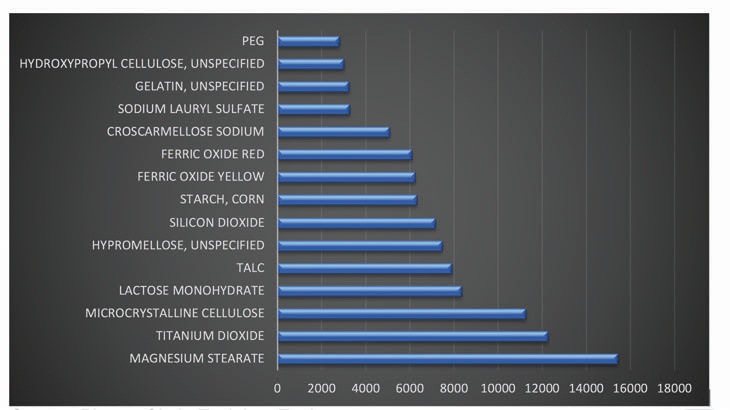
Figure 1: Excipients Used in Marketed OSDs. Source: PharmaCircle Excipient Explorer
Earlier this year, RIBUS launched two plant-based excipients. Nu-FILL is an organic-certified alternative to microcrystalline cellulose. The rice hull and rice bran-based excipient designed to replace microcrystalline cellulose in tablets, capsules and stick packs, offering supplement manufacturers a clean label and certified organic-compatible filler with comparable flow and compressibility performance. The company says Nu-FILL matches the performance of traditional fillers while complying with clean-label and organic standards. Nu-MAG® is a rice bran extract for tablet and capsule manufacturing, replacing magnesium stearate. The company says it reduces powder adhesion to dosing equipment and improves fill consistency, best suited for compressed lonzenges, effervescent tablets, and chewable formats (Source: RIBUS).
Considered more of a taste modulation technology platform rather than a single excipient (though the individual ingredients it uses function as formulation excipients or additives), ModulaSENSE® Bitter aims to tackle patient adherence by removing API bitterness at the receptor level. Instead of relying on generic masking, ModulaSENSE® Bitter, developed by dsm-firmenich, combines blockers, maskers, and sweeteners with evidence-based insights to create targeted, formulation-specific bitterness masking solutions. The technology has been developed through a multi-step, scientifically-driven workflow and is applicable across a wide range of APIs and oral dosage forms (Source: dsm-firmenich).
No matter the dosage form, stabilizing excipients play a critical role in maintaining molecular integrity and preserving the therapeutic performance of pharmaceuticals. In biopharmaceutical manufacturing, these excipients are increasingly employed to mitigate degradation, aggregation, and chemical instability, particularly in protein- and peptide-based therapeutics. Stabilizers can enhance product stability during processes such as lyophilization and aseptic processing, as well as under temperature-induced stress conditions. Consequently, their application has expanded significantly in the development of biologics, vaccines, and specialty injectable formulations (Figure 2).
GELITA, for instance, launched a gelatin excipient, featuring less than ten endotoxin units per gram, for vaccine stabilization and controlled and targeted drug delivery as well as 3D bioprinting of living tissue. Derived from collagen, MEDELLAPRO® closely mimics the natural extracellular matrix of the human body, providing a biocompatible and biodegradable solution that is safely absorbed by the body with time. The specialized gelatin can be processed into a wide range of forms, including hydrogels, films and nanoparticles, making it suitable for diverse applications (Source: GELITA).
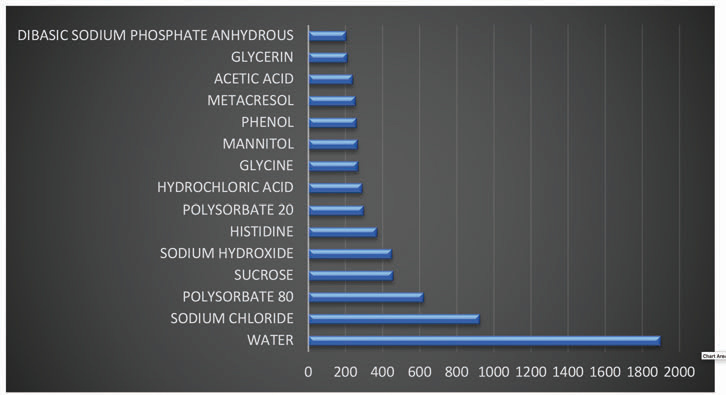
Figure 2: Excipients Used in Injectable Marketed Biologics. Source: PharmaCircle Excipient Explorer
AI & Computation Tools Seek Out the Best Excipients
Many are extremely interested in the suitability of Artificial Intelligence as a valuable tool for excipient selection and formulation design. Traditionally, formulation development relied heavily on expert knowledge combined with extensive experimental screening. “While this approach remains essential, AI can help accelerate decision-making by identifying patterns across large formulation datasets, and predicting which excipients are most likely to meet predefined formulation objectives,” says Fernández,
Recent analysis from Boston Consulting Group suggests that AI-enabled approaches could reduce time and cost in early development by 25-50%. The numbers bear out. In September, Quotient Sciences reported interim results of a clinical study in which a proprietary AI algorithm selected modified-release formulation compositions and doses during the trial. The algorithm reached the study’s preset pharmacokinetic target within three dosing periods, meeting the program’s interim objectives. The clinical work follows laboratory screening in which the same algorithm demonstrated that it could rapidly learn the relationship between tablet composition and in vitro drug release. The algorithm mapped the formulation design space after screening one-third fewer formulations than conventional methods. That finding prompted the hypothesis now being tested in the clinic: A model capable of learning that relationship in the laboratory could also learn how composition influences pharmacokinetics in humans.
Prior to the study, formulators identified a shortlist of excipients relevant for the desired formulation type, explains Andrew Lewis, Chief Scientific Officer at Quotient Sciences. The AI algorithm was provided with the excipient options, in vitro targets and constraints to work within (e.g. min/max levels of excipients). The AI then requested formulations which were manufactured and tested and the results used to train the model. The model was able to select excipients and identify formulations that met the in vitro Target Product Profile after screening up to 50% less formulations than conventional formulation development. These formulations were then optimized in a clinical study, where the same AI algorithm selected formulation compositions targeting a specific pharmacokinetic target. It managed to learn the relationship between composition and pharmacokinetics after evaluating only three prototypes.
“Generally speaking, the suite of excipients applied is governed by the physicochemical properties of the drug and the technology necessary to develop a particular formulation type,” he says. “The AI platform we have developed starts with excipient selection by our expert formulators and provides them with a tool to rapidly identify compositions that meet pre-defined criteria, simultaneously creating a digital twin of the formulation/drug product as it learns.”
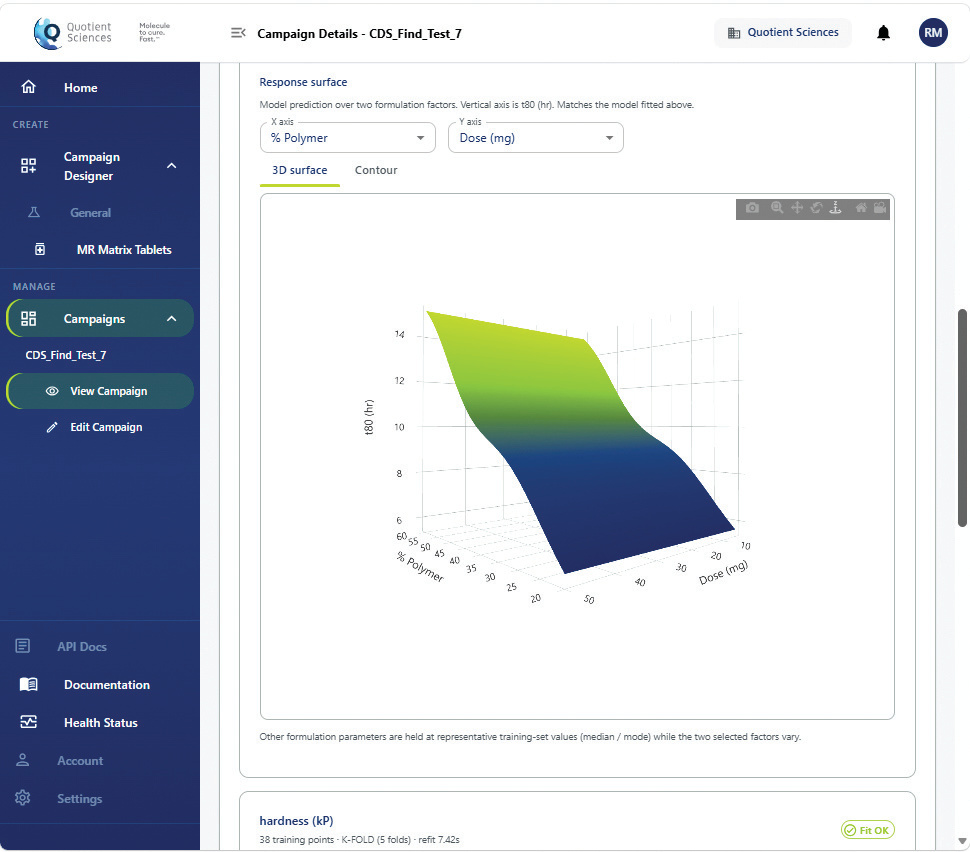
Quotient’s AI platform’s learned relationship between formulation composition and product performance.
This digital twin can synergize with other in-silico tools such as predictive stability and PBPK modelling to predict the impact of formulation and/or process changes on performance and product quality. “It’s entirely feasible that in the future AI, if trained on the right, high-quality data, may be able to select excipients based on a drug’s structure or limited characterization data and propose formulations and manufacturing routes that hit in vitro and in vivo targets,” says Lewis.
Another promising AI application is the prediction of excipient impact on critical quality attributes such as stability, solubility, dissolution performance, and ultimately bioavailability. Pharmaceutical formulations are complex systems, and predictive models remain highly dependent on the quality and quantity of available data. Experimental verification, mechanistic understanding, and formulation experience continue to be essential. “AI-based tools can help identify promising formulation approaches by analyzing large datasets and learning from previous formulation outcomes,” says Fernández. “This can reduce development timelines and allow scientists to focus experimental efforts on the most promising options. In the near future, the greatest value of AI will likely be its ability to support risk-based decision making, accelerate formulation screening, and help scientists navigate increasingly complex development challenges more efficiently.”
Scientists at the University of Minnesota are also seeking answers to complex development challenges. They have developed a computational tool called CapSACIN (Capsid Surface Abstraction and Computationally-Induced Nanofragmentation) to seek out the best combination of excipients for protecting vaccines, gene therapies, and other virus-based medicines if/when they are not stored and/or transported under prime conditions as the products move through the supply chain. Rather than simulating an entire virus, CapSACIN focuses on specific regions of a virus’s outer shell (the capsid). The research, published earlier this year in the Journal of Chemical Theory and Computation, used U.S. National Science Foundation (NSF) ACCESS allocations on the Expanse system at the San Diego Supercomputer Center (SDSC), located at the University of California San Diego Halıcıoğlu School of Data Science and Computing. The team tested CapSACIN using Porcine Parvovirus to determine which parts of the virus are most vulnerable to damage. Ultimately, CapSACIN also predicted the excipients sorbitol and trehalose would provide the greatest stability for the virus, while glycine would be less effective. These predictions closely matched results from wet-lab studies, providing strong evidence that the new tool works as intended and can significantly reduce the time and expense required to develop new vaccines, gene therapies and other biologic medicines (Source: U.S. National Science Foundation).

Photo courtesy of Ardena
While both AI and computation science may help identify promising candidates and prioritize experiments, ultimately the suitability of an excipient still needs to be supported by appropriate experimental data and scientific evidence. “The use of AI, or any other technology, does not change the fundamental expectations the FDA has of applicants: all decisions must be grounded in sound pharmaceutical science and supported by adequate scientific evidence,” says an FDA spokesperson. “Regulatory standards for the evaluation of inactive ingredients remain in full effect regardless of the methods used to select them, and applicants bear full responsibility for demonstrating that their products meet those standards.”
A Need for Aligned Standards
Regarding standards and regulations, industry insiders agree there is a need for continued alignment among standards-setting bodies, regulators, industry, and other stakeholders as excipients play a significant role in formulation of advanced medicines. “To support this evolving landscape, USP has been working with regulators and industry to help solve challenges related to excipients,” says Chisolm. “These include establishing standardized approaches to name, characterize, and define key functional properties for complex excipients such as PLGAs/PLGs (LG polymers), phospholipids, polyethylene glycols (PEGs), and polysorbates that are increasingly critical to long-acting injectables, lipid nanoparticles, and other advanced medicines.”
Unlike drug substances and drug products, pharma excipients are not covered by the ICH Q1 stability guidelines. However, excipients play a critical role in ensuring the quality, performance and shelf life of pharma products. In March, the 2026 IPEC Excipient Stability Guide was released, providing a science- and risk-based framework for designing, implementing, and documenting stability programs specifically for pharma excipients. A recent AAPS PharmSci 360 webinar, Establishing Effective Stability Programs for Pharmaceutical Excipients, presented by IPEC Americas and IPEC Federation, highlighted key enhancements in this new version of the guide:
- Three risk-based stability study designs: use of historical data in lieu of formal studies, warehouse studies, and formal stability studies.
- Expanded best practice guidance covering bracketing/matrixing for compound families, stability considerations for different types of excipients (e.g. novel, CoPE) and classic excipients when used in non-traditional dosage forms (e.g. vaccines and biologicals); bulk storage, accelerated and ongoing stability, transportation studies, expiration/retest periods, and specifications for tested attributes. In addition, throughout the guide efforts were made to harmonize terminology, add clarification, reorganize information and remove redundancies.
- Differentiation between excipient and API requirements, where applicable.
The FDA also released a new final guidance for industry titled “Evaluation of Therapeutic Equivalence (TE). While little changed from the draft guidance of the same title issued in July 2022, a new process has been introduced for applicants of certain hybrid 505(b)(2) applications to request TE codes. The guidance now states that “in certain circumstances, a 505(b)(2) application holder may use the process described in section 505(j)(7)(A)(v)(I) to request that FDA make a therapeutic equivalence evaluation for a prescription drug in a 505(b)(2) application where the sole difference from a listed drug relied upon in the application is a difference in inactive ingredients not permitted under 21 CFR 314.94(a)(9)(iii)-(iv),” (Source: FDA). “Some drug products reach the market through a 505(b)(2) application — a middle-ground approval pathway for drugs that are similar to a brand-name drug but have meaningful differences, sometimes due to differences in inactive ingredients (excipients),” an FDA spokesperson tells PharmaCircle. “Unlike standard generic drugs, 505(b)(2) drugs are not automatically evaluated for therapeutic equivalence by the FDA. However, if the only difference between a 505(b)(2) drug and the brand-name drug it references is a difference in excipients, that wouldn’t be permitted under rules applying to generic drugs. The law provides a streamlined process under Section 505(j)(7)(A)(v)(I) for the applicant to request a TE evaluation directly.”
Chisolm says that awareness of the impact of excipient quality specifications and critical material attributes (CMAs) on the performance and associated safety profile of drug products has grown increasingly complex. “As drug products have grown increasingly complex, so has awareness of the impact of excipient quality specifications and critical material attributes (CMAs) on the performance and associated safety profile of drug products,” she says.
A Future of Smarter Excipients
As formulators consider excipient attributes, they are definitely moving away from a one-size-fits-all approach. Excipients are increasingly being engineered to address the unique stability, delivery, and performance requirements of specific modalities such as proteins, peptides, inhaled biologics, sustained-release injectables, ophthalmics, and targeted delivery systems.
“As the industry moves toward complex biologics, advanced drug delivery, and patient-centric formulations, the strategic importance of excipients is becoming more visible than ever,” says Lal, who is excited about the future of excipients. “The excipient is becoming an integral part of the therapeutic platform rather than an afterthought. The future of excipients is not about replacing proven materials, but about engineering smarter, application-specific excipients that enable complex therapies, improve patient outcomes, and unlock new drug delivery possibilities.”
Total Page Views: 22