

Issue:October 2026
FORMULATION FORUM - Oral Delivery of Nanocrystal Suspensions
Key Points
- Nanocrystal suspensions can significantly improve the oral bioavailability of poorly soluble BCS II and IV drugs by increasing dissolution rate through reduced particle size and greater surface area.
- Top-down (wet bead milling, high-pressure homogenization) and bottom-up (antisolvent precipitation) manufacturing, paired with the right stabilizers, yields stable nanocrystals that can reduce or eliminate food effects.
- Particle size, morphology, and surface charge critically govern mucus permeation, membrane transport, and absorption, with smaller, rod-shaped particles generally achieving the best bioavailability.
By: Shaukat Ali, PhD, Sr. Director, Scientific Affairs & Technical Marketing, and Jim Huang, PhD, Founder & CEO, Ascendia Pharmaceutical Solutions
INTRODUCTION
Oral delivery remains most widely route of administration of drugs over the decades, and this trend continues. It is truly a hallmark of patient convenience and acceptance, ease of administration, stability, and most specifically, cost effectiveness compared to non-oral administered therapeutics.1 The molecules administered through other routes as well as oral (p.o) could have challenges stemmed from poor solubility and bioavailability, making formulation development more complex and time consuming. In fact, over 90% of new chemical entities are poorly soluble and over 40% marketed drugs below to either Biopharmaceutical Classification System (BCS) II or IV, making them less permeable and poorly absorbed, hence less bioavailable.2 Taken collectively, many of marketed molecules across all modalities are formulated in a class of excipients to provide an exceptional solubility, and permeability and to overcome the mucous membrane barrier in gastrointestinal (GI) tract.
Oral absorption is often hampered by the food effect. For example, if the food uptake interferes with absorption in the gut, it is so-called the negative food effect. In contrast, if absorption is increased on food intake, it’s so-called the positive feed effect.3 The gastrointestinal environment conditions such as pH, fluid volume, viscosity, motility, and stomach residence time, all impact the effective absorption of drug molecules. Lipophilic molecules generally tend to show improved solubility and absorption, and the exposure in plasma as result of pH shift in the fed state. As a result of positive food effect in the fed state causing higher bile secretion and fluid volume, it results in lower pH shift (ca. 1-3) and increased gastric empty or Tmax, which in turn helps improve drug solubilization with higher area under curve (AUC) than in the fasted state. As a result of negative food effect in the fed state, on the other hand, it leads to higher viscosity with higher pH shift (ca. 2-5) causing lower AUC as opposed to fasted state.4 The absence of food effect demonstrates the equal or similar exposure of drugs or AUC in fed state or fasted state, resulting in an increased Tmax with food due to delayed gastric emptying.
Huang and Ali have published a review on nanosuspensions for injectable formulations.5 Shi et al., have published their work citing the approved nanocrystal drugs for intramuscular, subcutaneous drugs.6 This article sheds light on the challenges and opportunities to improve solubility and enhance oral bioavailability of molecules in nanocrystals or crystalline suspensions.
STRATEGIES FOR INCREASING SOLUBILITY
Increasing solubility remains the primary objective to improve the bioavailability of NCEs possessing higher melting and higher log P.7 Of the solubilization technologies used, the nanostructured drug delivery system, complexation with cyclodextrins, pH alternation, salt formation remained the most conventional methods. Others non-conventional approaches as amorphous solid dispersions (ASD) technologies like hot melt extrusion, spray drying, Kinetisol®, and co-crystals, and self-emulsifying drug delivery systems are all commonly used for most challenging molecules, leading to marketing of several commercially drugs. In nanostructured delivery system, the nanocrystals derived from micronization or micro- or nano-milling with particles 1-100 nm can help enhance the solubility and bioavailability of molecules. It can also increase drug loading and improve long term physical and chemical stability. Often stabilized by surface active agents, e.g. solubilizer and polymers, these nanocrystals are suspended in aqueous and non-aqueous solutions and hence, prevent aggregation or flocculation by maintaining steric and electrostatic interactions.8
MANUFACTURING OF NANOCRYSTAL SUSPENSIONS
Drug nanocrystals are prepared by top-down and bottom approaches, or by combing the two. In top down or high shear with high energy input, the larger particles are broken into small particles, mostly irregular in shapes and sizes. In top-down approach, the milling process is accomplished by wet bead milling (WBM) and high-pressure homogenization (HPH). In WBM, for example, drug and stabilizers are milled together in a grinding medium container filled with wear-resistant beads derived from either yttria stabilized zirconia or cross-linked polystyrene. As a result, the particle size is reduced with high-speed rotor though shear friction and impact force between drug particles, grinding medium and wall of the milling chamber.9 In HPH, on the other hand, the particle size is reduced by turbulence and shear stress, and cavitation forces as it forced through a narrow aperture under pressure.10
In bottom-up approach, the process involves precipitation or forming nanocrystals through nucleation and crystal growth via antisolvent in a supersaturation solution. It is accomplished by dissolving the drug in organic solvent and crashing the drug in an aqueous solution containing stabilizers (solubilizers and polymers) in an anti-solvent manner, leading to the desired particles under rapid and efficient mixing or sonication.11 Use of compatible stabilizers is important to increase the suspension-ability of particles without agglomeration, sedimentation and/or to prevent Oswald ripening. These stabilizers tend to separate the particles and keep suspended by maintaining the distance between each other through electrostatic interactions and/or steric interactions.
NANOCRYSTAL SUSPENSION MARKETED DRUGS
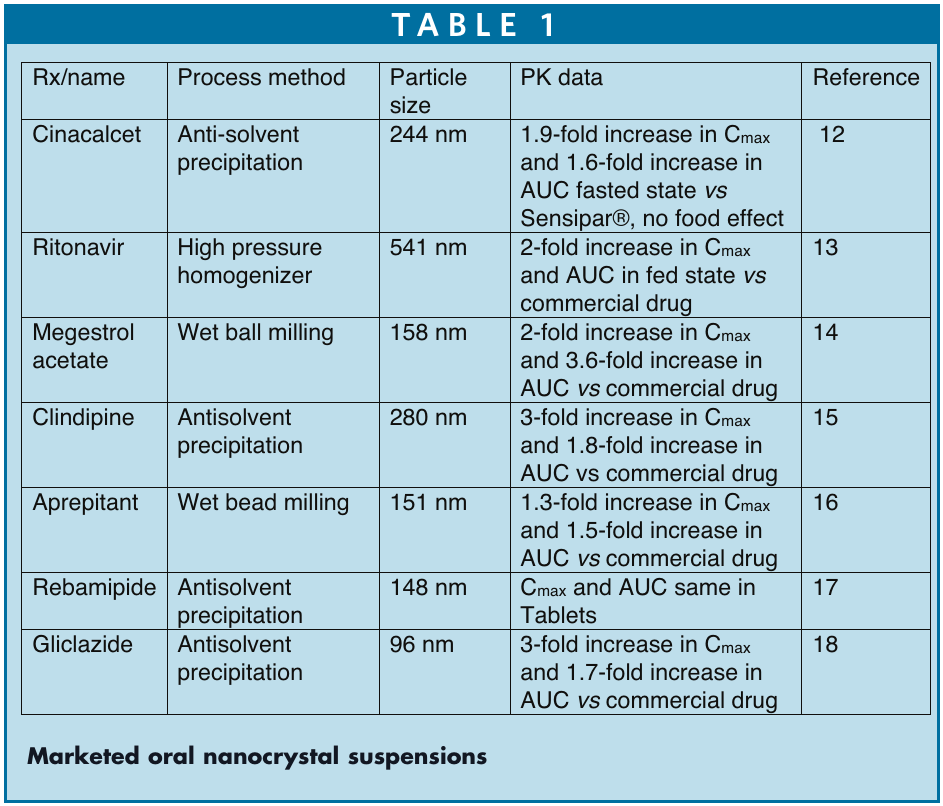
There are several nanocrystal drugs marketed over the years. First launched in 2000, sirolimus (Rapamune®) as tablets improved the oral bioavailability by 21% as compared to non-milled drug. Aprepitant nanocrystal launched as Emend® in 2003 showed 25-30% dose reduction due to its enhanced oral bioavailability. Fenofibrate as Tricor® and megestrol acetate as Megace ES® showed significant increase in oral bioavailability by reducing the food effect as nanocrystals.4 Table 1 lists examples of few commercially available nanocrystal drugs showing the method of preparation, particle size, and pharmacokinetic performance.
As cited above in Table 1 the nanocrystal drugs when compared with commercial drugs showed much greater bioavailability than commercial products. It can be taken to suggest that the processes and ultimately particle size and the morphology as a result, play an important role in absorption of drugs through gastrointestinal tract. Let’s take a closer look into some important factors contributing to higher bioavailability.
NATURE OF PARTICLES: MORPHOLOGY & SIZE
As evident from Table 1, nearly all drugs have a wide distribution range of particles prepared by different processes, whether used top down, bottom up or the combination of the two, and also on the properties of drugs, concentrations and type of stabilizers used. Each method requires different conditions and setups. In wet bead milling process, for example, the bead size and speed and time determine the particle size. Thus, finding an ideal condition for achieving the critical material attributes is essential for a robust process. The quality by design (QbD) approach is used to identify and minimize the variabilities during manufacturing.
Cyclosporine A, a known immune suppressant, was first launched as soft gel capsules and is now available as nanocrystal suspension achieved by nano-milling with particles ranging from 280 nm to 2967 nm. For nano-milled cyclosporine with 280 nm particles in size, the oral bioavailability was about 1.5-fold higher than those larger cyclosporine particles. A further reduction in particles to < 280 nm, could lead to improvement in pharmacokinetic performance.19 Ma et al. investigated the impact of particle size oral absorption of isoliquiritigenin nanocrystals varied between 46 nm and 555 nm. The Cmax and Tmax and AUC improved on nano-milled samples, with particles 277 nm showed a significant enhancement in pharmacokinetic performance as compared to 46 nm particles. In vitro release data is also consistent with the in vivo findings. Thus, achieving the optimal particle size is critical for each preparation to improve oral bioavailability. Predictive tools such simulation modeling could be used to further optimize the formulation to reduce particle size variability and to improve the bioavailability assessment.20
Like particle size, the morphology of particle also plays a critical role in mucus permeation and absorption. For example, lovastatin nanocrystal, is known to exhibit different bioavailability in rats depending upon the particle morphologies.21 The authors have demonstrated that rod shaped particles have much deeper penetration than flaky or spherical particles, suggesting that these rod-shaped nanoparticles can easily be internalized by epithelial cells, whereas, the spherical shaped particles are trapped in the mucus layer networks, thus, causing the reduced permeability as compared to rod shaped particles. It is believed that longer rod-shaped particle can increase the contact within the intestinal membrane by rotating through mucus networks.22
DISSOLUTION RATE & EFFECT OF FOOD EFFECTS OF NANOCRYSTAL SUSPENSIONS ON BIOAVAILABILITY
The dissolution of nanocrystals depends upon particle size and morphology as well solubilizers. The larger surface area to volume ratio and short diffusion distance can enhance the dissolution rate according to Noyes and Whitney equation.23 In the gut, the endogenous secretion of bile salts and phospholipids has drastic impact on dissolution rate. The particle curvature also affects the dissolution rate, which is due in part, by allowing more particles interact with intestinal membrane and blood vessels.24 Junyapraser et al. observed that dissolution rate of gliclazide at pH 7.4 and at 30°C was about 2.3-fold higher in Cmax and AUC as compared to pure drug.18 When tested in rats, the in vivo data showed a remarkable reduction in blood glucose level as compared to commercial drug or pure drug, further demonstrating the particle size reduction, and nanocrystal suspension stability which helped achieve the rapid dissolution, absorption and improve efficacy of drug. Thus, dissolution rate and oral bioavailability of poorly soluble can also be affected by fed and fasted states, but the nanocrystals have the potential to eliminate fed/fasted state since the dissolution rates in both conditions are fast enough.25 Other drugs like entrectinib, an anticancer drug with pKa of 2.5 (weak base) showed a poor solubility in the fasted state but higher solubility in gastric pH in the absence of food. The entrectinib nanocrystals with particle size 83 nm, on the other hand, dissolved >98% in 4 hours both in the fed and fasted states simulated intestinal fluids (FeSSIF and FaSSIF). In vivo data in rats showed nearly similar oral bioavailability (13949 ng.h/min vs. 11702 ng.h/min), with no food effects in the fed or fasted state. The Cmax and AUC of nanocrystals showed 4-fold and 3-fold increase, respectively, as compared to pure entrectinib. In other case, nanocrystals may not have an impact on drug absorption in the fed and fasted states.
For example, antiviral drug ritonavir nanocrystals with particle size 541 nm, the dissolution was complete within 2 hours, but the in vivo data of commercial drug showed AUC 1.3-fold increase as compared to nanocrystals in the fasted group.13 In the fed state, the AUC was 10-fold higher than fasted state (442 min.mg/ml vs 47 min. mg/ml). Taken together, these results suggest that nanocrystals may improve oral bioavailability, but they were sufficient to eliminate the food effect. It is evident that entrectinib nanocrystals, a BCS II drug with particle size, 83 nm were able to eliminate the food effects in fed and fasted states, but ritonavir nanocrystals, a BCS IV drug with particle size of 541 nm was still independent upon the food effects, suggesting by reducing the particle size of ritonavir to smaller ones could achieve the desired dissolution rate, required to eliminate the variability in fed and fasted states by increasing the permeability of this drug.26 Comparing the commercially available ritonavir (Norvir®) and ritonavir nanocrystals, there were similar effects in rats and humans in both forms.
On dosing in rats at 10 mg/kg (p.o.) of Norvir® showed a positive food effect as opposed to fasted state (AUC 222 min.ug/ml vs. 63 min.ug/ml). On dosing in humans at 100 mg/kg, a negative food effect was observed with AUC 3.5 min.ug/ml vs 4.6 min.ug/ml). This difference in oral bioavailability in humans is attributed to 5.5-time longer GI tract transit with surface areas 200x larger than rats.27 From differences in bioavailability in rats and humans, it can be suggested that animals other than rats like beagle dogs, monkeys can be used to conduct the studies involving nanocrystals for improving oral bioavailability in the fed and fasted states.
As Norvir®, the animal species dependent effects are observed with a BCS class II drug megestrol acetate nanocrystals. For instance, on dosing at 10 mg/kg in beagle dogs in the fed state, it showed 1.6-fold higher AUC than in the fasted state. Compared with commercially available Megace-C, the nanocrystals showed 2-fold increase in AUC in the fasted state, while the bioavailability was similar in the fed state.28 In a crossover healthy male volunteers’ study, megestrol nanocrystals dosed at 625 mg/5 ml in the fasted state, it was bioequivalent to marketed Megace-C®. These obvious differences in bioavailability in human and beagle dogs are due to inherent difference in gastric pH, with dogs the pH ranges between 2 and 6.5 vs gastric pH 1-2 in human in the fasted state. Thus, for a weekly acidic drug, the dissolution rate is faster in beagle dogs, leading to faster absorption. Therefore, to mimic the gastric human pH to compare the outcome from beagle dogs, a pH lowering synthetic peptide pentagastrin is used to drive the meaningful comparative data from in vivo PK data in beagle dogs.29 In a similar study, cinacalcet nanocrystals on comparing with marketed drug Sensipar® tablets, there was no food effect with nanocrystals in the fasted and fed states in rats. On comparing with commercial drug, nanocrystals showed improvement in Cmax and AUC in the fasted state, but in the fed state, both showed a similar Cmax and AUC values. In general, the lipophilic drugs taken with high fat diets, lead to greater solubility and higher absorption due to bile secretion in upper intestine.30
NANOCRYSTALS TRANSPORT ACROSS MEMBRANE & BLOOD BRAIN BARRIER
Since their smaller size and shape and higher surface area, the nanocrystals can increase solubility and improve the dissolution rate above the threshold of saturation solubility, creating a concentration gradient across the intestinal membrane and leads to transcellular diffusion via passive transport.31 Drug transport of an experimental insoluble CNS molecule as nanocrystals with particle size 85 nm, in rat plasma showed a significant increase in Cmax and AUC as compared to pure drug. In Mardin-Darby canine kidney (MDCK) model, ginkgolide B nanocrystals showed 2.7-fold in apparent permeability (Papp) than pure molecule. In vitro dissolution rate of nanocrystals was fast, yielding over 92% release at pH 7.4 within 30 min. In neuronal tissues, Cmax and AUC were 3-fold and 2.5-fold higher, respectively. In other words, the smaller nanoparticles can be used in brain drug delivery via permeation through blood brain barrier (BBB) following p.o. delivery.
Polymeric stabilizers such as cellulosic excipients like HPMC E5 can help enhance drug concentration in brain tissues.32 It is permeation rather than dissolution rate that enhances absorption of drug nanocrystals. In a permeation-dissolution study by Imono et al. it was demonstrated using a PVDF membrane separating the donor (pH 6.5) and acceptor (pH 7.4) chambers at 37°C, it was found that apparent permeability (Papp) of megestrol acetate (BCS class II) nanocrystals was dependent upon the particle size; which increased in order: 158 nm > 200 nm > 373 nm > 1950 nm (micro-suspension), and led to reduced drug concentration from donor to acceptor over time.14 The Papp was 2-fold higher for nanocrystals (158 nm) as compared to drug solution in methanol, suggesting that permeation across membrane is independent of dissolution. In pharmacokinetic studies, megestrol acetate nanosuspensions with particle size 158 nm showed 3.6-fold improvement in AUC as compared to 1.8-fold with micro-suspension bearing particle size 1950 nm. This study sheds light on permeation not dissolution that determines the oral absorption. Since megestrol acetate is a BCS class II drug with greater permeability, improving oral absorption and bioavailability is dependent upon the dissolution rate.
On the other hand, for BCS class IV drugs, improving dissolution via nanocrystals and permeability both contribute to enhance oral absorption and bioavailability.26 In a study where dissolution is driving force for absorption, the nintedanib as nanocrystals with particle size of 325 nm and in solution containing polysorbate 80, were investigated against transport through Caco-2 monolayers. The transport data showed 1.3-fold lower transport through Caco-2 monolayer than solution. The PK data indicate that drug in nanocrystals showed 2.5-fold increase in absorption compared to solution, suggesting that dissolution of nanocrystal rather than permeation is limiting step for improved absorption. In vitro drug release from nanocrystal was 74% within 10 min at pH 6.8 as compared to 6% of pure drug.33
EFFECTS OF STABILIZING AGENTS & SURFACE CHARGES ON STABILITY OF NANOCRYSTAL SUSPENSIONS
The milled nanocrystals as suspensions tend to agglomerate or undergo Ostwalt ripening to reduce the energetic state.34 To prevent this, a range of pharmaceutically accepted stabilizers- polymers, solubilizers, surfactants are often used to stabilize these particles to prolong stability on storage. In some instances, the combination of non-ionic polymers and ionic stabilizers are used to stabilize the nanocrystals by charge separation, through electrostatic interactions and/or steric interactions. A range of stabilizers including poloxamer 188, poloxamer 407, vitamin E-TPGS, cellulosic polymers (HPMC, HPC, carbomethoxy cellulose), glycyrrhizin (GL) among others are used. Quercetin nanocrystals stabilized with poloxamer 407 and vitamin E-TPGS (1:1, drug : stabilizer), with particle size of 200 nm increased 16-fold and 14-fold saturation solubility in water, respectively, as compared to pure drug.35 The dissolution rate decreased in order: Poloxamer 407 > Vitamin E-TPGS > GL > Poloxamer 188 > HPMC. In vivo data, AUC and Cmax both increased in the same fashion for nanocrystals versus pure quercetin. Although these stabilizers showed an impact on the stability and efficacy of nanocrystal drug, the exact mechanism remains unclear. The obvious reason for drug uptake is due to increased transport through transcellular and paracellular diffusion. The paracellular transport refers to diffusion of drug through tight junction with pore size < 20 nm, which further limits the transport via this pathway.31 To alleviate this challenge, additional stabilizers and Pgp inhibitor such as polyoxyl 35 castor oil, sodium deoxycholate, Soluplus® and chitosan are used to help increase the flux of drug across the membrane. In cases where the Pgp are overexpressed in the multidrug resistance (MDR) in oncology patients, BCS class IV drugs like nilotinib in Soluplus® showed a significant improvement in PK profiles.36 This increase in transport is likely due to passive diffusion, resulting in from inhibition of Pgp by the polymer.
Nanocrystals stabilized by surface charge modification can have impact on the absorption and bioavailability of molecules. Nanocrystals stabilized with cationic charge can interact with negatively charged mucin surface leading to poor absorption through mucus membrane and vice versa. For example, bufadienolide nanocrystals were evaluated for mucus permeation with different cationic stabilizers, and found that pectin-stabilized nanocrystals with particle size 209 nm and zeta potential -30.5 mV were highly permeable (or higher Papp) as compared to chitosan (a 3º ammonium) charged coated nanocrystals having particle size 438 nm, and zeta potential +30 mV, confirming the positive charged stabilizers compromised the permeation by interacting strongly with negatively charged mucin layer.37 In another example, thiol coated simvastatin nanocrystals with xanthan gum resulted in decrease in mucus permeation due to stronger interactions of positively charged nanocrystals and negatively charged mucin as compared to pure drug at acidic and alkaline pHs. On oral administration of nanocrystals in rats, the Tmax and AUC increased significantly as compared to pure drug, while the Cmax was about 2-fold lower versus pure drug.
Lower bioavailability of nanocrystals as compared to commercial drugs, might be related to macrophage phagocytosis.38 Once phagocytosed the nanocrystals can hold the release over several weeks, which results in compromised absorption.39 The longer half-life (t½) while the significant improvement in Cmax, Tmax and AUC suggest the slower or prolonged release due to internalization in epithelial cells. However, the longer half-life can raise concerns for potential toxicity when designing the nanocrystal suspensions. These concerns for the nanocrystals with particle size <100 nm are due to faster absorption but those larger particles the faster dissolution overtakes the absorption, thereby, alleviating the concerns for potential toxicity.40
CONCLUSION & FUTURE PERSPECTIVE
As more new drug candidates continue to be discovered and qualified as BCS II and IV molecules, finding the new technologies for formulation development and bringing them to clinic faster remain the ultimate goals for the drug manufacturers. Compared to non-conventional amorphous dispersions involving spray drying, hot melt extrusion, supercritical carbon dioxide (sCO2), self-emulsifying systems among others, the classical approaches will continue to dominate the oral liquids and solid oral dosage forms (SODF). Physical stability of the nanocrystals with the desired particles as opposed to amorphous state coupled with greater solubility, dissolution, and permeation and/or absorption could play an important role in enhancing the oral bioavailability. Faster dissolution versus absorption from nanocrystals can help determine the variabilities between the fed and fasted states. Other contributing factors such as inhibition of Pgp efflux pump and use of stabilizing agents and solubilizers all can help improve the cellular uptake or absorption of nanocrystals.
Ascendia with its enabling technologies including AmorSol®, NanoSol®, EmulSol® and LipidSol®, can help improve the solubility and bioavailability of small and large molecules across all modalities. Ascendia’s state-of-the-art facilities equipped with nano-milling and high-pressure homogenizers, and microfluidic systems can help expedite the development of oral and injectable nanocrystal suspension formulations with desired dissolution rate and permeation and/or absorption.
REFERENCES
- S. Ali and K. Kolter, Challenges and Opportunities in Oral Formulation Development, Am. Pharm. Rev., December 2012.
- S. Ali, Drug Delivery Roundtable, Am. Pharm. Rev. September 2016.
- S. Ali and J. Huang, Lymphatic versus portal drug delivery: An understanding of drug oral absorption and food effect, J. Nanomedicine, 2025, 8, 1072.
- L. de O. Macedo, J. F. Masiero and N. A. Bou-Chacra, Drug Nanocrystals in Oral Absorption: Factors That Influence Pharmacokinetics, Pharmaceutics, 2024, 16, 1141.
- J. Huang and S. Ali, Nanosuspensions, FORMULATION FORUM – Nanosuspensions – An Enabling Formulation for Improving Solubility & Bioavailability of Drugs< Drug Dev. Delivery, December 4, 2023.
- Y. Shi, A. Lu, X. Wang, Z. Belhadj, J. Wang and Q. Zhang, A review of existing strategies for designing long-acting parenteral formulations: Focus on underlying mechanisms, and future perspectives, Acta Pharmaceutica Sinica, 2021, 11, 2396-2415.
- S. H. Yalkowsky, Solubility and Solubilization in Aqueous Media, American Chemical Society, 1999, ISBN0841235767, 97808412357.
- I. S. Mohammad, H. Hu, L. Yin, and W. He, Drug Nanocrystals: Fabrication Methods and Promising Therapeutic Applications. Int. J. Pharm. 2019, 562, 187–202.
- E. Bilgili and G. Guner, Mechanistic Modeling of Wet Stirred Media Milling for Production of Drug Nanosuspensions. AAPS PharmSciTech 2021, 22, 2.
- G. Soni, K. Kale, S. Shetty, M. K. Gupta, and K. S. Yadav, Quality by Design (QbD) Approach in Processing Polymeric Nanoparticles Loading Anticancer Drugs by High Pressure Homogenizer. Heliyon 2020, 6, e03846.
- Z. Chen, W. Wu, and Y. Lu, What Is the Future for Nanocrystal-Based Drug-Delivery Systems? Ther. Deliv. 2020, 11, 225–229.
- X. Xu, G. Chen, Y. Li, J. Wang, J. Yin, and L. Ren, Enhanced Dissolution and Oral Bioavailability of Cinacalcet Hydrochloride Nanocrystals with No Food Effect. Nanotechnology 2019, 30, 055102.
- A. Karakucuk, Z. S. Teksin, H. Eroglu, and N. Celebi, Evaluation of Improved Oral Bioavailability of Ritonavir Nanosuspension. Eur. J. Pharm. Sci. 2019, 131, 153–158.
- M. Imono, H. Uchiyama, S. Yoshida, S. Miyazaki, N. Tamura, H. Tsutsumimoto, K. Kadota, and Y. Tozuka, The Elucidation of Key Factors for Oral Absorption Enhancement of Nanocrystal Formulations: In Vitro-In Vivo Correlation of Nanocrystals. Eur. J. Pharm. Biopharm. 2020, 146, 84–92.
- F. Shaikh, M. Patel, V. Patel, A. Patel, G. Shinde, S. Shelke, and I. Pathan, Formulation and Optimization of Cilnidipine Loaded Nanosuspension for the Enhancement of Solubility, Dissolution and Bioavailability. J. Drug Deliv. Sci. Technol. 2022, 69, 103066.
- J. Liu, S. Li, W. Ao, Y. Li, Y. Xiao, and M. Bai, Fabrication of an Aprepitant Nanosuspension Using Hydroxypropyl Chitosan to Increase the Bioavailability. Biochem. Biophys. Res. Commun. 2022, 631, 72–77.
- G. Jin, H. V. Ngo, J. Wang, J.-H. Cui, Q.-R. Cao, C. Park, M. Jung, and B.-J. Lee, Design and Evaluation of in Vivo Bioavailability in Beagle Dogs of Bilayer Tablet Consisting of Immediate Release Nanosuspension and Sustained Release Layers of Rebamipide. Int. J. Pharm. 2022, 619, 121718.
- S. Sampathi, S. Prajapati, V. Junnuthula, and S. Dyawanapelly, Pharmacokinetics and Anti-Diabetic Studies of Gliclazide Nanosuspension. Pharmaceutics 2022, 14, 1947.
- W. Sun, J. Gao, R. Fan, T. Zhang, Y. Tian, Z. Wang, H. Zhang, and A. Zheng, The Effect of Particle Size on the Absorption of Cyclosporin A Nanosuspensions. Int. J. Nanomed. 2022, 17, 1741–1755.
- J. Uhlemann, H. Diedam, W. Hoheisel, T. Schikarski, and W. Peukert, Modeling and Simulation of Process Technology for Nanoparticulate Drug Formulations—A Particle Technology Perspective. Pharmaceutics 2020, 13, 22.
- M. Guo, M. Wei, W. Li, M. Guo, C. Guo, M. Ma, Y. Wang, Z. Yang, M. Li, Q. Fu, L. Yang, and Z. He, Impacts of Particle Shapes on the Oral Delivery of Drug Nanocrystals: Mucus Permeation, Transepithelial Transport and Bioavailability. J. Control. Release 2019, 307, 64–75.
- M. Yu, J. Wang, Y. Yang, C. Zhu, Q. Su, S. Guo, J. Sun, Y. Gan, X. Shi, and H. Gao, Rotation-Facilitated Rapid Transport of Nanorods in Mucosal Tissues. Nano Lett. 2016, 16, 7176–7182.
- A. A. Noyes and W. R. Whitney, The Rate of Solution of Solid Substances in Their Own Solutions. J. Am. Chem. Soc. 1897, 19, 930–934.
- V. B. Junyaprasert and B. Morakul, Nanocrystals for Enhancement of Oral Bioavailability of PoorlyWater-Soluble Drugs. Asian J. Pharm. Sci. 2015, 10, 13–23.
- L. Gao, G. Liu, J. Ma, X. Wang, L. Zhou, and X. Li, Wang, F. Application of Drug Nanocrystal Technologies on Oral Drug Delivery of Poorly Soluble Drugs. Pharm. Res. 2013, 30, 307–324.
- Food and Drug Administration (FDA). Chemistry Review: Norvir (Ritonavir) Tablets. Available online: https://www.accessdata. fda.gov/drugsatfda_docs/nda /2010/022417s000_ChemR.pdf (accessed on 14 August 2024).
- J. M. DeSesso and C. F. Jacobson, Anatomical and Physiological Parameters Affecting Gastrointestinal Absorption in Humans and Rats. Food Chem. Toxicol. 2001, 39, 209–228.
- R. A. Femia and R. E. Goyette, The Science of Megestrol Acetate Delivery. BioDrugs 2005, 19, 179–187.
- M. Koziolek, M. Grimm, T. Bollmann, K. J. Schafer, S. M. Blattner, R. Lotz, G. Boeck and W. Weitschies, Characterization of the GI Transit Conditions in Beagle Dogs with a Telemetric Motility Capsule. Eur. J. Pharm. Biopharm. 2019, 136, 221–230.
- K. Jang, S. Yoon, S.-E. Kim, J.-Y. Cho, S.-H. Yoon, K. S. Lim, K.-S. Yu, L-J. Jang, and H. Lee, Novel Nanocrystal Formulation ofMegestrol Acetate Has Improved Bioavailability Compared with the Conventional Micronized Formulation in the Fasting State. Drug Des. Devel Ther. 2014, 8, 851–858.
- Z. Tian, Y. Mai, T. Meng, S. Ma, G. Gou, and J. Yang, Nanocrystals for Improving Oral Bioavailability of Drugs: Intestinal Transport Mechanisms and Influencing Factors. AAPS PharmSciTech 2021, 22, 179.
- S. Xiong, W. Liu, D. Li, X. Chen, F. Liu, D. Yuan, H. Pan, Q. Wang, S. Fang, and T. Chen, Oral Delivery of Puerarin Nanocrystals To Improve Brain Accumulation and Anti-Parkinsonian Efficacy. Mol. Pharm. 2019, 16, 1444–1455.
- Y. Zhu, Y. Fu, A. Zhang, X. Wang, Z. Zhao, Y. Zhang, T. Yin, J. Gou, Y. Wang, H. He and Z. Tang, Rod-Shaped Nintedanib Nanocrystals Improved Oral Bioavailability through Multiple Intestinal Absorption Pathways. Eur. J. Pharm. Sci. 2022, 168, 106047.
- E. Merisko-Liversidge and G. G. Liversidge, Nanosizing for Oral and Parenteral Drug Delivery: A Perspective on Formulating Poorly-Water Soluble Compounds Using Wet Media Milling Technology. Adv. Drug Deliv. Rev. 2011, 63, 427–440.
- Y. Zhu, F. Hu, C. Shen, B. Shen, and H. Yuan, Quercetin Nanocrystals for Bioavailability Enhancement: Impact of Different Functional Stabilizers on In Vitro/In Vivo Drug Performances. Pharm. Dev. Technol. 2024, 29, 551–558.
- K. Chougule, A. Sirvi, V. Saini, M. Kashyap, and A. T. Sangamwar, Enhanced Biopharmaceutical Performance of Brick Dust Molecule Nilotinib via Stabilized Amorphous Nanosuspension Using a Facile Acid–Base Neutralization Approach. Drug Deliv. Transl. Res. 2023, 13, 2503–2519.
- Z. Tian, Y. Zhao, Y. Mai, F. Qiao, J. Guo, L. Dong, Y. Niu, G. Gou, and J. Yang, Nanocrystals with Different Stabilizers Overcome the Mucus and Epithelial Barriers for Oral Delivery of Multicomponent Bufadienolides. Int. J. Pharm. 2022, 616, 121522.
- Y. Lv, W. Wu, C. D. Corpstein, T. Li, and Y. Lu, Biological and Intracellular Fates of Drug Nanocrystals through Different Delivery Routes: Recent Development Enabled by Bioimaging and PK Modeling. Adv. Drug Deliv. Rev. 2022, 188, 114466.
- A. S. Nowacek, J. McMillan, R. Miller, A. Anderson, B. Rabinow, H. E. Gendelman, Nanoformulated Antiretroviral Drug Combinations Extend Drug Release and Antiretroviral Responses in HIV-1-Infected Macrophages: Implications for NeuroAIDS Therapeutics. J. Neuroimmune Pharmacol. 2010, 5, 592–60.
- L. de O. Macedo, E. J. Barbosa, R. Lobenberg, and N. A. Bou-Chacra, Anti-Inflammatory Drug Nanocrystals: State of Art and Regulatory Perspective. Eur. J. Pharm. Sci. 2021, 158, 105654.
Total Page Views: 27