

Issue:October 2026
VACCINE TECHNOLOGY - Delivering Better Global Vaccination Programs by Removing the Needle, Syringe & Fridge
Key Points
- Vaccination program success is about incremental improvements in uptake, and removing the needle, for some people, is the difference between taking their first/second dose of a vaccine or not.
- The ideal scenario is availability of vaccines that are thermally stabilized, available in a ready-to-use format, and can be easily transported with and without refrigeration.
- Putting patients at the center of treatment and patient-centric medicine are phrases that have become routine in the development of new medicines.
By: Robin Cohen
Introduction
Vaccines are something that are easy to take for granted. For most people, each year, their doctors will contact them and, if eligible, they book their appointments, turn up at the clinic where a trained healthcare professional has already taken the vaccine out of the refrigerator and injects the antigen into their arms using a syringe with a thin, sharp needle. It’s only at this point the vaccine becomes a vaccination, and the immune system does the hard work. They have had a vaccination.
For many people, the sight and perception of the needle is a barrier to vaccination. Fear and anxiety (needle phobia) is real and something that may stand in the way of turning up to be vaccinated. The bigger issue for global vaccination programs is the ability to maintain a robust and intact cold chain all the way to the point of delivery.
It is a sad fact the COVID 19 vaccination program success also starkly highlighted the enormous difference in vaccination rates around the world – with variation seen across high-income countries but most significantly seen in the poorest countries of the world.1
The reasons behind the varying uptake of COVID 19 vaccines are equally as diverse and challenging – availability of supply, cost, logistics, and vaccine hesitancy all played a role. However, COVID 19 highlighted a problem that existed for a long time – why do some countries have better access to life-saving vaccines than others?
Vaccine Delivery’s Difficult “Last Mile”
The challenge of storing vaccines at temperatures as low as -80°C in a wide variety of healthcare settings is very real. The “last mile” of vaccine delivery – the transportation and storage from a central facility to the point of actual administration is particularly burdensome for many low- and middle-income countries. Clinics are not always based in hospital or facilities with suitable refrigeration – the transport may be by motorcycle or by hand – all the time the vaccines must be stored within strictly defined conditions to ensure they remain effective. There is a real cost in the wastage of vaccines due to a break in the cold-chain, and there are costs associated with the actual storage and handling of vaccine in this way, both in financial terms as well as in the carbon footprint – refrigeration is energy hungry.2
Anyone who has watched a doctor or nurse fill a syringe, squeeze the air out of the long needle, and ask the recipients to roll up their sleeves will understand a needle is, for many people, a fear-inducing but vital part of medical intervention. The needle and syringe are employed to deliver antigen into the muscle; however, this is not the only route or method of delivering vaccines. The immune system is active throughout the body, and the route of antigen delivery is a subject of intense R&D. Skin delivery, intramuscular, subcutaneous, intranasal – all have been used to successfully generate an antibody response to vaccines. Vaccination program success is about incremental improvements in uptake, and removing the needle, for some people, is the difference between taking their first/second dose of a vaccine or not.
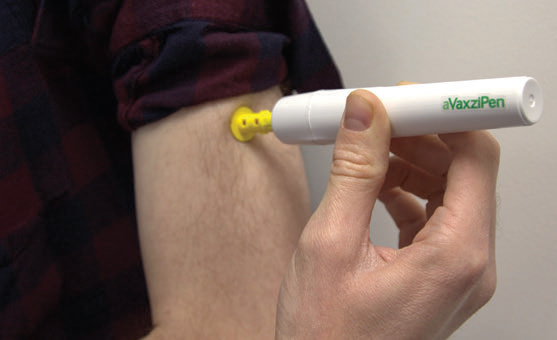
Several new technologies have emerged that aim to address these critical areas. The challenge is how to deliver vaccines intact, at low cost, and with equal or better efficacy to populations around the world whilst avoiding or minimizing the requirements for cold-chain – making the “last mile” of vaccine delivery less burdensome.
Moving On From Liquid to Solid Dose Vaccine Technology
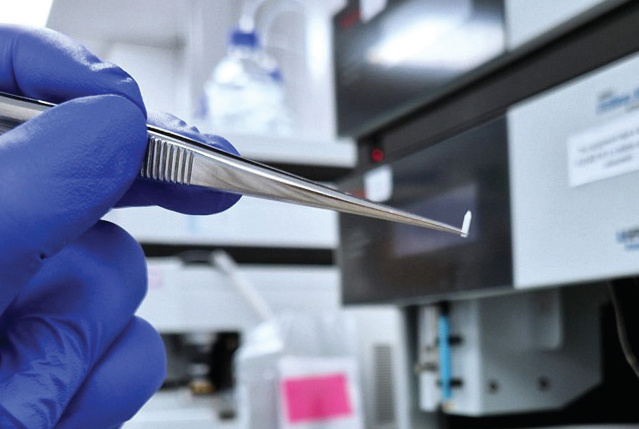
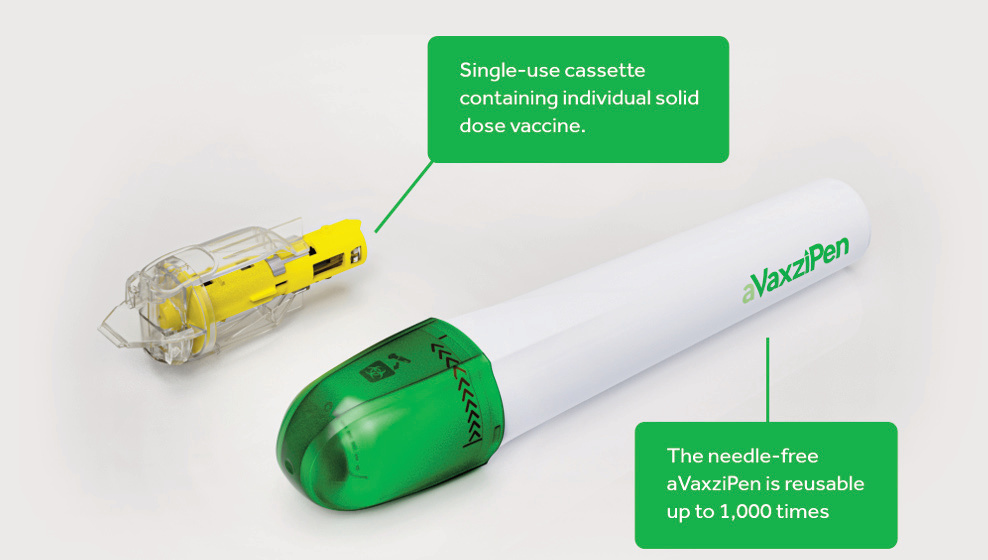
Solid-dose vaccine technology may have the answer to many of these challenges. Take a conventional liquid vaccine (mRNA, proteinaceous, or vector based), and stabilize the antigen in a tiny, thermostable solid dose. This solid dose is pre-loaded into a small, disposable cassette, and a multi-use pen is used to deliver the dose almost without sensation. Due to the highly thermostable nature of the solid doses, the disposable cassettes can be easily shipped and stored at ambient temperature. The multi-use pen avoids needles and is simple to use; in an emergency, it would allow the potential for self-administration or less training required for healthcare professionals (HCPs). The solid dose dissolves rapidly in the skin, releasing the vaccine, and the body’s immune system takes over. Simple, highly cost-effective, and inherently safer for HCPs who avoid the risks associated with needles and syringes. The platform has demonstrated stability and immunogenicity across a wide range of vaccine types so can be considered vaccine type agnostic.
The stockpiling of vaccines is another important consideration to protect against bioterrorism or future pandemics. Vaccines must be rapidly manufactured and deployed to all affected areas in the event of an outbreak or threat. To do this effectively, vaccines need to be stored at central depots with the infrastructure already in place to ship them anywhere they are required. This is not easy, by definition, it is difficult to quantify the scale, the timelines, and the location of where these life-saving vaccines need to be delivered. An approach to secure global resilience against what the future may bring is to stockpile vaccines with broadly protective immunity, ready to be shipped at short notice. This requires appropriate storage and distribution conditions (such as cold-chain), an appropriate shelf-life for the vaccines, and vaccines already in a form that is easy to administer in the most challenging conditions. Vaccine stability and its ability to be easily shipped at ambient temperatures become critically important. The availability of needles and syringes, the essential equipment to inject people with the vaccines, may also become a rate-limiting step. The key is simplification of the process. The ideal scenario is availability of vaccines that are thermally stabilized, available in a ready-to-use format, and can be easily transported with and without refrigeration.
Reducing the Needle-Stick Risk
Vaccine administration via needles and syringes represents a risk to HCPs, and measures are put in place to reduce this risk; however, the risk cannot be eliminated, and the sheer volume of doses administered in a mass vaccination program means occurrences are highly likely.3 Once a vaccine has been administered, the needle becomes a cross-contamination risk to the HCP, containing pathogens that may be present in the blood of the vaccinated individual. Sharps bins are provided to reduce these risks, and handling procedures help reduce the chances of injury. Novel vaccine administration technology has the potential to reduce or eliminate these risks. Methods of delivery to remove the needle take away the chance of blood-to-blood transmission of disease. “Click and deliver” technology that ensures reliable dose delivery to the subject but avoids sharp and contaminated parts of the delivery mechanism would be preferable. Solid-dose vaccines are administered using the vaccine itself as the penetrating device. This means the cartridge that carries the vaccine does not need to contain a needle – rather a blunt plastic plunger that is unlikely to penetrate skin and therefore is inherently safer than a conventional needle.
Putting patients at the center of treatment and patient-entric medicine are phrases that have become routine in the development of new medicines. Gone are the days of a physician dictating the treatment pathway for a range of diseases – the patient is now front and center in the decision-making process. Patients (and patient groups) know best as to the balance of disease outcome and quality of life – about the route of administration of treatments, the location for their treatment, and level of involvement they wish to have. Vaccines today, stand out as an exception to the shift to patient centricity. The choice of vaccine and the route of delivery are decisions taken well beyond the physician’s office. Vaccines are different, they are usually given to healthy subjects as opposed to treating an active disease. However, the recipient should also have a say in the choice of vaccines and the route of administration. The growth in alternative routes of vaccine delivery is a key component of bringing patient-centric medicine into the prophylactic vaccine space. One day, people will get to choose if they wish to have an intramuscular, intranasal, or solid-dose version of their boosters, and those choices will be driven by the person receiving the vaccine. Patient groups will help design vaccination programs for targeted groups based on their insights into the route of administration and how it is likely to affect the individuals and ultimately, the uptake of the program.
Applying Pharmaceutical Marketing 101 to Vaccines
For all the advances in novel vaccine delivery, and there are many, one final challenge remains. Needles and syringes are cheap, which feeds through to lower cost vaccines. They are also easy to make at scale, and the infrastructure to do so is established. Novel technologies are different. They must be designed to be made in significant numbers (100 million plus doses), and in the event of future pandemics, in the billions of doses. Scaled up production requires significant amounts of CAPEX, which requires large amounts of funding in challenging times for biotechnology companies to raise funds. The business case for investing in novel routes of vaccine delivery, such as aVaxziPen’s “click and deliver” solid-dose technology, lies in the application of sophisticated cost-effective modelling of the vaccine market. The cost of developing cutting-edge technology can be offset by the improvements in vaccine coverage and offsetting the costs of getting vaccines to the point of use. In high-income countries, the case for making vaccine delivery less painful and easier also challenges the conventional view of the lower margin, high-volume market, compared to conventional medicines developed by global pharmaceutical companies. The world needs cost-effective vaccines, and consumer preference will drive market uptake. It’s pharmaceutical marketing 101 applied in the vaccine space.
Despite the significant advances we have seen in antigen design and our understanding of the immune system, it should be remembered that a vaccine can only work once it is delivered, intact, and into the arm of the person who needs it. The vaccine chain (from manufacturing through to transportation, storage, and delivery) and the resources required at each stage should be considered holistically, and the burden on healthcare systems as well as minimizing the risks to the healthcare professionals at the sharp end should all be minimized where possible. The entire value chain is of critical importance. Novel vaccine technology does not relate simply to the antigen within the vaccine, it also relates to the method of administration, the route of delivery, and the system costs of achieving an immune-protected population. Affordable, simple, reliable, and safe vaccines are needed. Removing the needle, syringe, and refrigerator from vaccine delivery is a significant step in the right direction toward better global vaccination programs.
References
- It is not too late to achieve global covid-19 vaccine equity BMJ 2022; 376 doi: https://doi.org/10.1136/bmj-2022-070650 (Published 24 March 2022) Cite this as: BMJ 2022;376:e070650.
- Kurzweil, P.; Müller, A.; Wahler, S. The Ecological Footprint of COVID-19 mRNA Vaccines: Estimating Greenhouse Gas Emissions in Germany. Int. J. Environ. Res. Public Health 2021, 18, 7425. https://doi.org/10.3390/ijerph18147425.
- Needlestick injury surveillance during mass vaccination clinics: Lessons learned and why more is needed—Tri-County (Denver Metropolitan) region, Colorado, 2009 https://doi.org/10.1016/j.ajic.2011.09.014.
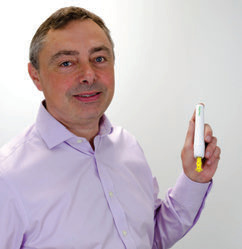
Robin Cohen is Chief Business Officer and Director at aVaxziPen. He has over 25 years of experience in the pharmaceutical industry with a strong executive level commercial and business development focus. He is a highly experienced senior level leader with a strong track record in biotech fund raising, commercializing products from preclinical through to post license as well as building commercial teams and leading them to exceed their strategic and commercial goals in both global pharmaceutical and biotech organizations. Prior to joining aVaxziPen, he worked in a variety of senior level commercial roles at Janssen Cilag (Johnson & Johnson) where he was a key part in a number of ground-breaking therapeutic product launches across a range of the therapeutic areas from oncology to infectious diseases with a focus on HIV, hepatitis, and the wider infectious disease portfolio.
Total Page Views: 16