

Issue:October 2026
EXECUTIVE INTERVIEW - Bone Biologics Corp.: Recombinant Protein Development in Engineering Active Orthobiologics & Targeted Bone Therapies
Key Points
- There is a trend toward making regenerative therapies more targeted rather than simply increasing biological activity throughout the treatment area.
- NB-1 is designed to use familiar graft-preparation and placement procedures, which could potentially make adoption easier if clinical and regulatory requirements are met.
- There is potential to stimulate bone where it is needed while minimizing unwanted bone growth and inflammation.
 In orthopedic care, supporting complex bone healing for high-risk patients requires solutions that balance strong bone growth with patient safety. While traditional growth factors have improved spinal fusion, side effects like swelling and unintended bone growth outside the target area show the clear need for more precise options.
Bone Biologics is addressing this challenge as it advances from early research into clinical-stage development. Powered by NELL-1, a proprietary recombinant human protein, the company’s lead candidate, NB-1, is designed to foster controlled bone growth precisely where it is needed. Because NELL-1 acts later in the bone formation process, it helps limit unwanted bone growth in surrounding tissue and reduces inflammatory risks. It also fits directly into existing surgical routines, requiring no change to standard operating room procedures.
Beyond its primary focus on the $3 billion global spinal fusion market, Bone Biologics holds rights to apply NELL-1 to the $8 billion trauma and $11 billion osteoporosis markets. Guided by an experienced leadership team and a defined regulatory path with the FDA, the company is positioned to improve standard practices in bone regeneration.
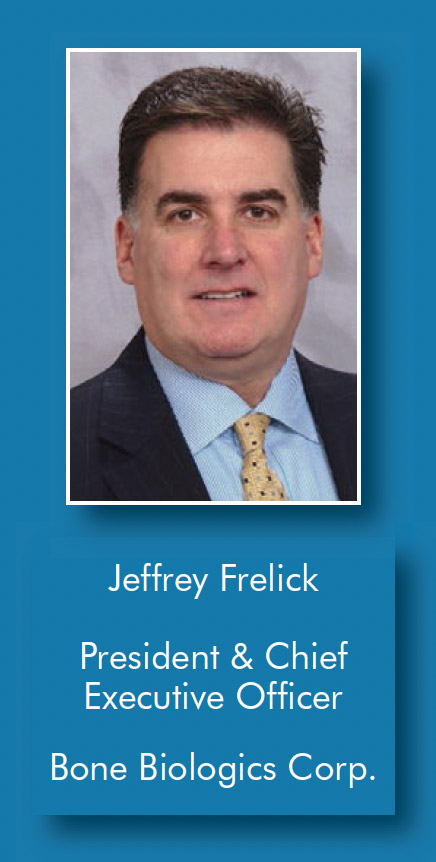
Drug Development & Delivery recently spoke with Jeffrey Frelick, President and Chief Executive Officer of Bone Biologics, to discuss the science behind NELL-1, progress in clinical trials, and the future of targeted bone therapies.

Could You Share a Brief Overview of Bone Biologics and the Unmet Clinical Needs You Are Addressing for “Hard Healers” in the Spinal Fusion Market?
A: Bone Biologics Corporation is developing differentiated orthobiologic products for the multibillion-dollar spinal fusion market. Building upon the NELL-1 protein – the subject of a significant number of research studies and publications in peer-reviewed journals – the Company is undertaking groundbreaking work involving regenerative medicine therapies with select strategic partners. While current development efforts with Bone Biologics’ bone graft substitute are focused on bone regeneration in spinal fusion, the Company also holds technology rights in trauma and osteoporosis indications. Smokers, diabetic, and/or obese patients are all known to be “hard healers”, e.g., those at higher risk for pseudoarthrosis because of a diminished biological capability to produce bone. This is an unmet clinical need because traditional orthobiologic solutions are unable to increase fusion rates in this population. Literature demonstrates that these “hard healers” are prevalent in the spine fusion population (smokers consisted of 32.5%, diabetics 18.8%, and obese 35.2% of lumbar fusion patients). The ongoing NB1 clinical study includes these hard healers.
What Sets Your Lead Product, NB-1, and Its Proprietary NELL-1 Recombinant Protein Apart From Traditional Orthobiologic Solutions?
A: Traditional orthobiologic solutions are inert scaffolds that are generally comprised of ceramics (the mineral component of bone) or allograft (the non-mineral, organic component of bone). The mechanism of action is passive and involves the process of osteoconduction in which bone cells migrate into the scaffold. In contrast, rhNELL-1 is an active component that is osteopromotive.
Osteopromotive NB1 rhNELL-1 plus inert carrier, increases bone formation and the incidence of spinal fusion compared to the inert carrier alone, which has been demonstrated in several publications and by independent studies.
How Does NELL-1’s Mechanism of Action Promote Targeted Bone Formation While Avoiding the Inflammatory Responses Associated With Other Approaches?
A: NELL-1’s mechanism of action (MOA) is well published. The MOA utilizes rhNELL-1 attachment to a cellular receptor followed by intracellular signaling that is targeted to bone formation. rhNELL-1 enhances bone formation by upregulating Runx 2, which is the master transcriptional activator of bone formation. Runx2 is only active in bone cells. Thus rhNELL-1 promotes a targeted increase in bone formation (e.g., only increases bone formation in the presence of bone) because it acts on the main regulator of bone formation, which is only available in bone cells [Truong 2007; Bokus 2008; Zhang 2011].
NELL-1 is not inflammatory as demonstrated in a rat bone study that used a positive control, BMP-2, that induces local inflammation. In contrast to BMP-2, treatment with NELL-1 elicited no inflammatory response (Shen 2013). Furthermore, co-treatment with both proteins demonstrated that NELL-1 significantly attenuated BMP-2 induced inflammation (Shen 2013). The marked reduction in inflammation was attributed to NELL-1 signaling pathway which does not induce inflammation and appears to also inhibit BMP-2 induced inflammation (Truong 2007; Bokus 2008; Zhang 2011; James 2016).
As a Clinical-Stage Innovator, Can You Share an Update on Your 30-Subject Pilot Study Currently Underway in Australia?
A: Bone Biologics remains committed to advancing the field of spinal surgery. What we have stated publicly is that we continue to progress through the recruitment phase of the NB1 study and hope to complete enrollment in the coming quarter or so, with an interim trial update around end of the year and 1 year data reported around mid-next year.
How Is the NB-1 Convenience Kit Designed to Integrate Into Existing Surgical Workflows Without Requiring Changes to Current Preparation Protocols?
A: Workflows include preparation of the graft material in the surgical field and delivery/ placement of the graft material in the surgical site. The placement of NB1 into a lumbar arthrodesis site is within and around the implant cage, which is the same as standard surgical practice that is used for any graft material. The delivery of NB1 is the same as has been routinely performed for allograft demineralized bone matrix (DBM) and DBX, both of which have been commercially utilized for over 20 years. The preparation of graft materials (including DBX/DBM) typically includes a hydration step. The only operating room preparation difference between NB1 and DBM/DBX is the addition of the rhNELL-1 to DBM/DBX, which is a process comparable to hydration. The specific step of adding contents of a drug vial to the bone graft has been commonly utilized for other orthobiologics. The process requires aspiration of the drug from a vial and addition to the medical device.
What Does Your Regulatory Pathway Look Like, Given the FDA’s Indication That NELL-1 Will Be Reviewed as a Device/Drug Combination Product?
A: Bone Biologics has completed PreSubmission discussions with the FDA that elucidated the regulatory pathway as summarized below:
- The primary review center is CDRH (medical devices). CDER (drugs) consults for review of the recombinant protein Chemistry, Manufacturing and Controls.
- Commercial approval will be after a PMA approval from FDA, which requires a pilot clinical study (analogous to a Phase I-II trial) followed by a pivotal clinical study (analogous to a Phase III trial).
- The pilot clinical study is ongoing in Australia and FDA has indicated that data generated from Australia is acceptable and will be reviewed prior to initiation of a pivotal clinical study in the United States.
Looking Ahead, What Is the Long-Term Expansion Potential for Your Therapies Into the Trauma and Osteoporosis Markets?
A: While we believe this rhNELL-1 platform technology has additional clinical applications in osteoporosis and trauma, we are currently singularly focused on spine fusion applications. As spine is one of the most challenging healing environments in the body, we feel that as we demonstrate success in our spine fusion studies, the additional clinical applications will get pulled along. For osteoporosis, there are publications that describe that rhNELL-1 improves bone formation using osteoporotic animal models.
Total Page Views: 16