

Issue:September 2026
FORMULATION FORUM - High Concentration Biologics for Injectable Drug Delivery
Key Points
- Formulating high-concentration biologics is technically challenging, but they are increasingly important for patient-friendly delivery.
- Increasing protein concentration can cause aggregation, high viscosity, particle formulation, and potential immunogenicity, which can impact safety and efficacy.
- The future of biologic delivery is moving toward smaller-volume, high-concentration subcutaneous injections.
By: Shaukat Ali, PhD, Sr. Director, Scientific Affairs & Technical Marketing, and Jim Huang, PhD, Founder & CEO, Ascendia Pharmaceutical Solutions
INTRODUCTION
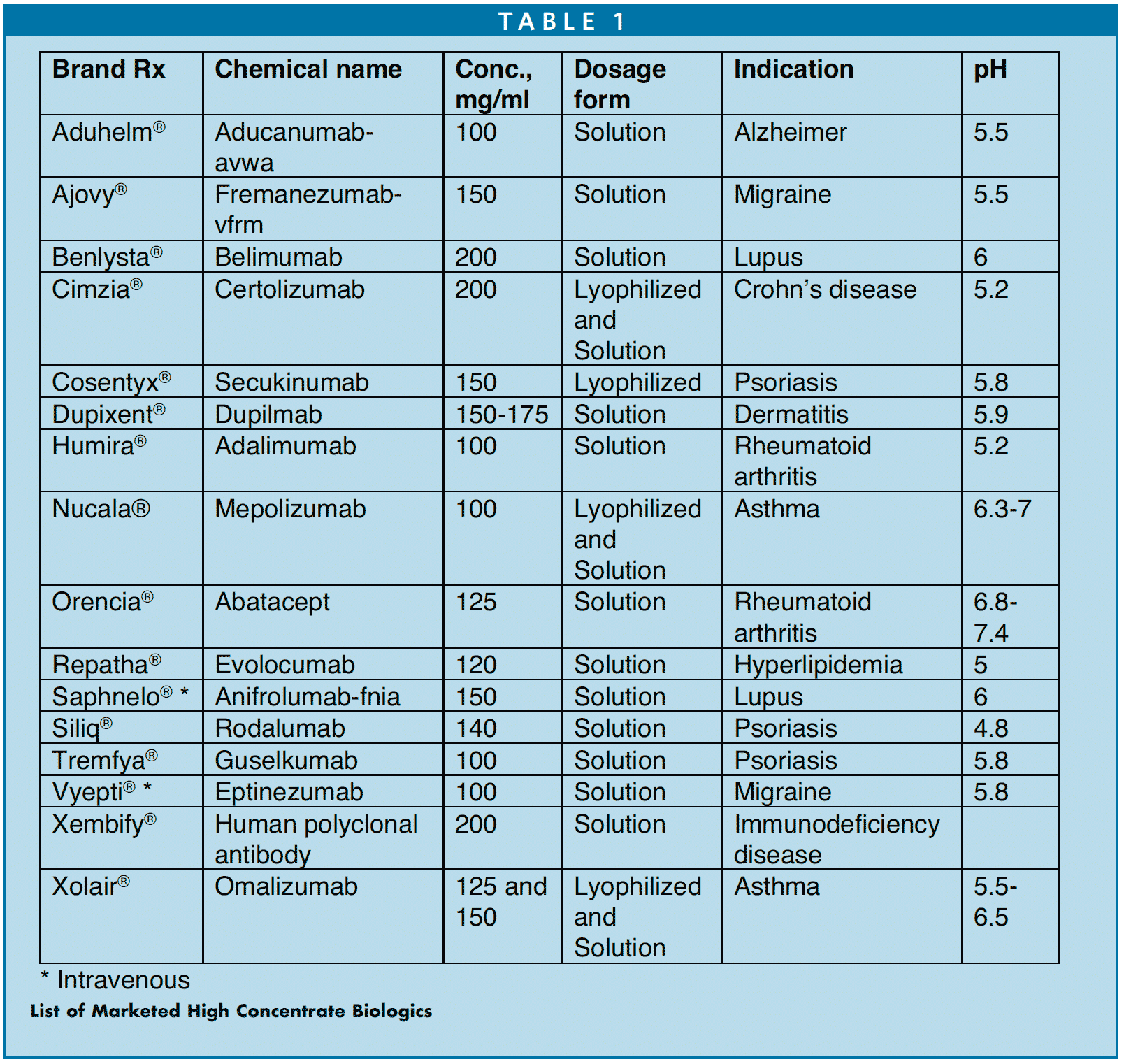
Continued interest in development of high dose proteins or biologics for injectables has changed the basic understanding of drug delivery.1 It sounds simple but is complex due to macromolecule irreversible aggregation, increased viscosity, particle formation, long term stability and safety, immunogenicity and efficacy of drug products. Derived from living cells, these biologics or proteins can be used for treatment of a variety of life-threatening diseases because of their specificity to certain target cells. Formulations requiring high dose when often administered intravenously (IV) by dilution are aimed at preventing aggregation of proteins. Higher drug concentrations in an alternative to IV in smaller injection volumes could alleviate injection site pain.2 Drug concentration at and above 100 mg/ml is categorized as high dose, whereas, at or above 250 mg/ml is categorized as ultra-high dose with injection volumes of about 2 ml.3 Other factors affecting the high dose proteins, most specifically, include their syringeability and injectability, which are governed by concentration of drugs in certain injection volumes. Determining the optimal dose and volume in early clinical phases is challenging. The high dose and less volumes of proteins/biologics are desired for higher clinical efficacy for treatment of certain disease such as rheumatoid arthritis, psoriasis, and neurological disorders, and preferably administered by subcutaneous (SC) than intramuscular (IM) or IV route of administration, primarily aimed at long term care and life cycle management, and to comply with patient compliance. Ghosh et al cites the number of drugs approved and of them, over 46 high concentration antibodies or biologics, 34 of them approved by subcutaneous (SC), and only 6 by intravenous (IV), and 1 by intramuscular (IM) route of administrations. This article also cites that majority of them approved as ready to use (RTU) and only 4 are approved as lyophilized drugs.4
FORMULATION DEVELOPMENT CHALLENGES WITH HIGH CONCENTRATION BIOLOGICS
High concentrated biologics prone to aggregate which may negatively impact product’s quality, safety, stability and efficacy, and also could lead to immunogenicity risk by SC.5 These challenges stem from formulation development to analytical and then continue during manufacturing. All these can be addressed by physical characterization tools and analytical methods. For biologics at concentrations 100 mg/ml or higher with limited supply of API, a 2-fold or higher concentrations are attained by centrifugation or diafiltration or tangential flow filtration. Increasing concentrations lead to increased protein-protein interactions, which could impact on conformational and/or colloidal stability and aggregation. Measured by differential scanning calorimetry (DSC) to quantify the free energy difference (DG) between natural and denatured proteins, this value dictates the confirmational stability; higher DG, means greater the stability of proteins or vice versa. Other parameters such as particle size can be measured for colloidal stability by dynamic light and static light scattering. Higher colloidal stability means the proteins maintain stability as a monomer in native state or partially denatured states due to repulsive or electrostatic interaction.2
Analytical challenges require rapid and simultaneous liquid chromatography and mass spectrometry methods for determination of degradants or any other impurities. An understanding of mechanism of proteins and excipients degradation and their interactions in solutions is equally important for selecting the appropriate bio-analytical methods for determining formulation stability. Polysorbates, for example, are known to form reactive oxygen species, may react with proteins to cause significant degradation. In cases like these, LC-MS could be used to quantify the chemical degradants. Physical degradants like conformational changes, denaturation and protein surface adsorption can also be detected by appropriate techniques including DSC and DLS. Other complementary techniques such as differential scanning fluorometry (DSF) can also be used to understand thermal stability, NMR for structural characterization, FTIR for examining the amide I and II bonds of proteins to probe the secondary structure, while circular dichroism (CD) can be used to understand the secondary and tertiary structures of proteins.6
Manufacturing challenges stem from lack of appropriate equipment and/or facility. Therefore, a clear guidance is required for scale up and manufacturing high concentration biologics. For example, vessel size with appropriate shaft or mixer can all play an important role for high concentration formulations. Overly mixing time can increase the chances for degradation of biologics, especially, at higher concentrations. Thus, the real emphasis is to reduce processing time by maximizing flux rates under controlled temperature and pressure to further minimize the risks for potential degradation in either aqueous or non-aqueous manufacturing media.6
Processing techniques such as spray drying, solvent extraction, dehydration, the ionic liquids among others are used for manufacturing non-aqueous based suspensions. Spray drying, for example, is applied for creating small spherical fine powder with 5-30 microns in size with the intend to provide better shear thinning and injectability and to protect moisture sensitive drugs. The dried powder is then suspended in non-aqueous injectable non-aqueous vehicle potentially in high concentrations (100 mg/ml – 250 mg/ml) with desired viscosity (<20 cP or less) to help improve stability by reducing aggregation and minimizing risks for inherent hydrolytic degradation. Low temperature solvent extraction and dehydration technique can be used for thermally labile drugs. This anti-solvent technique results in an amorphous powder following precipitation wherein drug particles are embedded in polymeric matrix, allowing excellent controls over particle size, morphology, and surface characteristics with the abilities to maintain colloidal stability in non-aqueous suspensions. Shire et al developed a low shear high concentrated biologic suspension by particle engineering of a protein for subcutaneous injection through small gauge needle by reducing the injection force.7
INJECTABILITY OF HIGH CONCENTRATION BIOLOGICS
Jayaprakash et al. evaluated range of highly viscous liquids using creative ways to reduce 7-fold injection force.8 This significant reduction was calculated on buoyancy-driven eccentricity with aim to control the nominal pressure. The authors used these findings to develop a double-barreled syringe to apply for range of high concentration biological injectables. This low-cost injectable technology is ideally suited for highly viscous SC formulations using conventional medical syringes. Usach et al. examined the SC injectables drugs with reference to pain sensation at the injection site.9 They proposed that maximum volume of an SC injection is 1.5 ml with exception of no more than 4 ml if necessary as higher volume is typically associated with the injection site pain. Berteau et al. evaluated different viscosity in SC to monitor the pain at injection site and observed that high viscous liquids with viscosity 15-20 cP caused less pain and were easily tolerated as opposed to those having viscosity 1 cP or 8-10 cP.10 In another study, Fransson et al. investigated the effect of pH and buffer strength and found that at neutral pH 7 and buffer strength as low as possible, the SC formulation was more tolerated with reduced pain upon injection.11 Phosphate and citrate buffers with concentrations 10 mM and 7.3 mM, respectively, caused less pain at the injection site.9 It is, therefore, imperative to maintain pH and buffer strength, and keep low volume when administering SC, especially, for dosing high dose proteins or biologics. Those SC administrations are typically used in 2 ml volume in prefilled syringe (PFS) or autoinjector (AI). Low volume, high dose SC formulation poses some challenges and to overcome those, a few approaches are used including (i) adding viscosity reducing agent to target drug concentrations as low as 100 mg and as high as 250 mg/ml (ii) use novel technologies to deliver the protein concentration as high as 250 mg/ml or higher, and (iii) use a large delivery device with the capabilities to delivery 2 ml to 40 ml volume. In cases where it is critical to achieve the desired relative bioavailability (rBA), a 2 ml PFS or AI is recommended as compared to large volume delivery device, which is needed for high dose to yield low rBA. Higher volumes > 5 ml/min may pose the challenges in SC, for example, with hyaluronan, a highly viscous liquid that breaks down to hyaluronic acid (HA) by rHUPH20. Thus, maintaining the physiological pH and ionic buffer strength plays an important role in development of SC formulations.
Currently the SC approved drugs belong to 2 categories: low volume (< 2ml) with rapid injection (0.5 ml/min) and high volume >2 ml) with slow injection (< 5 ml/min). Low volume and rapid SC injection meet the patient compliance.
EXCIPIENTS FOR HIGH CONCENTRATION PROTEINS & BIOLOGICS
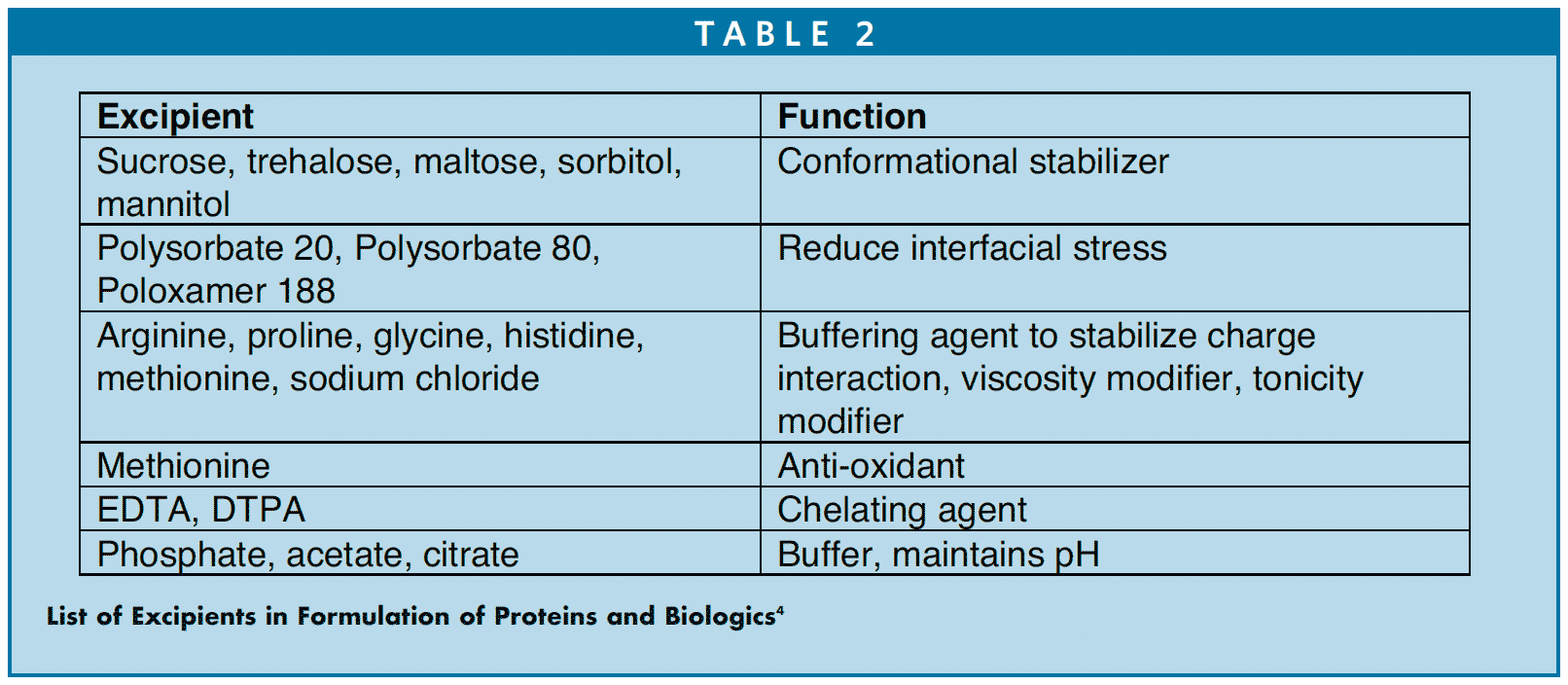
A number of key ingredients are used to formulate high dose proteins and biologics. Those excipients belonging to different class and type, help stabilize the formulations. These ingredients are often used to counter the intermolecular interactions arise from van de Waal’s forces, hydrogen bonding, hydrophobic and electrostatic forces. These include amino acid salts like arginine hydrochloride, histidine hydrochloride, lysine hydrochloride, and inorganic salts like sodium chloride, sodium sulfate, sodium acetate and their utilities in reducing the viscosity of high concentration drug products.
Ghosh et al. lists all the excipients with different functionalities.4 Citing only those, such as the tonicity modifiers like sucrose, sodium chloride and others are added to maintain the blood osmolality of 300 mOsm/kg with the optimal osmolality range of isotonic solution not greater than 600 mOsm/kg to prevent pain.9 Sucrose is commonly used as a tonicity modifier for 18 out of 46 high concentration marketed biologics. Citing a few examples, Tragarzo® and Vabysmo® both contain sucrose and sodium chloride. There are several examples of marketed drugs containing sucrose, sodium chlorides along with trehalose, and amino acids. Xolair®, Aduhelm®, Evekeeza®, for examples, contain arginine, most commonly amino acid, use as stabilize to prevent aggregation of high concentration biologics. Interestingly, a majority of high concentration approved drugs contain polysorbate 80, 10 contain polysorbate 20, 3 contain poloxamer 188 as solubilizers or stabilizers. On packaging, it’s worth noting that majority of the products are approved in the vials except 10 in autoinjectors and 5 in pre-filled syringes.3
NOVEL TECHNOLOGIES FOR HIGH & ULTRA-HIGH CONCENTRATED BIOLOGICS
HILOPRO® technology is used to achieve the drug concentrations as high as 250 mg/ml by reducing the viscosity of mAbs liquid < 20 cP by adding two ingredients, nicotine and tryptophane in 20 mg or less.12 Comera Life Sciences, for example, utilized caffeine to reduce the viscosity 37 cP or less to achieve the concentration as high as 200 mg/ml of two mAbs: ipilimumab and infliximab.13 Avantor used bis acetyl lysine and propionyl serine to reduce viscosity and increase concentration and also to improve shelf life and stability of proteins. Xeris Pharmaceutical utilized its Xeriject spray drying and particle engineering technology to achieve crystalline suspensions with concentrations as high as 400 mg/ml, while Lindy Biosciences used its particle engineering microglassification technology in organic solvents to achieve spherical dense, stable particles with drug concentrations as high as 300 mg/ml and 600 mg/ml. Elektrofi, on the other hand, used its Electroject technology to achieve the ultra-high drug concentrations; 500 mg/ml and 700 mg/ml as microparticle based suspensions with greater stability by reducing protein-protein interactions and maintaining it injectability. Seran Bio used its proprietary spray drying technology to achieve protein concentrations as high as 400 mg/ml by particle densification to minimize glide force. Jons et al. used novel polyacrylamide-based surfactant in spray drying to increase the glass transition of particles to help improve the mechanical properties for robust suspensions and injection forces for syringeability.14 ENHANZE®, a subcutaneous proprietary technology by Halozyme, depolymerizes hyaluronan enzyme to improve mobility of protein solutions, thus allowing much greater volumes (ca.5-10 ml) of high concentration therapeutic doses of mAbs including Herceptin Hylecta® (trastuzumab and hyaluronidase, Phesgo® (pertuzumab, trastuzumab and hyaluronidase) among others.15
IONIC LIQUIDS FOR HIGH CONCENTRATION BIOLOGICS
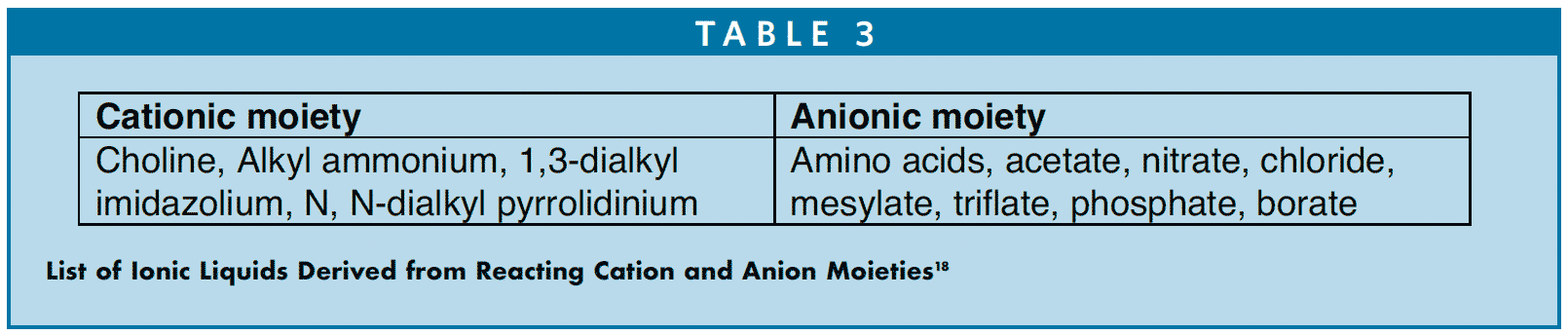
Since discovery of ethyl ammonium nitrate as IL in 1914 by Paul Walden, ILs have gained universal recognition.16 Ionic liquids (ILs) are considered environmentally green solvents, derived from salts and exist as liquid at temperature below 100ºC Because of the abilities to dissolve challenging poorly soluble molecules, they have been used in formulation and drug delivery in modern times. Formed by combining the cation and anion entities, ILs are stable, non-flammable and act as non-volatile solvents for dissolving difficult molecules.
ILs utilities in formulation of small and large molecules and biologic are also noteworthy. For instance, ILs have been known to mitigate protein-protein interactions to formulate antibodies at an ultra-high concentration as high as 200 mg/ml with viscosity <20 cP, stable at 37ºC, and ideally suited for SC administration leading to improved bioavailability.17 Since many of the biologics and antibodies are approved at low dose concentrations (cs. 50 mg/ml or less), preferably administered via intravenous infusion, ILs open doors for many biologics requiring high doses with low injection volumes by SC. Zinbryta®, for instance, is approved in pre-syringe at 150 mg/ml, whereas, Benlysta® is approved at 200 mg/ml in autoinjectors for subcutaneous administration. Higher concentrations can lead to higher viscosities, thus finding a balance to minimize aggregation by decoupling protein-protein interactions, degradation and denaturation is an optimal requirement for manufacturing biologics.17
Protein aggregation in biologics remains challenging, especially at high concentrations. Those challenges can also be overcome by genetic engineering and/or chemical modification of “aggregation prone” amino acid sequences to alleviate protein-protein interactions. Chemical modifications of biologics through PEGylation, acylation and cyclization have been used to improve stability and help increase immunogenicity and reduce activity. Excipients like sugars, amino acids, solubilizers like polysorbates, are used to protect proteins on storage. ILs offer an exceptional stabilization property by providing a charge shielding effect around drug molecule, thereby, reducing aggregation and denaturation.
Banerjee et al. evaluated CAGE, an IL derived from choline and geranyl acid as salt, in oral insulin formulation and found that it was absorbed through intestinal membrane via modulational of intestinal mucus properties.19 In another study, Sundaram et al. used ILs derived from choline and amino acids for oral delivery of insulin and found that depending upon concentrations of amino acids used, some amino acids have more profound effect on secondary structure of insulin and other ILs derived from choline-glycine and choline-alanine formed appreciable amounts of aggregates at high concentrations.20 Tien and Kayser observed that choline-glycine IL at concentration of 10 mM or less, showed highest potential due to enhanced stability while preserving the conformation stability.21
Dhiman et al. evaluated an IgG antibody in ILs comprised of choline (Chol) and different counter ions such as acetate (Ac), chloride (Ch), dihydrogen phosphate (Dhp), and found that thermal stability was improved at 0.5-2.5 mM in the order: Chol:Ac > Chol-Ch > Chol-Dhp > IL free.22 Increasing the concentration of Chol-Ac and Chol-Ch increased the melting to 8ºC and 80ºC, respectively, from 76ºC. Long term stability also improved significantly at 2 mM and 2.5 mM of all ILs. Taken collectively, ILs comprised of Cho-Ac and Chol-Ch showed an excellent long-term stability. Reslan et al. examined the stability of trastuzumabat 20 mg/ml in an IL comprised of Chol-Dp and compared with Herceptin® at 60 mg/ml at 25%, 40% and 53% of Chol-Dhp comprised of 5.5 mM histidine, 6.4 mM histidine chloride monohydrate, 144 mM trehalose dihydrate and 10 ppm polysorbate 20.23 In all cases, the thermal stability in Chol-Dhp was significantly greater, and adding the excipient further enhanced the thermal stability.
In a recent study, Alkhawaja et al. investigated atezolizumab (Amab), a highly susceptible antibody prone to aggregation and instability due to lack of an oligosaccharide moiety, at concentrations 300 mg/ml (30%), 500 mg/ml (50%), 700 mg/ml (70%) and 800 mg/ml (80%) in Tris HCl buffer and in ILs each comprised of choline-valine (Chol-Val) and choline-glycine (Chol-Gly).24 The data suggests that Chol-Val at 30% and 50% stabilized the antibody on incubation over 7 days period as represented by no or insignificant changes in particle size distribution and/or polydispersity index (PDI) but showed a significant degradation at higher concentrations 70% or above. On the other hand, Chol-Gly IL showed much greater colloidal stability of Amab on incubation at concentrations as high as 70% as observed by no change in particle size distribution and/or PDI over 7 days period at room temperature. Tris HCl buffer exhibited a similar colloidal stability as Amab in Chol-Val at concentrations as high as 50% and was independent of temperature.
ASEPTIC SPRAY DRYING FOR HIGH CONCENTRATION BIOLOGICS
Aseptic spray drying can be used to manufacture small and large molecules as well as biologics including vaccines, proteins, peptides, antibiotics for IV, IM and SC dosages. Fast drying with short residence time during process gives an edge to many temperature sensitive molecules like vaccine, proteins and biologics to yield dry powder in aseptic and non-aseptic conditions. Aseptic spray drying was first used in 2006 for Exubera® VR by Pfizer for an insulin inhaled powder. Other examples include Verity Pharmaceutical’s triptorelin pamoate (Trelsatar LA) as intramuscular microsphere suspension for prostate cancer, lanreotide acetate (Somatuline LA microspheres by Ispen, RaplixaVR, a biologic for topical formulation by ProFibrix BV and levodopa (Inbrija) by Acorda Therapeutics.25
In aseptic process, the equipment is maintained in sterility with convenient drying throughout the production run. In a recent article, Ali and Huang described the use of aseptic spray drying for production of amorphous solid dispersions for improving the bioavailability of poorly soluble drugs.25 The challenges, however, in aseptic spray drying stems from maintaining the sterilization and product handling (filling vias) during manufacturing in the cleanroom environment (ISO 5, 6 and 7). Furthermore, during aseptic manufacturing the liquids and gas entering and leaving the drying zone must be adequately filtered. This aseptic powder derived from the process, can be conveniently filled and easily scalable as opposed to lyophilized powder filled vials, which is time consuming and costly.
BIOAVAILABILITY OF HIGH DOSE BIOLOGICS
As compared to intravenous (IV) route, the biologics possess lower bioavailability by SC route, stemming from large molecular weight, solubility. pH, aggregation, permeation and poor transport. The multilayered skin comprised of epidermis, dermis and hypodermis provide a barrier to entry of drug molecules in adipose tissues. Lymphatic circulation and systemic circulation both account for bioavailability. Biologics and large molecules with molecular weight 16 kD or larger such as antibodies are absorbed through lymphatic capillaries and those with low molecular weight 1 kD and under, are absorbed by blood capillaries.26 Thus, the rate of absorption through lymphatic systems depends upon concentration, molecular weight, pH, ionic strength, viscosity, hydrophilicity, diffusivity and injection volume. Yang et al. evaluated pharmacokinetic (PK) profile of high concentration antibody at 200 mg/ml crystalline infliximab suspension comprised of 10% ethanol, 10% PEG 3350, 0.1% polysorbate 80, 50 mM trehalose in 50 mM sodium phosphate buffer at pH7 with viscosity <30 cP and compared with solution in IV solution vs crystalline SC suspension.27 While the Cmax and AUC0-t were comparable for both IV solution and SC crystalline suspension (95 mg/ml vs 112 mg/ml; and 42.8 mg.h/ml vs. 37.5 mg.h/ml)), respectively, terminal half-life (t½) for suspension was 2-fold higher than solution (779 h vs. 390 h).
SC route is highly patient-centric and can be accommodative by adjusting the dosing at certain sites. For example, with a few exceptions, a delivery rate of 0.5 ml/min in abdomen can be administered for volumes as large as 5 ml or higher. In fact, Mathaes et al. from a study concluded that SC injection volume as high as 5 ml is possible by using special injection technique and devices, especially, for the high dose therapies.28 Increasing concentrations, hydrophobicity of biologics, further increases the risk for precipitation and, hence, yields lower bioavailability. All the uncertainties coupled with lack of a reliable in vivo model could lead to poor correlation between human clinical and animal preclinical data due to differences in hypodermic structures, physiology and the extent of catabolism. For instance, SC preclinical data in rats, monkeys and min pigs all lack a good correlation with human clinical bioavailability data.
CONCLUSION & FUTURE PERSPECTIVE
High concentration and low volume injections have been the subject of continued interest to meet the patient compliance. It also brings challenges in developing and dispensing the formulations due to high viscosity, attenable stability and also ease of manufacturability. The latter could lead to major issues in production for clinical and later in commercialization due to lack of adequate facility and equipment if it was not tackled in very early stage of development. With some exceptions for high volume SC formulations, the “fit for purpose” reusable syringe or infusion pump can be used in early stage until the drug device combination product ready for clinical stages. There are few tools available to predict the in vitro release and stability of biologics. Pion’s SCISSOR (subcutaneous injection site stimulator), for example, can be used in early phase or preclinical stage to assess the risk associated with precipitation and hence the release characteristics of biologics, whereas, the SILCS (site identification by ligand competitive saturation) can be used to understand the excipient interactions and stabilization of biologics. While other tools like spatial charge map (SCM), a silico-based model can identify the high viscous polymers by computing the electrostatic charges around the biologic surface, mAb aggregation prediction tool (MAPT) can predict charge aggregation as function of pH.3 Prefilled syringe and cartridge with dual chambers enable reconstitution of lyophilized biologics with the diluent to enhance stability and shelf life. These innovative tools are as important as the regulatory guidelines for developing right devices, packaging and needles with relatively larger gauges (23-26) for efficient delivery of high viscous formulations. All these basic understandings are important to improve patient safety and compliance for treatment of chronic diseases and life cycle management.
Ascendia with its expertise in high concentration and high viscous formulations (solutions and suspensions) of small and large molecules and biologics and with its state-of-the-art manufacturing facility equipped with fill finish capabilities of vials, prefilled syringe and cartridges, can help expedite the development in the clinical stages of drug products in the ISO 5, 6 and & 7 (Grade A, B and C) clean rooms. Biologic therapeutics, for example, risankizumab (Skyrizi®), first developed in prefilled syringe (90 mg/ml) and later launched in an autoinjector cartridge (150 mg/ml) in conventional excipients or novel ionic liquids, can be manufactured by Ascendia’s aseptic process to fill high concentration liquids in vials, prefilled syringes and cartridges using peristaltic and piston pumps. Ascendia with its aseptic spray drying capabilities, can help expedite the development of small and large molecules, and high concentration proteins and biologics in ready to use vials in ISO cleanrooms.
REFERENCES
- R. G. Strickley and W. J. Lambert, A review of formulations of commercially available antibodies, J. Pharm. Sci., 2021, 110, 2590-2608.
- B. Johnson and A. Rostovtsev, High concentration biologic formulations: Challenges and solutions, Drug Discovery and Development, June 29, 2017.
- I. Ghosh, D. Miranda, T. A. Kulkarni, S. Deodhar, S. Tummala and D. Bindra, Development roadmap for subcutaneous delivery of high dose biologics – high concentration formulation, analytical comparability and patient preference considerations for large volume devices, J. Pharm. Sci., 2025, 114, 103914.
- I. Ghosh, H. Gutke, M. E. Krause, R. Clemens and R. S. Kashi, A systematic review of commercial high concentration antibody drug products approved in the US: formulation composition, dosage form design and primary packaging considerations, MABS, 2023, 15, 2205540.
- W. Wang and S. Nema, and T. Teagarden, Protein aggregation – mechanism, detection and control, Int. J. Pharm., 2010, 390, 89-99.
- T. A. Khan, D. Bhattacharya, T. R. Christian, M. Holstein, X. Hua, R. James, B. Jiang, A. Josowitz, D. Laiacona, S. Mehta, A. More, E. Mullen, M. Myers, B. Ricart, T. Rickenbacher, Y. su and N. K. R. Yaragudi, Adv. Drug Deliv. Rev., 2026, 235, 115885.
- S. J. Shire, Z. Shahrokh and J. Liu, Challenges in the development of high protein concentration formulations, J. Pharm. Sci., 2004, 93, 1390-1402.
- V. Jayaprakash, M. Costalonga, S. Dhulipala, K. Varanasi, Advanced Healthcare Materials,
- I. Usach, R. Martinez, T. Festini, and J. S. Peris, Subcutaneous injection of drugs: literature review of factors influencing pain sensation at the injection site, Adv. Ther. 2019, 36, 2986-2996.
- C. Berteau, O. Filipe-santos, T. Wang, H. E. Rojas, E. Granger, and F. Schwarzenbach, Evaluation of the impact of viscosity, injection volume, and injection flow rate on subcutaneous injection tolerance, Med. Devices (Auckl), 2015, 8, 473-484.
- J. Fransson and A. Espander-Jansson, Local tolerance of subcutaneous injections, J. Pharm Pharmacol., 1996, 48, 1012-1015.
- Bhami’s Research: https://bhamilab.com/index.php/hilopro.
- Y. Zeng, S. Naik, T. Tran, P. Wuthrich, N. Muni, and R. P. Mahoney, Preclinical pharmacokintetic study on caffeine as an excipient for monoclonal antibody formulations, J. Pharm. Sci., 2023, 112, 2933-22937.
- C. K. Jons, A. N. Prossnitz, N. Eckman, C. Dong, A. Utz, and E. A. Apple, Ultrahigh concentration biologics therapeutics enabled by spray drying with glassy surfactant excipient, Sci. Transl. Med., 2025, 17, eadv6427.
- I. Ghosh, S. Deodhar, H. Gutke, S. Sridharan, and D. Bindra, Subcutaneous drug delivery of high concentration antibody products – part 2: formulation, device options, and clinical bridging strategies for patient-centric commercial presentations, MABS, 2026, 18, 2680773.
- Z. Lei, B. Chen, Y. M. Hou, and D. R. McFarlane, Introduction: Ionic Liquids, Chem. Rev., 2017, 117, 6633−6635.
- A. Ramesh, M. Erdi, S. Zhang, V. C. Suja, S. Mitragotri and B. Sing, J. Controlled Release, 2025, 388, 114295.
- M. Guncheva, Role of ionic liquids on stabilization of therapeutic proteins and model proteins, Protein J., 2022, 41, 369-380.
- A. Banerjee, K. Ibsen, T. Brown, R. Chen, C. Agatemor, and S. Mitragotri, Ionic liquids for oral insulin delivery, Prc. Natl. Acad. Sci., 2018, 115, 7296-7301.
- V. Sundaram, R. N. Ramanan, M. Selvaraj, R. Vijyayraghavan, D. R. MacFarlane and C. W. Ooi, Enhanced structural stability of insulin aspart in cholinium aminoate ionic liquids, Int. J. Bio. Macromol. 2022, 208, 544-552.
- S. Tien and V. Kayser, Ionic liquids as stabilizers for therapeutic protein formulations: a review of insulin and monoclonal antibodies, Biophy. Rev., 2025, 17, 89-101.
- D. Dhiman, M. Bishi, A. P. M. Tavares, M. G. Freire, and P. Venkatesu, Cholinium based ionic liquids as efficient media for improving the structural and thermal stability of immunoglobulin G antibodies, ACS Sustain Chem. Eng. 2022, 10, 5404-5420.
- M. Reslan and V. Ranganathan, D. MacFarlane, and V. Kayser, Choline ionic liquid enhances the stability of Herceptin (trastuzumab), Chem. Commun. 2018, 54, 10622-10625.
- B. Alkhawaja, F. Al-Akayleh, S. Daadoue, N. Alkhawaja, G. AlDabet, J. Nassereden, M. Bustami, N. Qinna, M. Al-Remawi, and A. G. watts, Insight into the colloidal and structural stability of atezolizuman with nonpolar amino acid-based ionic liquids under multiple stresses: Phase two, RSC Advances, 2026, 16, 5548-5560.
- S. Ali and J. Huang, Aseptic spray drying for poorly soluble molecules, J. Nanomedicine, 2026, 9, 1076.
- M. Viola, J. Sequeira, R. Seica et al., Subcutaneous delivery of monoclonal antibodies: how do we get there? J. Control. Rel., 2018, 286, 301-314.
- M. X. Yang, B. Shenoy, M. Disttler, R. Patel, M. McGrath, S. Pechenov and A. I. Margolin, Crystalline monoclonal antibodies for subcutaneous delivery, proc. Natl. Acad. Sci., 2003, 100, 6934-6939.
- R. Mathaes et al., Subcutaneous injection volumes of biopharmaceuticals – Pushing the boundaries, J. Pharm. Sci., 2016, 105, 2255-2259.

Shaukat Ali, PhD, Sr. Director, Scientific Affairs & Technical Marketing

Jim Huang, PhD, Founder & CEO, Ascendia Pharmaceutical Solutions
Total Page Views: 20