

Issue:March/April 2026
POLYMACROCYCLIC PEPTIDES - Engineering Structure for Function in Next Generation Therapeutics
Key Points
- Peptides occupy the space in between. They inherit the sequence programmability of proteins, yet can be engineered to approach the permeability and stability of small molecules. They present more binding surface than small molecules and, unlike large proteins, can sometimes be tuned to cross membranes, occupy shallow clefts, or clamp onto protein surfaces. The key challenge, and opportunity, is to sculpt peptide architecture so that shape and chemistry are presented to the target in the right place, at the right time, and for long enough to matter clinically.
INTRODUCTION
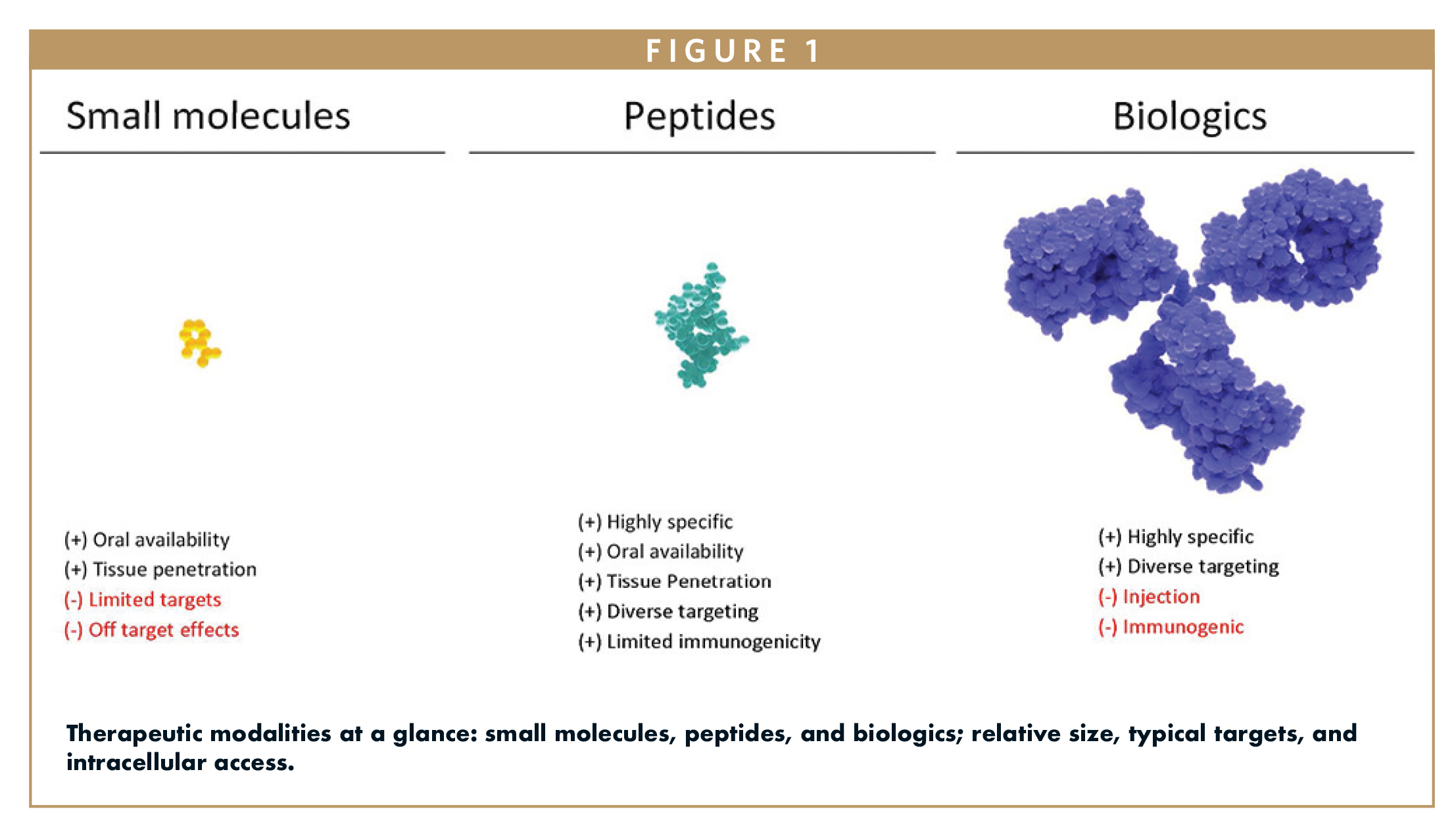
The modern therapeutic toolbox has been dominated by two poles. Small molecules excel at oral dosing, distribution, and manufacturing, and they are superb when a target exposes deep, well defined pockets. Yet their very compactness, typically <600 Daltons, constrains the surface area they can contact, making it difficult to modulate large, relatively flat protein–protein interfaces (PPIs) or to discriminate among closely related binding epitopes.
At the other pole, biologics (antibodies, proteins, and related modalities) bring tremendous shape complementarity and affinity to accessible extracellular targets. But macromolecular size, charge, and trafficking obstacles limit efficient penetration into cells, which is why biologics have historically focused on extracellular or lumenal proteins; cytosolic targets remain challenging without specialized delivery tricks.
Small molecules remain the workhorses of medicine, from statins, painkillers, antibiotics, to kinase inhibitors, but they rely on highly complementary pockets and well behaved absorption, distribution, metabolism, and excretion. When the thermodynamic currency of binding is spread over hundreds of square angstroms, as in many PPIs, small molecules often cannot make enough contacts without becoming too bulky or polar to be “drug like”. Biologics, by contrast, bring tremendous shape complementarity and affinity to accessible extracellular epitopes, but struggle to reach intracellular targets at pharmacologically useful concentrations.
Peptides occupy the space in between. They inherit the sequence programmability of proteins, yet can be engineered to approach the permeability and stability of small molecules. They present more binding surface than small molecules and, unlike large proteins, can sometimes be tuned to cross membranes, occupy shallow clefts, or clamp onto protein surfaces. The key challenge, and opportunity, is to sculpt peptide architecture so that shape and chemistry are presented to the target in the right place, at the right time, and for long enough to matter clinically.
STRUCTURE EQUALS FUNCTION: FROM BIOLOGY 101 TO DRUG DESIGN
One of the first durable lessons in biology is that structure determines function. Proteins fold; the fold creates pockets, surfaces, and defined electrostatics; those features control catalysis and recognition. Drug design is no different: a therapeutic’s topology, the way its atoms are organized in space, often dictates its fate. Yet most peptide discovery platforms today search libraries that explore sequence far more than architecture. Many screens limit candidates to a single macrocycle or a narrow set of constrained motifs, which restricts the exploration of shape space.
Consider insulin – the clinically used hormone comprises two chains (A and B) held by disulfide bonds. Efforts to collapse insulin into a single chain receptor agonist underscore how hard it can be to recapitulate a multi segment architecture with fewer connections. The broader point is that architecture is causal and limiting architecture up front can limit what biology you can access. However, there are two root cause problems in peptide therapeutics:
Problem 1: Searching Astronomical Sequence Space : High throughput selection technologies have transformed discovery. mRNA display covalently links a nascent peptide to its mRNA via a puromycin “bridge,” enabling in vitro selections over libraries that can exceed 10¹² distinct sequences. Phage display genotypically couples peptides to bacteriophage coat proteins (commonly pIII or pVIII, two of the viral “appendages”) for iterative biopanning. DNA encoded libraries (DELs) extend the barcode concept to small molecules and peptidomimetic search spaces. Each platform makes it possible to sift through large diversity because the barcode (DNA/RNA) can be amplified from an incredibly small signal.
In each display system, the barcode is the engine: it ties genotype to phenotype and allows exponential amplification of faint signals by PCR or phage replication. That same barcode, however, can perturb physics at the interface. In mRNA display and DELs, long, polyanionic nucleic acids can electrostatically repel negatively charged patches on targets or nonspecifically attract basic surfaces. In phage display, the per virion copy number, orientation, and spatial crowding on the capsid can alter the apparent fitness of certain peptide topologies versus their behavior as free molecules.
Problem 2: Conformational Control (the “Floppiness” Problem): Linear peptides are intrinsically disordered. Without constraints, they can adopt many conformations, only a small fraction of which align with the bioactive pose, lowering apparent affinity and making them susceptible to proteolysis. Chemistry has long fought back with macrocyclization, historically via disulfide bridges, then with lactams, ring closing metathesis, click reactions, and staples. These strategies often stabilize a single ring. They improve stability and sometimes permeability, but they inherently limit architectural diversity because only a few bond forming reactions are both reliable and library compatible across many sequence contexts.
NATURE’S BLUEPRINT: ENZYMES THAT BUILD RIGID, BIOACTIVE SCAFFOLDS
Nature points to a practical way forward. Ribosomally synthesized and post translationally modified peptides (RiPPs) are encoded as linear precursors and then sculpted by tailoring enzymes into compact, diverse scaffolds with exceptional stability and activity. Among the most celebrated are lantibiotics, such as nisin, which uses multiple thioether (sulfur-to-carbon) bridges to achieve food grade stability and long-term potency. Beyond lanthipeptides, the radical S adenosyl L methionine (rSAM) superfamily forges many unique radical-based transformations in diverse contexts, including generating thioethers in peptide contexts.
Two families of thioether rich RiPPs illustrate how chemistry grants stability. Lanthipeptides (eg, nisin) are built by first dehydrating serine and threonine residues to dehydroalanine/dehydrobutyrine and then adding generate the thioether through a Michael-addition via a cysteine residue to form lanthionine/methyllanthionine bridges; bonds that resist reduction where disulfides would not. Sactipeptides/ranthipeptides use rSAM enzymes to forge C-S bonds directly to aliphatic carbons, again delivering robust thioether linkages.
A standout example is PapB, an rSAM RiPP maturase that installs thioether cross links between Cys and Asp/Glu residues. In its native substrate PapA, PapB introduces six thioether linkages, and in-vitro studies show striking substrate promiscuity: PapB accepts a range of Cys Xₙ Asp (or Cys Xₙ Glu, were Xₙ is a number of additional amino acids) motifs, can form nested and in line cross links, and tolerates unnatural amino acids at the cross linking positions. These features suggest that enzyme installed linkages could decouple sequence from topology, enabling many ring architectures beyond what chemical methods comfortably deliver.
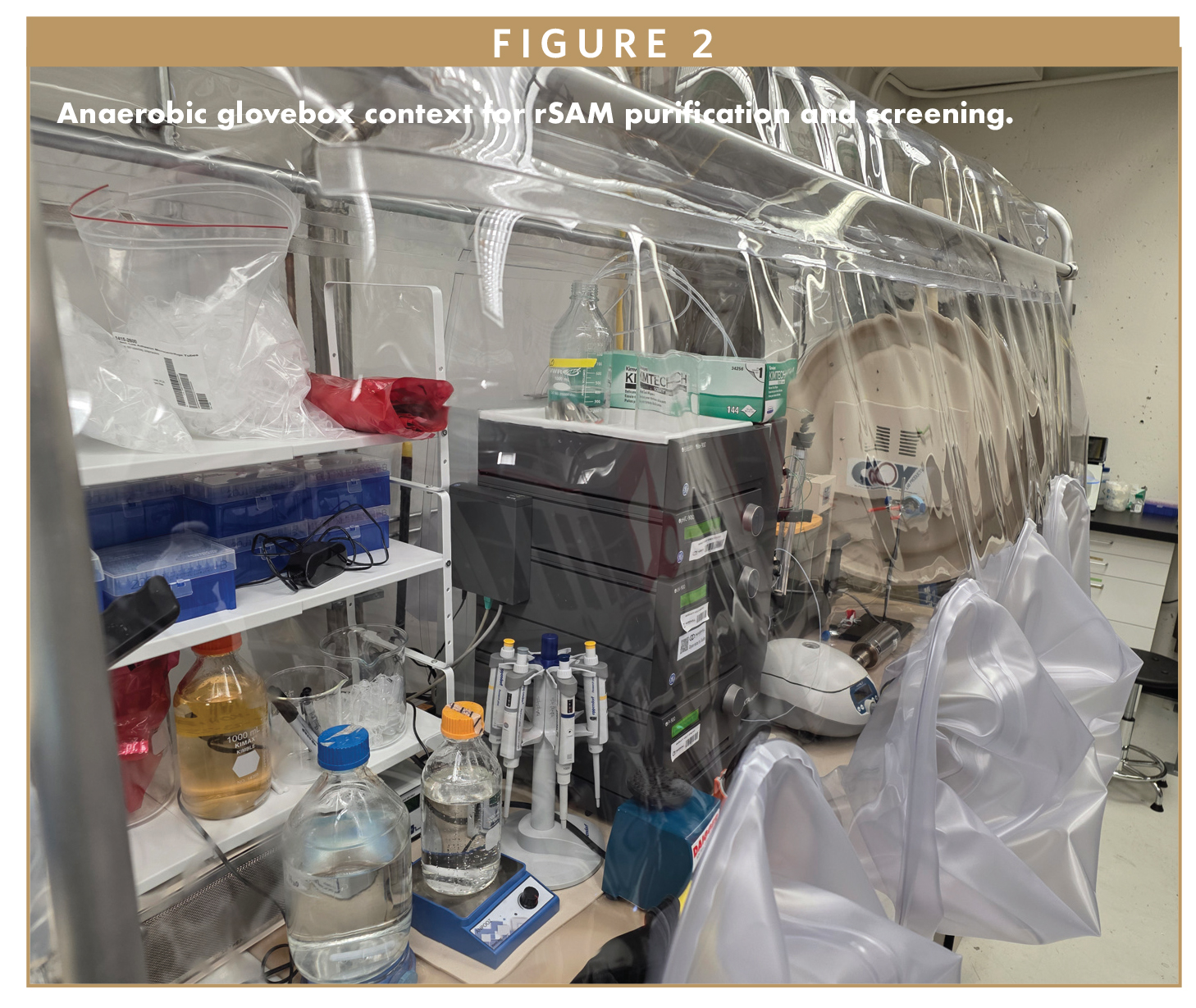
There is a catch: most rSAM enzymes are oxygen sensitive because their [4Fe 4S] clusters are labile. Practical deployment at discovery scale therefore requires anaerobic handling and careful attention to reducing systems during expression, purification, and catalysis.
WHAT IT TAKES TO EXPLOIT ENZYMATIC MACROCYCLIZATION AT HTS SCALE
To translate these natural capabilities into a discovery engine, three requirements must be met: (1) Enzyme tolerance to library diversity, so that billions of unique sequences with cross link motifs can be processed, (2) Evidence of cyclization in HTS contexts, demonstrating that cross links can be installed on constructs used for phage and mRNA display, and (3) Fast topology confirmation, so that hits can be prioritized by architecture as well as sequence.
For topology confirmation, mass spectrometry can diagnose the characteristic 2 Da mass loss per thioether, judicious isotopic labeling, and protease mapping can rapidly fingerprint ring count and connectivity. On target functional triage should begin early (eg, receptor activation assays) because architectures that bind but do not signal are often unhelpful for therapeutics. Combining these readouts with next generation sequencing (NGS) enables structure aware enrichment curves in which rises and falls in specific ring patterns are tracked alongside sequence frequency.
SETHERA’S APPROACH: DECOUPLING TOPOLOGY FROM SEQUENCE
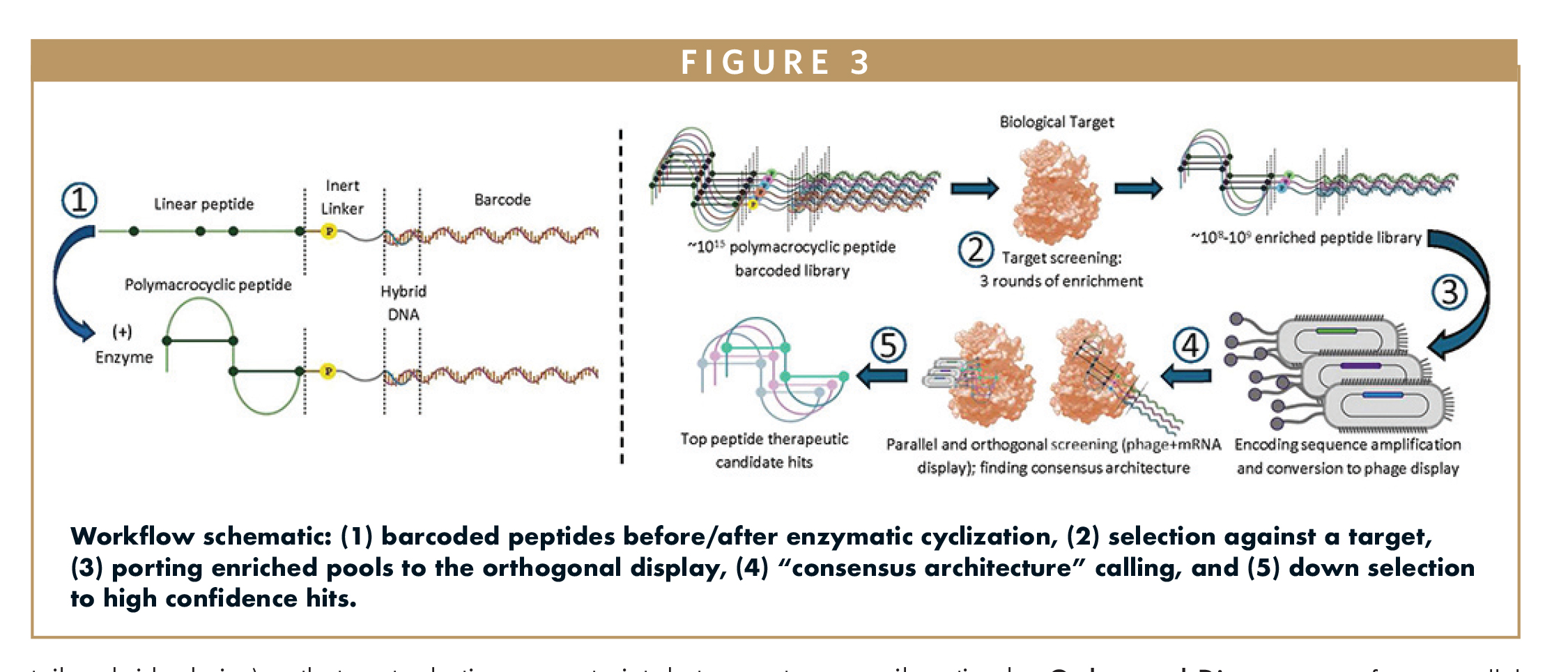
Sethera Therapeutics, Inc. is developing an enzymatic platform that decouples topology from sequence, enabling controllable, site specific multi ring formation under biological conditions while preserving chemical handles for downstream conjugation. The working model is straightforward: encode CXₙD/E motifs within diverse peptide backbones, allow PapB like rSAM enzymes to install thioether cross links, and carry out selections on the cyclized, barcoded products.
Click to enlarge
Early cell free biosynthesis (CFB) experiments and pIII based phage selections already hint at architecture specific enrichment, consistent with the notion that topology, nested versus in line versus triple, can dominate fitness during selection. The platform keeps orthogonal chemical handles available (eg, N termini, C-termini or tailored side chains) so that post selection conjugations (fluorophores, affinity tags, payloads) can be attached without disturbing the enzyme set cross links. Together, this enables rapid hit confirmation and assay portability across formats.
To reduce format bias, discovery is run in two orthogonal display contexts on the same targets. mRNA display provides ultra large sequence spaces with a polyanionic barcode (RNA/DNA) that can, in some cases, shift electrostatics near the binding interface. Phage display imposes capsid sterics (eg, pIII spacing, avidity, and orientation) that can mask or exaggerate certain architectures. By selecting an mRNA display and then reformatting enriched pools into phage for orthogonal/parallel screens, Sethera maximizes search breadth while minimizing format artifacts.
Why explicitly combine both HTS systems? Because each has systematic artifacts. In mRNA display, the long nucleic acid barcode can create electrostatic halos that disfavor some topologies or select for peptides that bind in geometries compatible with the tag. In phage, virion proximity effects and copy number can favor architectures that survive secretion and display constraints but are not necessarily optimal in free solution. Convergent enrichment across both formats flags architectures that are more likely to be intrinsically fit, and thus, more likely to survive translation into therapeutic scaffolds.
THE WAY FORWARD: FROM BINDERS TO FUNCTIONAL MODULATORS
Polymacrocyclic peptides are more than “better binders”. Multiple rings can pre organize pharmacophores, enforce multivalent effects within a single chain, and bias conformational dynamics in ways that translate into signaling outcomes; for example, agonism versus antagonism at GPCRs or isoform specific engagement of homologous domains. Sethera’s development path emphasizes:
Library Design by Topology: construct families that systematically vary ring count, spacing, and order (nested, in line, and triple ring motifs), not just side chain identities.
Orthogonal Discovery: perform parallel mRNA and phage selections on identical targets to identify architectures that reproduce in both contexts.
Rapid Structure Confirmation: use MS/MS fingerprints and enzymatic digestion to verify cross link count and placement early, accelerating hit triage.
Functional Assays, Not Only Binding: prioritize cell based readouts (activation, inhibition, internalization, trafficking) to learn which architectures modulate biology, not merely associate with targets.
Developability Filters: bake in plasma/microsomal stability and permeability screens; leverage the inherent reduction resistance of thioether bonds relative to disulfides, and preserve orthogonal chemical handles to enable payload conjugation or depot strategies.
Polymacrocyclic peptides can address intracellular protein-protein interactions long considered “undruggable” to small molecules and too hidden for antibodies; they can be tuned to bias receptor signaling or recruit endogenous machinery (eg, for targeted degradation or trafficking). Most importantly, they let us search the middle ground by structure, where the best medicines for complex diseases may be hiding.
The field has long known that shape underlies function, but our discovery engines have searched sequences far more than shapes. Enzyme installed polymacrocyclization changes that calculus. By merging RiPP enzymology with genetically barcoded discovery and orthogonal selection formats, we can systematically explore topology as a drug variable. Sethera’s platform is designed to do exactly that, turning nature’s blueprint into a practical path to specific, stable, and effective peptide therapeutics.
Dr. Karsten Eastman is the CEO of Sethera Therapeutics, Inc. He earned his PhD from the University of Utah (under the mentorship of Professor Vahe Bandarian), where they discovered the key processes that enable Sethera Therapeutics’ innovative technology. As a co-founder of Sethera, Dr. Eastman is leading the company’s efforts to commercialize cutting-edge peptide therapeutics, drawing on their experience in enzyme and peptide research, patent development, and engagement with key business mentors.
Dr. Vahe Bandarian is the CSO and President of Sethera Therapeutics, Inc. He earned his PhD in Biochemistry from the University of Wisconsin-Madison. He is a distinguished faculty member and Associate Dean at the University of Utah, recognized for his exceptional contributions to the field of chemistry. He is a Fellow of the American Chemical Society (ACS), the American Association for the Advancement of Science (AAAS), and the American Society for Biochemistry and Molecular Biology (ASBMB). His groundbreaking research has earned him the prestigious Pfizer Award in Enzyme Chemistry from the ACS and the Distinguished Research Award from the University of Utah.
Total Page Views: 2577