

Issue:January/February 2026
MAB FORMULATION & FILL-FINISH - Obstacles in Monoclonal Antibody Formulation & Fill-Finish
Key Points
- As biologic pipelines diversify and patient demand increases, manufacturers must navigate formulation challenges, such as high viscosity, protein aggregation and solubility limitations, while ensuring fill-finish operations remain sterile, precise and compliant.
INTRODUCTION
Since the first monoclonal antibody (mAb) was approved in 1986, these protein therapeutics have become a cornerstone of healthcare, offering targeted treatment options across a broad range of indications, including oncology, autoimmune disorders and infectious diseases. In recent years, the landscape of antibody-based therapeutics has expanded well beyond traditional mAbs. This therapeutic class now includes multispecifics: bispecific and trispecific antibodies designed to engage multiple targets simultaneously, antibody-drug conjugates (ADCs) that deliver cytotoxic payloads directly to diseased cells, and Fc-fusion proteins that enhance half-life or biological activity. Additionally, engineered antibody fragments and Fc-only formats offer new possibilities for tissue penetration and alternative routes of administration.

As the number and variety of mAb-based therapeutics in development pipelines continue to grow, so does the need for greater operational efficiency, manufacturing flexibility and scalability. Addressing these imperatives must encompass not only upstream production and downstream purification, but also the final manufacturing steps, namely formulation, sterile filtration, and fill-finish. Robust formulation and fill-finish strategies are essential to ensuring product quality, long-term stability, and patient safety. From selecting the right excipients to managing complex aseptic filling processes, drug developers face a host of technical and logistical hurdles that can ultimately impact the efficacy, availability, and success of these life-saving biologics.
The following explores some of the key challenges in mAb formulation and fill-finish, offering practical insights to help developers navigate complexity and ensure success. Considerations related to operational efficiency, flexibility and scalability are also highlighted.
OVERCOMING TECHNICAL CHALLENGES
Intravenous (IV) and subcutaneous (SC) routes have been the primary methods for administering parenteral biologic formulations, each with distinct advantages and limitations. IV administration allows for low-dose formulations and ensures rapid absorption into the bloodstream, offering precise control over the amount and rate of drug delivery. It bypasses barriers associated with oral and intramuscular routes, making it ideal for treating cancers and viral infections.
In contrast, SC injection is limited by small delivery volumes, necessitating high-concentration formulations. Although absorption is slower and bioavailability lower, SC delivery is increasingly favored for chronic conditions such as asthma, psoriasis and autoimmune diseases due to its convenience and potential for self-administration.1 The growing interest in biosimilars and patient-centric care models also drives innovation in SC biologic delivery. However, SC delivery requires formulations with high protein concentrations, often greater than 100 mg/mL, which introduces significant formulation and manufacturing challenges related to viscosity, protein aggregation and chemical degradation.1
Protein viscosity increases exponentially with concentration due to electrostatic and hydrophobic interactions. This poses hurdles for both manufacturing and drug delivery, particularly in prefilled syringes or autoinjectors, where high viscosity can affect dose accuracy and patient comfort. Addressing these challenges requires careful selection of formulation excipients to ensure the final product is stable, safe, and practical for use. Therefore, viscosity reducers are often employed to alter electrostatic interactions by masking protein charges or binding to protein surfaces, affecting hydrophobic interactions.2 For example, sodium chloride can lower the viscosity of a formulation by shielding protein charge and decreasing electrostatic protein-protein interactions. Arginine, another excipient used to reduce viscosity, works by directly binding to a protein’s surface by interacting with aromatic residues.2 However, formulation scientists are facing difficulties developing drug formulations using currently available excipients, as some are not a one-size-fits-all solution for therapeutic proteins.
Excipients, including amino acid derivatives, can be leveraged to reduce viscosity, protein-protein interactions, and influence the physical and chemical stability of mAbs. Two such excipients being investigated, bis-acetyl lysine and propyl serine, have been shown to both reduce viscosity at mAb concentrations up to 250mg/mL and control the rate of physical and chemical degradation by reducing mAb deamidation under accelerated stability conditions.3 Various computational molecular modeling and simulation tools are currently available that can also be used to select an appropriate excipient based on a protein’s behavior in its presence; Schrodinger Suite, for example, can predict specific excipient effects on protein folding, aggregation, or surface charge.4 Additional decisions related to the choice of surfactants and buffers, along with optimization of buffer conditions, must also be made. For example, biologic drugs delivered subcutaneously are often formulated at an acidic pH with a variety of stabilizing agents and buffers designed to mitigate injection-site pain.5 Once the formulation strategy is defined, fluid handling and filtration systems designed to ensure accurate and aseptic handling of the therapeutic are essential. Selecting the right components, with the right raw materials of construction and pressure capabilities, mitigates the possible physical degradation of the protein due to mechanical agitation and shear forces and contamination with leachables and extractables.
Finally, reliable sterile filtration processes using customized/configurable assemblies and appropriate filtration pump skids to control differential pressure help to maximize product recovery and maintain sterility in the final filling process. Pre-use post-sterilization integrity testing (PUPSIT) may be considered to detect potential integrity defects in the filter and avoid contamination of the final product. During filling operations, accurate transfer and dosing of fluids is paramount, as is the ability to adjust flow speed to prevent foaming and splashing. Manufacturing challenges of high-dose biologics pose their own unique set of challenges, specifically back-pressure on tangential flow filtration (TFF) equipment, filter clogging, and fill-rate accuracy. This can impact processing time, further emphasizing the need for careful excipient selection during formulation development.

ENSURING REGULATORY COMPLIANCE
Adherence to stringent quality standards and regulatory frameworks is pivotal at this final manufacturing stage. While the same chemicals are used in other phases of mAb manufacturing, meeting critical quality attributes is equally as important in formulation to assure product efficacy and safety.
Identifying the right supplier of high-quality chemicals that have been extensively tested, documented, and meeting regulatory requirements contributes to patient safety and helps to avoid product loss. Use of a single excipient grade in multiple process steps can further reduce risk and may offer additional operational benefits.
Suppliers of fluid handling systems and assemblies need to demonstrate an adeptness in navigating the complexities of regulatory and quality compliance. At a minimum, they should provide an assessment and summary of potential material impurities, along with their risk assessment and documentation, including analytical test data, such as lot release testing, in-process controls, and validation processes. Trusted, qualified suppliers will further help manufacturers reduce risk through comprehensive process understanding, equipment selection, equipment qualification, and documented current good manufacturing practice (cGMP) processes for material traceability.
GAINING EFFICIENCY & FLEXIBILITY
Operational efficiency has become a critical success factor in mAb formulation and fill-finish. Even when the right compendial excipients are selected and formulation design is sound, process inefficiencies can derail development timelines, inflate costs and delay regulatory approval.
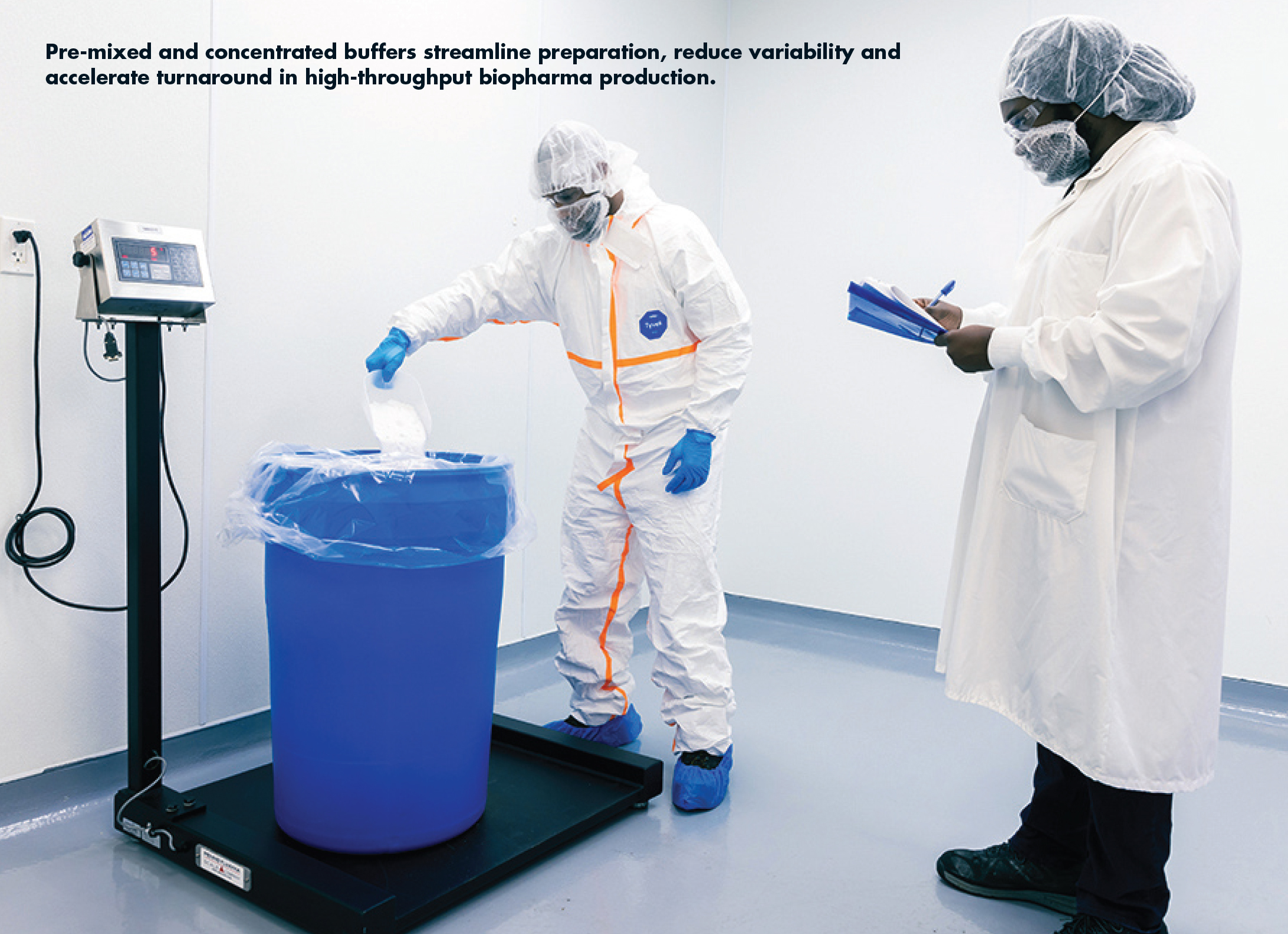
As the industry shifts toward more agile, high-throughput production models, speed and labor reduction are front and center. Companies are adopting strategies like pre-mixed or concentrated buffer solutions to streamline preparation and reduce variability, while innovations, such as direct dispense systems, are minimizing manual handling during fill-finish. In many cases, the rate-limiting step is no longer the production of the drug substance itself, but rather the turnaround time between campaigns or the labor-intensive process of buffer preparation. These operational pain points are where targeted process innovations can make the greatest impact, enabling faster, more scalable and resource-efficient production.
Flexibility is also essential in today’s formulation and fill-finish operations, especially as the biopharmaceutical landscape evolves to include a growing array of antibody-based modalities, ranging from traditional mAbs to bispecifics, ADCs, and Fc-fusion proteins. Each format presents unique requirements for stability, viscosity, and dosing, demanding tailored formulation strategies and adaptable fill-finish solutions. At the same time, manufacturers are moving away from single-product facilities in favor of multi-modal platforms that can accommodate a diverse pipeline. This shift calls for fluid handling systems and equipment that can easily adapt to different processes and facility layouts while minimizing cross-contamination risks and product loss. By building flexibility into both infrastructure and process design, companies can better respond to shifting priorities, reduce downtime, and future-proof their operations for whatever comes next.
POSITIONING FOR SCALABILITY
Scalability is a growing priority in formulation and fill-finish, as manufacturers look to bridge the gap between early stage development and commercial production with greater speed and confidence and less risk. The focus today is less on breakthrough technologies and more on integrated, adaptable solutions that support smart, efficient scale-up. Decisions made early, such as material choices, formulation strategies, and equipment selection, can have far-reaching implications. Using consistent technologies across scales helps reduce variability, streamline tech transfer, and minimize regulatory risk. Modular equipment platforms, for example, that deliver the same performance and user experience at different volumes allow teams to scale production seamlessly without retraining staff or redesigning workflows. In a dynamic environment where product pipelines and demand forecasts can shift quickly, scalable formulation and fill-finish solutions offer the agility and reliability needed to meet both clinical and commercial needs.
INCREASING SUPPLY CHAIN RESILIENCE
A high-quality source of cGMP chemicals and customized/configurable fluid handling equipment is of no value unless those materials are available on time, in the required quantities. Specific to formulation, capacity gaps related to excipients, such as amino acids, salts, and buffers, create the risk of production delays and slow time to market.
Drug manufacturers can apply a range of strategies to overcome supply constraints, including smart forecasting, dual sourcing for redundancy, and collaborative planning. Having trusted suppliers with global networks and multiple regional sites qualified for cGMP raw materials critical to formulation and fill-finish enhances redundancy and strengthens business continuity.
Supply partners that continually invest in increasing production capacities of indispensable chemicals that meet the highest demands of quality and performance ensure a robust and secure supply chain. Such strategic investments, backed by a local footprint, minimize disruptions and ensure product consistency when bringing new therapeutics to patients.
SUMMARY
Formulation and fill-finish are critical steps in the successful development and delivery of mAbs and other antibody-based therapeutics, yet they remain some of the most complex and risky phases of biomanufacturing. As biologic pipelines diversify and patient demand increases, manufacturers must navigate formulation challenges, such as high viscosity, protein aggregation and solubility limitations, while ensuring fill-finish operations remain sterile, precise and compliant.
Success at this stage of manufacturing depends not just on technical expertise, but on the ability to drive operational efficiency, enable flexible manufacturing and scale successfully and intelligently. These imperatives are increasingly interdependent: efficiency is driven by flexible solutions that reduce labor and turnaround time; flexibility enables the same infrastructure to support multiple modalities; and scalability is achieved through standardized, modular systems that perform consistently from clinical to commercial scale.
Achieving this level of integration and reliability requires the right partners with proven experience in bioprocessing, a deep understanding of regulatory requirements and a commitment to innovation and supply chain resilience. The right partner for formulation and fill-finish can help guide raw material selection and fluid path design and provide customizable/configurable, cGMP-ready systems. Importantly, the partner should also be able to ensure the supply of necessary materials and components for formulation and fill-finish.
This type of relationship will ensure that formulation and fill-finish steps contribute to accelerated timelines, minimize risk and ensure the delivery of safe, effective therapies to patients worldwide.
REFERENCES
- Davis, J., et al. Subcutaneous administration of monoclonal antibodies: Pharmacology, delivery, immunogenicity, and learnings from applications to clinical development. Clin Pharmacol Ther. 2024; 115(3): 422-439.
- Prasnikar, M., et al. Additive effects of the new viscosity-reducing and stabilizing excipients for monoclonal antibody formulation. Int J Pharm 2025; 674: 125451.
- Srivastava, A. et al. Viscosity reduction and stability enhancement of monoclonal antibody formulations using derivatives of amino acids. J Pharm Sci 2022; 111(10): 2848-2856.
- Barata, T., et al. Identification of protein-excipient interaction hotspots using computational approaches. J Pharm Sci 2016; 17(6): 853.
- Srivastava, A., et al. Approaches to alleviating subcutaneous injection site pain for citrate formulations. Pharm Technol. 2020; 44(6): 30-37.

Dr. Nandkumar Deorkar is Senior Vice President, Biopharma Production Research & Development for Avantor. He is responsible for innovation strategy and planning, and execution of new products and technology development. During his 25+ year career in research & development, he has been leading teams working on various aspects of upstream and downstream bioprocessing, single use systems, chemical/polymer R&D, drug development, formulation, drug delivery technologies, process development, and technology transfer. He has published more than 30 articles and holds more than 20 patents. He earned his PhD from Indian Institute of Technology, Mumbai, India, and his MBA in Marketing from Fairleigh Dickinson University, Madison, NJ.
Total Page Views: 7447