

Issue:January/February 2026
MRNA THERAPEUTICS - Strategies for Enhanced Stability, Targeted Delivery & Safe Translation
Key Points
- The evolution of mRNA platforms is far from complete, with the next step moving from vaccines to therapeutic applications. Some pioneering companies have already made significant strides by developing in-house technologies that not only enhance the delivery of therapeutic payloads to the lungs and other organs but also address key challenges that have historically hindered treatment efficacy.
INTRODUCTION
Messenger RNA (mRNA) therapeutics have rapidly advanced from conceptual promise to clinical reality, catalyzed by the success of COVID-19 vaccines and a growing ambition to treat complex diseases – including genetic metabolic disorders, rare diseases, conditions benefiting from protein replacement therapies, and respiratory conditions, among many others. Yet, the field’s progress has been shaped as much by its challenges as by its triumphs. The journey from bench to bedside has required not only innovation in molecular design and delivery, but also a rigorous response to issues immunogenicity, translation fidelity, scalability, manufacturability, stability and optimal delivery. This article explores each of these challenges and the solutions offered by novel technology platforms, providing insight into the evolving landscape of mRNA drug development and its potential as a future transformative modality.

THE CHALLENGE OF MRNA IMMUNOGENICITY & TRANSLATION FIDELITY
At the heart of mRNA therapeutics lies the challenge of molecular fragility and translation fidelity, the accuracy with which the genetic information encoded in mRNA is converted into a functional protein.
Unmodified mRNA is highly susceptible to enzymatic degradation and can provoke robust innate immune responses. The immunogenicity of mRNA therapeutics is a double-edged sword, which limits its practical utility as a drug. While immune activation is desirable for vaccines, it can be problematic for protein replacement therapies and chronic treatments, where repeated dosing is necessary. Minimizing innate immune activation and the risk of anti-drug antibodies is critical for therapies targeting chronic diseases. This can be achieved by careful chemical modification of the mRNA and optimization of sequence design to remove immunogenic motifs.1,2
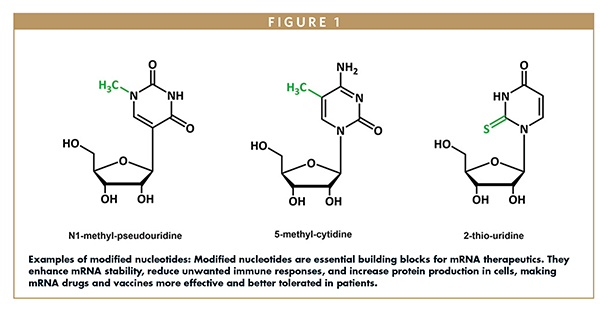
A variety of strategies to address mRNA immunogenicity issues have been explored over the years, with the goal of ensuring reduced immunogenicity and the highest safety. For example, early strategies focused on chemical modifications-most notably, the incorporation of nucleoside analogues such as N1-methylpseudouridine (N1mΨ)-which have been shown to decrease recognition by innate immune sensors and enhance protein expression. However, it was seen that those modifications resulted in the production of off-target protein products through “ribosomal frameshifting” during translation, occurring when the ribosome slips out of the correct reading frame. This off-target products may elicit unintended immune responses3, a phenomenon particularly relevant for conditions needing chronic or high-dose applications. While no adverse outcomes have been reported to date with mRNA vaccines, technology continues to improve especially for its application in chronic or high-dose settings.
Click image to enlarge
As such, advanced mRNA platforms such as Ethris’ non-immunogenic messenger RNA (SNIM®RNA) technology have adopted a multifaceted approach: the use of non-immunogenic, sequence-optimized mRNA. This is achieved through the careful selection and partial incorporation of modified bases beyond N1mΨ, together with proprietary sequence optimization strategies that reduce the likelihood of frameshifting without altering the encoded protein’s amino acid sequence.4 This rigorous attention to translation fidelity, combined with in vitro and in vivo validation, is critical for ensuring that mRNA therapeutics produce only the intended therapeutic protein and remain both functional and safe, without provoking significant inflammatory responses or anti-drug antibodies- a critical feature for therapies that require long-term dosing such as in chronic disease management. By minimizing innate immune activation through chemical modification and careful sequence design, mRNA therapies can be both potent and well-tolerated over multiple doses.
MANUFACTURABILITY & SCALABILITY
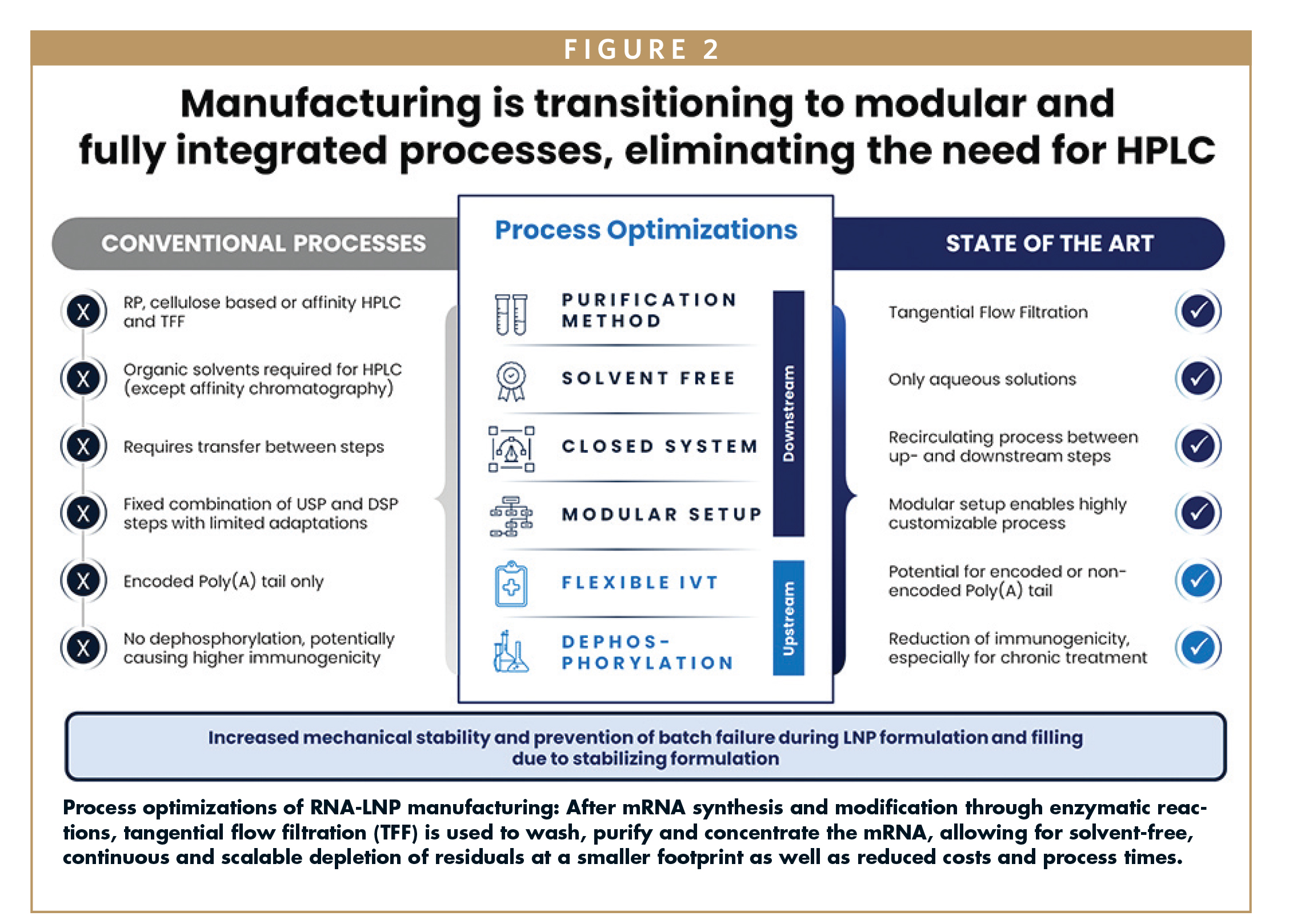
As mRNA therapeutics transition from niche applications to mainstream medicine, scalability and cost-effectiveness become paramount to reducing the complexity of bringing mRNA therapeutics to market. This includes addressing the high cost of cGMP-grade reagents required for in vitro transcription, the need for rigorous quality control to remove immunostimulatory by-products such as double-stranded RNA, and the lack of standardized production pipelines. Ongoing efforts to optimize manufacturing processes, such as HPLC (high performance liquid chromatography)-free purification steps, or the development of standardized protocols, are critical for ensuring the affordability and accessibility of mRNA medicines on a global scale. For instance, tangential flow filtration (TFF) is being used as an alternative purification method to HPLC, given it is more scalable, less labour intensive, and has lower operational costs.

STABILITY: LYOPHILIZATION & SPRAY DRYING
One of the most persistent challenges in mRNA therapeutics is ensuring product stability during storage and distribution. Most commercial mRNA vaccines require ultra-cold storage, complicating global access and logistics.5
Lyophilized and spray-dried formulations have emerged as promising solutions, as they not only enhance long-term stability at room temperature but also streamline manufacturing and distribution, making it feasible to produce and deliver large quantities of mRNA drugs worldwide without the need for a cold chain.
Spray drying, in particular, offers the advantage of scalability and is the standard technique for producing inhaled drugs. Spray-dried formulations achieve low water content and high stability, with ongoing studies aiming to confirm equivalence to lyophilized products in terms of shelf life and efficacy. These advances are crucial for inhaled therapeutics and vaccines, where stability at ambient temperature can dramatically expand global reach and reduce waste.
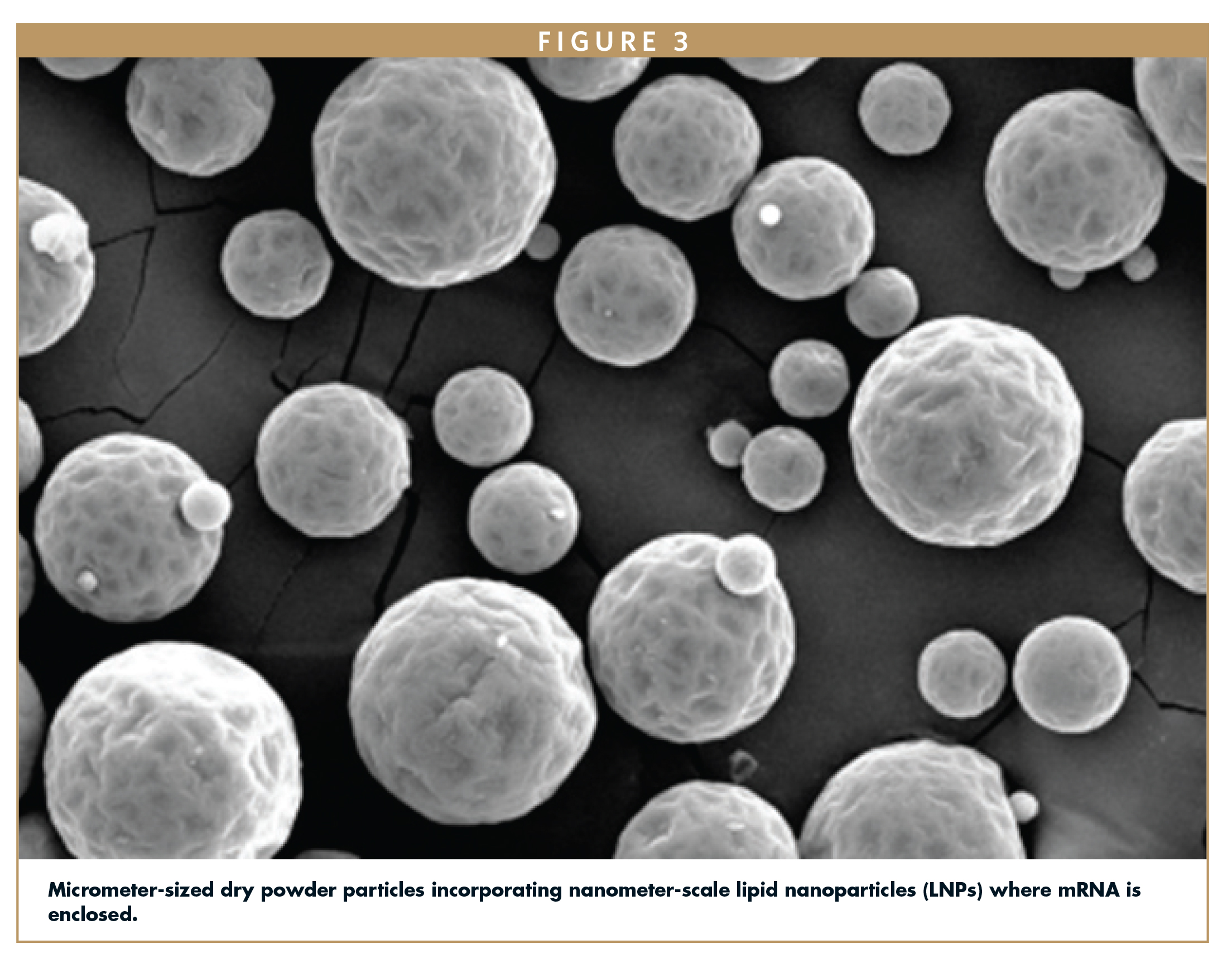
However, lyophilization and spray drying present their own technical hurdles. During lyophilization, lipid nanoparticles (LNPs) can deform or aggregate, and mRNA can break or lose integrity, leading to reduced encapsulation efficiency and therapeutic potency. mRNA products need to be formulated to withstand the stresses of drying and reconstitution, maintaining nanoparticle integrity and biological activity for extended periods. Optimization of the lyophilization process, including the use of stabilizing excipients and tightly packed LNPs, such as Ethris’ SNaP LNP® technology, has been shown to mitigate these risks, resulting in drug products that remain stable for up to six months at room temperature and for over 18 months in lyophilized form.
Spray dried formulation of LNPs facilitate a highly scalable manufacturing process. For inhaled therapeutics and vaccines, they can also improve patient convenience, allowing patients to carry their drugs easily in their pockets while traveling, without the need for a cold chain, as the dried formulation can be stored at room temperature.
DELIVERY: FROM SYSTEMIC EXPOSURE TO TARGETED LUNG DELIVERY
In addition to stability, unleashing the full potential of an mRNA therapy is dependent on a delivery system that protects the cargo mRNA during transport to the target cells, facilitates entry through the cell’s membrane and efficiently releases it into the cell. The delivery of mRNA to the target tissue and cell type remains one of the most significant technical hurdles in the field.6 LNPs have emerged as the leading vehicle for mRNA delivery, protecting the cargo from degradation and facilitating cellular uptake. However, conventional LNPs tend to accumulate in the liver following systemic administration, limiting their effectiveness for diseases outside the hepatic system. Likewise, dissemination following local administration may confer unwanted expression in non-target organs. For respiratory diseases, direct delivery to the lungs via inhalation is preferred, but this route introduces new challenges: the pulmonary mucus barrier, mucociliary clearance, and the risk of LNP aggregation during nebulization or spray drying, as explained previously.7,8
To overcome these challenges, particularly for inhaled delivery, researchers have developed LNP platforms that utilize tightly packed specific lipidoid formulations and stabilizing excipients, such as those described above, to create nanoparticles with enhanced stability and resistance to mechanical stress. Such design allows for efficient packaging of mRNA, improved resistance to aggregation during nebulization, and targeted delivery to the respiratory tract allowing penetration of the mucus barrier and achieve even distribution within the respiratory tract.
These advances have also demonstrated the ability to localize protein expression to the nasal epithelium without significant systemic spillover, a key step in minimizing off-target effects and maximizing therapeutic impact. This precision in drug delivery is a game-changer, as it enhances treatment efficacy and reduces adverse reactions. Clinical data have shown that such approaches can result in localized protein expression in the respiratory tract with minimal systemic exposure, supporting the safety and efficacy of targeted mRNA therapies.
FUTURE DIRECTIONS: INTEGRATION & INNOVATION
The evolution of mRNA platforms is far from complete, with the next step moving from vaccines to therapeutic applications. Some pioneering companies have already made significant strides by developing in-house technologies that not only enhance the delivery of therapeutic payloads to the lungs and other organs but also address key challenges that have historically hindered treatment efficacy.9 At Ethris, for instance, we look forward to continuing to advance our program targeting the upstream triggers of asthma exacerbations and chronic obstructive pulmonary disease (COPD) by encoding interferon lambda (IFNλ), a protein essential innate antiviral host immunity in the respiratory tract. Phase 1 trials have demonstrated not only safety and tolerability but also localized induction of antiviral pathways in the respiratory tract, supporting the potential for mRNA therapeutics to address both chronic and acute lung diseases.
Inhaled mRNA platforms are also being applied to rare genetic disorders such as primary ciliary dyskinesia, where inhaled mRNA can deliver corrected genetic instructions directly to the affected tissues, potentially restoring normal function and halting disease progression. These advances underscore the versatility and promise of mRNA medicines in addressing a wide range of respiratory conditions
Beyond respiratory therapies and vaccines, mRNA therapeutics can be used for a broad and rapidly expanding range of medical applications. Their versatility comes from the ability to encode virtually any protein, allowing for targeted treatments across multiple disease areas. To expand this potential, future directions include the integration of artificial intelligence and high-throughput screening in sequence design and formulation development, enabling more precise targeting and improved safety profiles. Personalized mRNA medicines, tailored to individual genetic or immunological profiles, are on the horizon, particularly in oncology and rare diseases. Ongoing research into alternative delivery vehicles, such as polymeric nanoparticles, lipid-polymer hybrids, and peptide/protein conjugates, is additionally expanding the toolkit for mRNA delivery and enabling more precise targeting of specific cell types within the lung and other organs. We are only at the beginning of an mRNA revolution.
REFERENCES
- https://www.tandfonline.com/doi/full/10.1080/ 17460441.2021.1935859
- https://www.nature.com/articles/s12276-023-00999-x
- https://www.nature.com/articles/s41586-023-06800-3
- https://www.nature.com/articles/nbt.1733
- https://www.mdpi.com/2218-273X/13/10/1497
- https://www.pnas.org/doi/10.1073/pnas.2109256118
- https://pubs.rsc.org/en/content/articlelanding/2025/bm/d5bm00322a
- https://www.nature.com/articles/s41467-024-53914-x
- https://www.pnas.org/doi/10.1073/pnas.2307798120

Dr. Carsten Rudolph is Co-founder and Chief Executive Officer of Ethris. He is a pharmacist by training and a leading expert in mRNA technology. As CEO of Ethris, he leads the company’ efforts to develop innovative mRNA-based medicines for diseases such as asthma and rare pulmonary conditions, as well as vaccines, focusing on inhaled delivery systems and novel RNA stabilization technologies. He is the principal inventor of Ethris’s proprietary SNIM® RNA platform, who led to the founding of the company, and co-inventor of 15 drug delivery patent applications. He has authored more than 120 scientific publications. In 2005, he received the prestigious BioFuture Award of the BMBF, which is the highest endowed young investigator award in Germany. He is also affiliated with the Dr. von Haunersche Children’s Hospital, part of Ludwig Maximilian University in Munich. He earned his pharmaceutical degree from the Freie Universität Berlin and his PhD from the Department of Pharmacy at the same university.
Total Page Views: 6179