

Operational Excellence at Scale: Why Integrated Manufacturing is the Future Biopharmaceutical Standard
By: Pierre Catignol, Executive Vice President  & Head of Operations, Samsung Biologics
Introduction
Demand for end-to-end, integrated manufacturing capabilities continues to intensify across the biopharmaceutical landscape. Clinical pipelines diversify, launch windows narrow, and tolerance for delay or rework collapses to near zero. In this climate, the conventional model—where drug substance (DS), drug product (DP), quality, and regulatory functions sit apart in distance, systems, and governance—creates friction when the industry needs fluidity. Integrated manufacturing answers that call by converting logistical complexity into a reliable operating rhythm that clients trust.
Fragmentation has long been a by-product of specialization. A manufacturing plant for mammalian cell culture might sit thousands of miles from a fill-finish facility; analytics and quality teams operate on separate platforms with different data models and documentation styles. As a result, each transfer introduces misinterpretation risk, forces duplicate validation work, and breaks data integrity expectations.
Integration addresses these process discontinuities, information silos, and regulatory gaps, incorporating flexibilityand speed into operations. When DS, DP, quality, analytical, and regulatory operations run under a single harmonized framework, teams align on shared objectives and common systems from the outset. Electronic manufacturing batch records (eMBRs) connect production to quality review; manufacturing execution systems (MES) enforce golden-batch parameters and recipe governance; analytics flow intact from development to commercial supply. This shift re-engineers the value chain, standardizes strategies for consistency, enables scalable production, and accelerates execution.
Clients experience that shift as reduced uncertainty. Technology transfers shrink from months to weeks because the receiving site is no longer a foreign environment—it is the same ecosystem, using the same documentation standards, master batch records, and deviation workflows. Batch release becomes more predictable because data are captured, contextualized, and reviewed within one digital thread. Even when programs pivot—new dosage strengths, accelerated submissions, or emerging market filings—the integrated framework adapts without adding risk.
Building Blocks for Integration
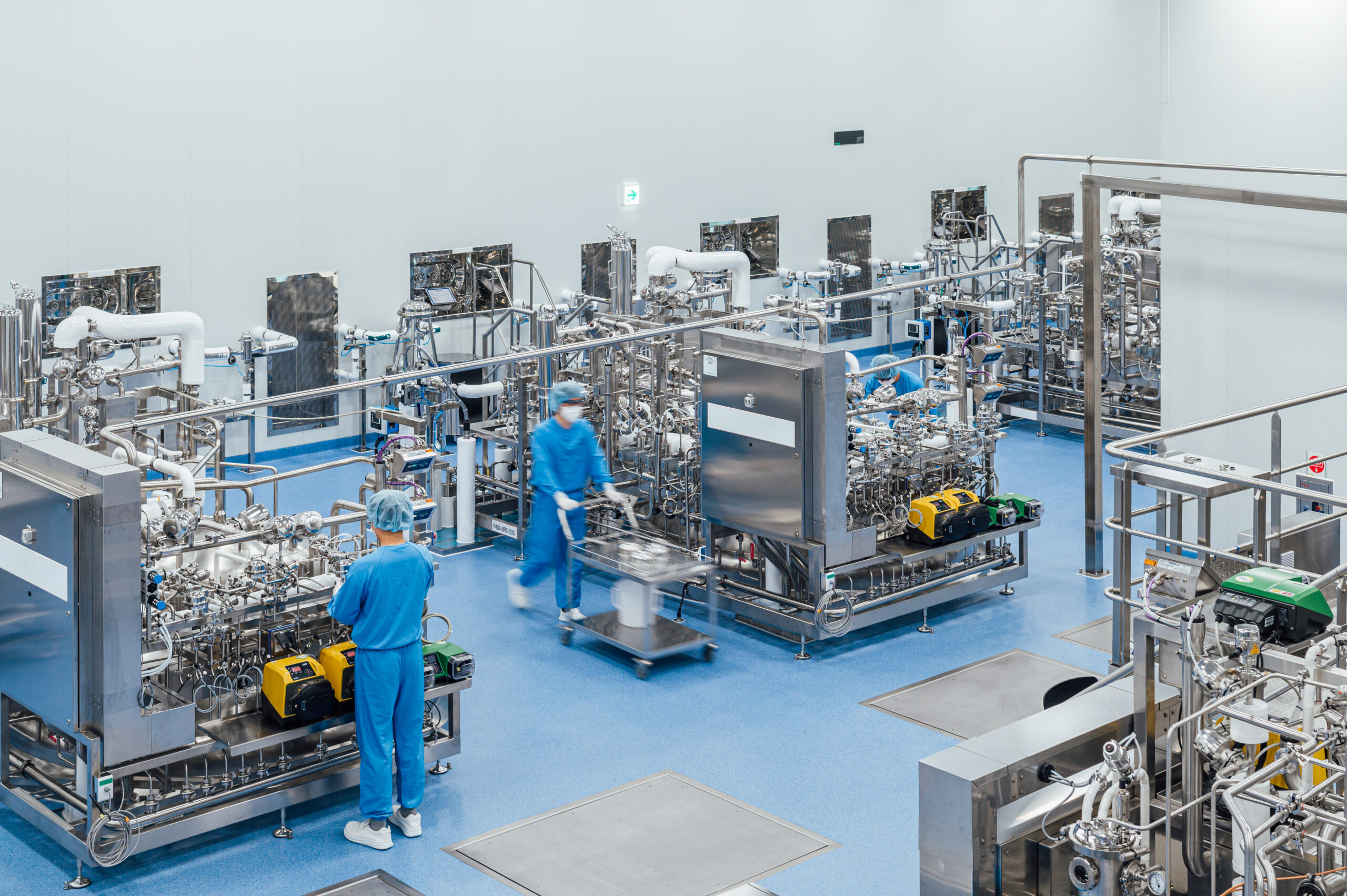
Integration starts with facility design. A CDMO facility is an architecture built to evolve. Hybrid stainless-steel and single-use systems balance durable capacity with rapid changeover; modular cleanrooms reconfigure without interrupting operations; redundant utilities protect against downtime and support concurrent qualification work. By analyzing cumulative process and product data, facilities can be tuned to address evolving market demand—robust for large-scale biologics and flexible for specialized modalities—without over-engineering and shutdowns.
Process adaptability is the second pillar. Upstream operations increasingly leverage process analytical technology (PAT)—including Raman-based monitoring of nutrient concentrations—to maintain cultures within tight design spaces and trigger automated adjustments before deviations take hold. Dual-feeding strategies, which combine bolus and continuous approaches, expand the manufacturability window across diverse molecules. Interchangeable centrifuge bowls accommodate different cell densities without sacrificing yield. In downstream operations, multi-train configurations and flexible chromatography columns enable parallel processing, rapid changeovers, and scale matching to program needs.
Digitalization binds these modular capabilities into an integrated whole. eMBRs and MES unify production floors with quality management, ensuring real-time traceability and structured, exception-based review. Digital integration stitches together in-process analytics, equipment health, and environmental monitoring, so investigations draw on complete evidence rather than anecdotes. Crucially, digitalization converts experience into institutional knowledge. Learnings harvested from one program—titration strategies, cleaning verifications, chromatographic load limits—become accessible templates for the next.
Systems alone cannot sustain integration. Culture drives it. A right-first-time mindset turns small acts—accurate label printing, precise pH documentation, crisp line-clearance checks—into daily quality practice. Continuous improvement evolves from an initiative into muscle memory: preventive-maintenance windows optimized by production data; CAPA closure times monitored as closely as yield; and near-misses treated as opportunities to learn. When teams share a common quality vocabulary and a unified deviation playbook, they respond to issues faster and spend less time debating root cause than fixing them.
Strategic partnerships complete the picture. Integration thrives when CDMOs and clients establish joint governance and transparent metrics from the start. This one-team cooperation builds a feedback loop that strengthens the platform itself. Facility layouts reflect common bottlenecks seen across client projects. Modular suites reserve capacity for complex modalities where flexibility commands premium value. Digital dashboards answer the questions clients actually ask in technical reviews and boardrooms.
Three Competitive Advantages
From the client’s perspective, the advantages cluster into three themes. First, streamlined processes reduce friction. Shared validation strategies let DS and DP qualification campaigns run with aligned protocols. Parallel reporting eliminates duplicate write-ups. Serialization reduces paperwork and waste while increasing downstream traceability.
Second, standardized strategies build consistency. Harmonized documentation, retained process knowledge, and common governance expedite technology transfers through optimized engineering runs and the process performance qualification (PPQ) runs. Scale-ups happen on schedule because recipes, training matrices, and equipment qualification paths are aligned.
Third, scalability turns stability into strategic advantage. Integrated networks centralize supply across clinical and commercial phases, run versatile manufacturing slots with full utilization over time, and respond to demand without sacrificing right-first-time production.
Fragmented models often stumble over inconsistent batch records, site-to-site data gaps, or misaligned change control—problems that can undermine client trust. An integrated operation presents the same data architecture, the same quality manual, and the same approach to deviation classification and CAPA follow-through. This continuity drives accelerated but thorough regulatory filings. Customized chemistry, manufacturing, and controls (CMC) strategies provide traceable lineage from development through PPQ and into continued process verification. Inspections become more about verifying a known system than discovering a new one. In advanced therapies—where chain-of-custody, chain-of-identity, and real-time release strategies are under intense scrutiny—end-to-end integration is becoming the baseline regulatory requirement.
The daily mechanics of integration are evident at the DS and DP interface. On the DS side, co-location with DP eliminates blind spots. Upstream teams can tune media or feeding strategies in response to DP feedback on viscosity, particulates, or stability. Intermediate storage strategies are validated once under a unified oversight model, simplifying logistics and enabling rapid rescheduling when clinical demand changes. Deviations are investigated by one cross-functional team with access to the same raw data, which shortens root-cause analysis and prevents recurrence.
On the DP side, immediate access to DS materials removes the uncertainty of inter-site transfers—no waiting on transit, no need for re-qualification due to temperature excursions, no re-sampling because the batch crossed a geographic line. Fill-finish experts adjust promptly to upstream attribute shifts, enabling first-pass success. With harmonized product records, regulatory documentation is assembled faster and with fewer contradictions. Labeling and serialization changes can be executed in real time, preserving launch timelines even when market requirements evolve late.
Supply chain resilience is another dividend of integration. Raw materials programs—vendor qualification, alternate sourcing, lot-to-lot comparability—benefit from a centralized strategy and unified quality agreements. Warehouse design supports both DS and DP flows with continuous chain-of-custody. Release testing can be staged efficiently across shared labs, and disposition decisions draw on a consistent data model rather than reconciling different information management systems. When disruptions occur, integrated operations reroute rather than stall because stakeholders are working from the same protocol.
Integration: The Strategic Imperative for Quality Biologics
A well-designed integrated site is modular at the edges and standardized at the core. It is built to interoperate with external labs, secondary packaging, or regional distribution when needed—without forfeiting control of the master data and quality narrative. Purposeful modularity keeps optionality high, and platform standardization keeps risk low.
Biologics demand good manufacturing practice (GMP) rigor. Manufacturing them on schedule and without compromise requires an architecture with stringent quality systems, long-cycle analytics, and regulatory accountability.
Consider two archetypal scenarios. A monoclonal antibody program enters late Phase 2 with promising data and aggressive timelines. In a fragmented model, the technology transfer to commercial scale triggers a cascade of engineering runs, new sampling plans, and re-verification of utilities at the DP site. Weeks slip into months. In an integrated model, DS and DP share a common recipe structure and validation library; eMBRs are adapted; and analytics are harmonized. PPQ runs proceed on scripted timelines, and commercial launch builds on a continuum of evidence.
Now consider a multispecific antibody with small batch sizes, patient-specific logistics, and robust stability. Fragmentation multiplies risks: chain-of-identity can be compromised by manual handoffs; temperature excursions during transit can force costly remanufacture; and documentation gaps can trigger inspection findings. An integrated operation shortens the physical and digital distance between steps, embeds real-time monitoring, and centralizes chain-of-identity management. The very features that make these antibodies complex—tight timelines, stringent handling, and bespoke analytics—become manageable because the system is designed for coherence.
Integration will deepen as new technologies mature. AI-assisted analytics will help predict deviations before they occur, tuning set points in response to subtle multivariate shifts. Digital twins will simulate changeovers and PPQ strategies, reducing the need for trial-and-error engineering runs. Sustainability will be engineered in: energy-efficient utilities, optimized cleanroom airflows, smart waste reduction for single-use systems, and materials programs that balance environmental impact with GMP control. Workforce models will continue to evolve, integrating cross-trained operators, data-literate scientists, and quality professionals who transition seamlessly between unit operations through systems unified by design.
None of this diminishes the importance of fundamentals. Integration succeeds when the basics are strong: crisp master data governance; disciplined change control that connects documents, equipment states, and training records; robust supplier management; and transparent metrics that make performance visible. Clients care about the same things regulators do—consistency, traceability, and credible root-cause analysis—because those same signals protect patients. An integrated CDMO aligns those incentives and makes the desired behavior the easiest behavior.
Trust is integration’s most valuable output. Clients want fewer status meetings and more status clarity. Regulators want fewer explanations and more evidence. Patients want fewer shortages and more timely access. When the operating model is integrated, trust accrues from the steady hum of a system that works as promised. Batches release on time because process capability is real. Submissions move forward because the documentation tells one coherent story. Inspections conclude cleanly because the same practices observed on the floor appear in the records.
Ultimately, integrated manufacturing turns a CDMO from a collection of services into a single promise: speed with certainty. It streamlines processes across the value chain, standardizes strategies so teams can act with confidence, and scales production with the agility that modern pipelines demand. It also clarifies accountability. When DS, DP, quality, and regulatory live in one ecosystem, there is no ambiguity about who owns outcomes. The system is designed to deliver, and the team is structured to stand behind it.
As pipelines grow more complex, global regulatory submissions multiply, and launch windows compress, end-to-end integration becomes a strategic imperative rather than a differentiator. Fragmented models can no longer meet the demands of advanced modalities or the expectations of global health authorities. Integrated operations—anchored by adaptable facilities, modular bioprocessing, digitalization, a durable quality culture, and strategic partnerships—create the infrastructure to perform, adapt, and excel.
For clients, the upshot is a partner capable of moving at the speed of science without compromising compliance. For regulators, it is a system that presents consistent, auditable evidence. For patients, it is faster, more reliable access to life-changing therapies. Operational excellence at scale is what integrated manufacturing makes possible every day. As the biopharmaceutical industry continues to evolve, the CDMOs that embrace integration will set the standard for manufacturing success.
Author Bio
Pierre Catignol has over 25 years of experience in the biopharmaceutical and pharmaceutical industry. Prior to joining Samsung Biologics, he began his career at Sanofi-Pasteur in 1995, and extended his career in Stallergenes & Virbac as Head of Operations & Supply site and Operations & Quality, respectively. His recent leadership role was at Lonza as Head of the Portsmouth NH, site. He earned his Master’s degree in General Engineering at ECAM university.
Total Page Views: 2235