

COLD CHAIN SUSTAINABILITY - Cold Front: The Growing Need for Controlling Cold Storage Energy Costs
By: Søren Skov Mogensen
INTRODUCTION
The pharmaceutical and biotech industries are not only one of the most prominent users of cold storage solutions today but are also one of the market’s most important growth drivers. Several factors, including the rise of temperature sensitive drugs, growing energy prices, and increasing regulatory scrutiny are inevitably compelling the pharmaceutical industry to consider its use of the global cold chain with sustainability in mind.
GROWTH OF TEMPERATURE SENSITIVE DRUGS
The pharmaceutical cold storage market is growing rapidly, from $17.7 billion in 2025 to a projected $34.5 billion in 2035. The growth driver is the growing prevalence of medicines requiring cold storage, with cold chain products (biologics, vaccines, and insulin) currently accounting for approximately 30% to 35% of total global pharmaceutical revenue.1
A recent analysis by the IQVIA Institute for Human Data Science indicated that around 50% of all medicines launched in the next half decade will require refrigeration and cold storage. This trend is corroborated by data from the U.S. Federal Drug Administration (FDA), which shows nearly half of new drugs approved by the agency in recent years require some form of temperature-controlled storage.
The increase in temperature sensitive drugs is linked directly to the R&D shift towards biologics, complex, large-molecule drugs derived from living cells, that are highly susceptible to denaturation or degradation from heat or freezing. Most biologics require storage in temperature-controlled environments ranging from 2°C to 8°C. Prominent examples of biologics that have gained popularity amongst the public include GLP-1 weight loss drugs, such as Ozempic and Monoclonal Antibodies (mAbs) such as Humira and Keytruda.
Cell and Gene Therapies (CGTs) are growing even faster than biologics and are considered the next big growth opportunity for the industry. CGT’s, however, require far more extreme and precise temperature control, since they contain living cells. If growth isn’t “paused” correctly, the cells will continue to metabolize and eventually die, rendering the treatment useless. Gene therapies require ultra-low temperature (ULT) storage of -60°C to -80°C, while cell therapies require cryogenic storage of -150°C to -196°C. With a greater share of the industry’s product mix requiring some form of refrigeration, cold storage will be in increasing demand.
UNPRECEDENTED TIMES FOR ENERGY PRICES
The development and widespread use of temperature sensitive drugs comes at a time when energy demand is experiencing an unprecedented surge both in the U.S. and in Europe, leaving energy-intensive industries vulnerable.
For the U.S. market, electricity demand growth remained at a steady 0.5% per year from 2000 to 2022, despite a 50% expansion of the U.S. GDP during that time. AI-driven data center demand, reshoring, and electrification of heating and transportation has accelerated that growth to 3% per year in 2024, and the Energy Information Agency (EIA) projects growth of 2.5% to 3% compound annual growth rate (CAGR) through 2030-2035.

The U.S. grid’s unique regional structure works against the pharmaceutical industry, as many of the states that have concentrations of cold storage facilities are also the ones experiencing above average growth. These include states like Indiana, New Jersey, and North Carolina, all of which are part of the PJM grid region where wholesale electricity capacity prices surged more than 800% in recent auctions due to the rapid expansion of energy-hungry data centers. California, holding 17% of the U.S. cold storage market, not only has some of the highest electricity costs in the nation, but is expecting demand to grow at rates far above the national average.
The European Union’s electricity demand picture is also challenging for pharmaceutical companies. Prices spiked up during the 2022 energy crisis, and while they have stabilized since, they remain roughly 2-4 times higher than prices in the U.S. or China. Electricity prices will face further upwards pressure due to carbon taxes, phase-outs of subsidies, and new costs associated with grid upgrades.
While energy prices are driven by differing demand drivers on both sides of the Atlantic, it is becoming more likely that energy prices will remain high or go higher, and with it, the cost of cold storage.
POLICY DRIVING PHARMACEUTICAL SUSTAINABILITY
The push towards sustainability in the European market is also driven by legislation, marking a dramatic shift from voluntary initiatives to mandatory, audited compliance. While the EU legislation covers just one market of many, it is the second-largest market for pharmaceuticals in the world, and home to many of the leading companies in the industry.
The EU’s Corporate Sustainability Reporting Directive (CSRD) will compel large biopharma and pharma companies to assess and publicly report on their emissions and sustainability practices. Companies over a certain size operating in the EU will be required to publish detailed, audited reports on their sustainability performance, going far beyond previous requirements. The legislation explicitly requires reporting on environmental matters, including a company’s Greenhouse Gas (GHG) emissions across their Scope 1, 2, and 3 categories.
Scope 3 emissions are of particular concern to the pharmaceutical industry, as studies have shown that 75%-80% of the industry’s total greenhouse gas (GHG) emissions fall under Scope 3. These emissions are tied to raw material extraction, Advanced Pharmaceutical Ingredient manufacturing, and critically, logistics, including the cold chain.
Beyond the CSRD, the pharmaceutical industry faces additional scrutiny under the General Pharmaceutical Legislation package. While the CSRD seeks to compel large companies to assess and disclose their overall corporate sustainability and emissions, the pharmaceutical legislation will look at product-level environmental impact and risk assessment for all medicines on the EU market. Most importantly, it treats energy use as a component of environmental sustainability and means that every individual drug must now prove its own environmental efficiency to stay on the market.
Finally, the EU’s revised Energy Efficiency Directive (EED) will directly address the energy intensive storage and distribution of the pharmaceutical industry’s products. The EED mandates that energy used for storage and distribution is no longer treated as an “overhead cost” but treated as a regulatory compliance metric that must be mitigated within the drug’s lifecycle.
FOCUSING ON COLD CHAIN SUSTAINABILITY
The combination of increased energy costs, new regulations, and consumer expectations places the pharmaceutical industry in a tough position where companies must simultaneously abide by stricter environmental and safety standards while lowering their energy footprint. Looking at the cold storage chain as a source of achieving new efficiencies will be paramount. Three areas where efficiencies and cost savings can be found in cold storage are insulation, energy use, and refrigerants.
The insulation industry standard in cold storage is Polyurethane (PUR) and the more fire-resistant Polyisocyanurate (PIR), used in roughly 33-47% of all cold storage containers. In light of new regulations in both the EU (F-Gas Regulation) and U.S. (AIM Act), the pharmaceutical industry should consider accelerating the switch to facilities using Vacuum Insulation Panels (VIPs).
While VIP is more expensive than PIR, they feature thermal resistance (R-value) orders of magnitude higher than PIR. The R value of PIR is approximately -6.5, while VIP can range anywhere between -30 and -50. VIP insulation can also be much thinner than that used by PIR reefers (refrigerated transport units), achieving the same level of thermal protection with 5 to 10 times thinner insulation. VIP insulation technology comes with higher upfront costs and can be harder to recycle, but pharmaceutical companies can avoid such issues by leasing cold storage containers, rather than purchasing them outright.
Incorporating renewable energy into cold storage offers the pharmaceutical industry the opportunity to lower their energy costs, decrease emissions, and demonstrate regulatory compliance. Renewable energy helps protect cold storage facilities against the threat of surge pricing, which can significantly impact energy costs. Retrofitting warehouses with solar panels can be cost-intensive, but companies can opt to use reefers with built-in solar to take advantage of the cost savings.
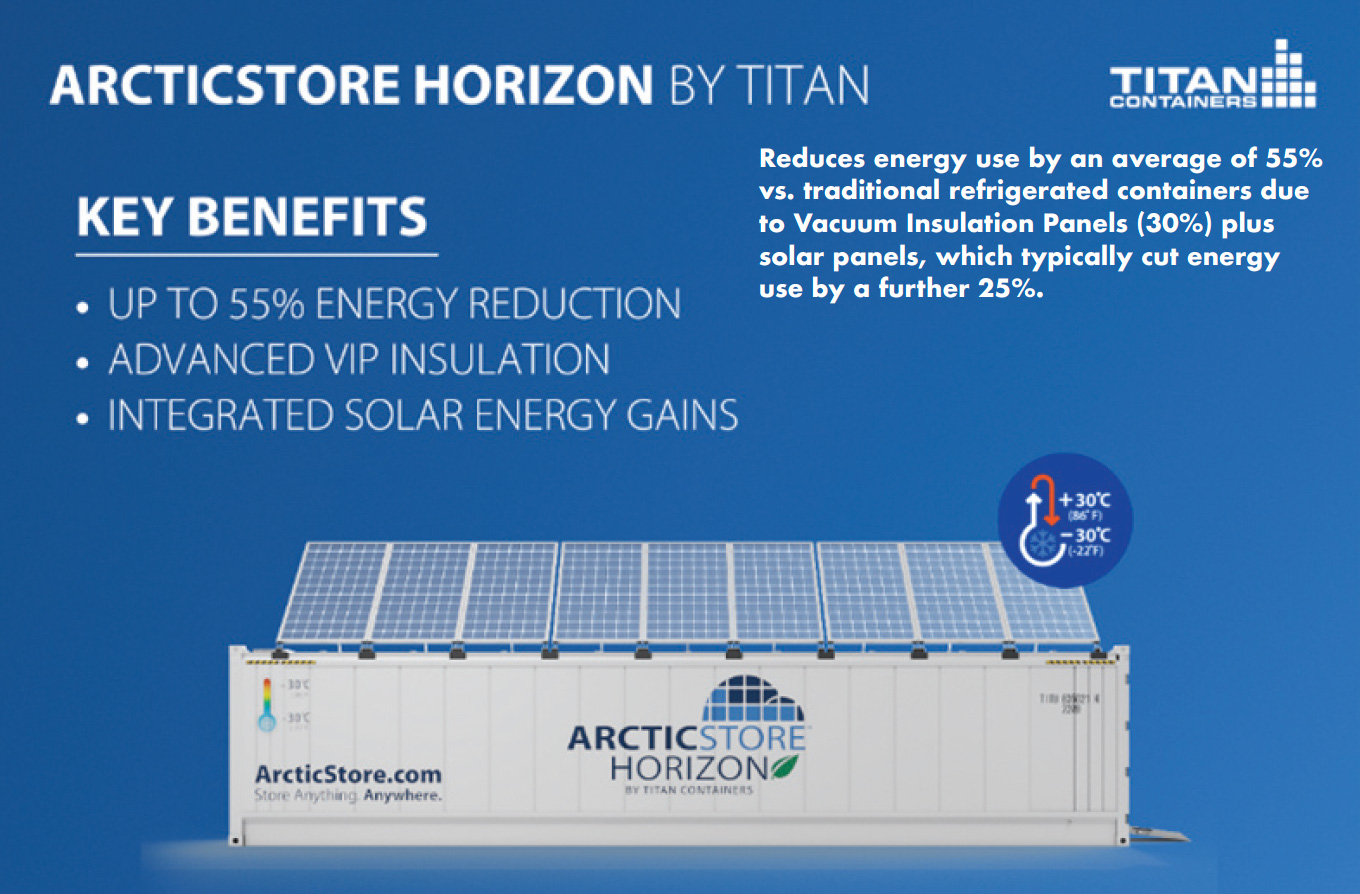
In our own research, TITAN Containers has found that a combination of VIP insulation combined with solar panels, can lower energy usage by up to 55% in cold storage reefers like the ArcticStore Horizon. From a sustainability perspective, incorporating renewable energy into cold storage can have a material impact on Scope 2 and Scope 3 emissions.
Pursuing a deliberate transition to low-GWP (Global Warming Potential) refrigerants can positively impact the overall sustainability of the pharmaceutical industry. The global cold storage chain is currently undergoing a refresh cycle in the types of refrigerants being used, switching from high-GWP Hydrofluorocarbons (HFCs) to Low-GWP alternatives. This is driven in large part by afore-mentioned AIM Act and F-Gas regulations.
The shift toward low-GWP refrigerants includes a trade-off of higher upfront costs for operators and customers, with lower long-term operating costs in the future. Systems using low GWP refrigerants can cost 10% to 25% more than traditional HFC systems, thanks to the need for stainless steel piping (for ammonia) or high-pressure components (for CO2). Handling CO2 and ammonia carries unique risks compared to legacy HFC, driving up labor costs significantly. However, low GWP cooling systems can save energy, refrigerant, and maintenance costs over a 25-year lifespan.
For the pharmaceutical industry, the switch in refrigerants has a significant positive impact on a corporate carbon footprint by addressing both direct emissions (Scope 1) and indirect emissions (Scope 2). The Total Equivalent Warming Impact (TEWI) of refrigerants is most relevant in the cases of leakages. For high GWP refrigerants, even a small leak can drive up emissions. For example, a common legacy refrigerant like R-404A has a GWP of 3,922, meaning that just 1 kg of R-404A has the same warming impact as releasing 3,922 kg (nearly 4 tons) of CO2. Low GWP refrigerants can cut the carbon by over 99.9%, erasing thousands of tons of CO2 equivalent from a company’s carbon impact total.
Low GWP refrigerants also have positive impacts on the Scope 2 emissions from the electricity purchased to run the cold storage facilities. Natural refrigerants like Ammonia are 10-15% more efficient than HFCs. They have better heat transfer properties, meaning the compressors don’t have to work as hard to maintain the same temperature.
THE ROAD AHEAD FOR COLD STORAGE & THE PHARMACEUTICAL INDUSTRY
The pharmaceutical industry is experiencing a period of rapid changes on many fronts, ranging from an evolving mix of temperature sensitive product offerings to sustainability regulations, and technology upgrades. Energy efficiency is no longer just a cost issue but will be a key determinant of a drug’s commercial and regulatory viability.
Solutions to navigate these changes exist and are readily available. By working with partners that offer products that integrate advanced vacuum insulation, on-site renewables, and low-GWP refrigerants, companies can transform their cold chain from a vulnerability into a competitive advantage – ensuring that the next generation of life-saving therapies is delivered through a resilient, future-proof network.
REFERENCES
- Pharmaceutical Cold Storage Market Size, Share & Forecast 2025-2035/Growth Analysis By Equipment Type, Temperature Range, Application, End-User & Geography
BIOGRAPHY
 Søren Skov Mogensen is CEO of TITAN Containers, a global provider of flexible, container-based storage solutions with a strong focus on refrigerated and temperature-controlled storage. TITAN supports customers across pharmaceuticals, food, retail, and logistics with scalable temperature-controlled storage capacity that can be deployed quickly and efficiently. Søren brings a strong background in management consulting and financial services, having held senior leadership roles at McKinsey & Company, Danske Bank, and Banking Circle Group. His experience spans strategy, M&A, transformation, and P&L leadership, including driving significant international growth. As CEO, Søren is responsible for setting TITAN’s strategic direction, driving innovation, and ensuring customer-centric execution. He is focused on building long-term partnerships and advancing more energy-efficient, sustainable solutions for the global cold chain.
Total Page Views: 665