


SPECTROSCOPY - High-Precision Tunable Laser Spectroscopy: A “Library-Based” Approach to Quantitative Bioprocess Analytics
By: Bryan Hassell, PhD
The accuracy and speed of analytical measurements play a critical role in biopharmaceutical development and manufacturing. In particular, the ability to quantify both active pharmaceutical ingredients (APIs) and formulation excipients – such as buffers, amino acids, sugars, and surfactants – is essential for ensuring product quality, process consistency, and regulatory compliance.
However, a significant gap exists between the need for real-time data and the capabilities of traditional analytical tools. Many conventional techniques require separate assays for each formulation component due to limitations in detector sensitivity, dynamic range, and specificity. Current methods are often based on chromatographic separation (e.g., HPLC) or single-wavelength detection, which necessitates extensive method development, sample manipulation, and dilution. These manual steps not only introduce variability but also create a delay of days or weeks between sampling and results, making active process control impossible.
High-Precision Tunable Laser Spectroscopy (HPTLS) addresses these challenges by enabling simultaneous, solvent-free quantification of proteins and excipients. By combining the chemical specificity of the near-infrared (NIR) combination band with the high power density of a tunable laser, HPTLS provides high-speed, multi-component analysis suitable for diverse unit operations – from drug substance concentration to final fill-finish.
THE TUNABLE LASER ADVANTAGE
The foundation of HPTLS lies in its unique optical architecture, designed specifically to overcome the limitations of traditional spectroscopy in aqueous environments. Standard NIR systems, such as Fourier Transform NIR (FT-NIR), typically employ broadband halogen light sources. While versatile, these sources lack the power density required to effectively penetrate water in the “combination band” region (2100–2400 nm). This spectral window is rich in chemical information – containing distinct overtone and combination vibrations for N–H, C–H, and O–H bonds found in biologic formulation – but it is also where water absorption is strongest. In a broadband system, the water signal often drowns out the subtle features of excipients and proteins, resulting in a low signal-to-noise ratio.
HPTLS solves this physics problem by utilizing a MEMS-based tunable laser that sweeps this specific region with orders of magnitude higher power density than halogen sources (Figure 1A). This higher power ensures that distinct spectral features for proteins, sugars, and surfactants are resolved clearly above the detector noise, even when using a robust 1 mm pathlength.
The impact on data quality is immediate. As shown in Figure 1B and 1C, HPTLS delivers a highly stable baseline with water-to-water repeatability of less than 12 µAU. In contrast, traditional FT-NIR sources show considerable noise and drift under identical conditions. This stability is the prerequisite for detecting minor components (like 0.1% surfactant) in the presence of high-concentration proteins.

HPTLS: PHYSICS OVER STATISTICS
To leverage this high-quality signal, HPTLS employs a different mathematical approach than conventional NIR, moving away from “black box” statistics toward physical modeling. Conventional NIR often relies on “Inverse Calibration” methods, such as Partial Least Squares (PLS). In a PLS model, the software requires massive datasets to statistically correlate spectral variance with analyte concentration. While effective in stable environments, this approach is notoriously fragile in bioprocessing. A change in the background matrix – such as a shift in temperature, turbidity, or buffer composition – can break the statistical correlation, necessitating extensive recalibration and limiting the method’s transferability.
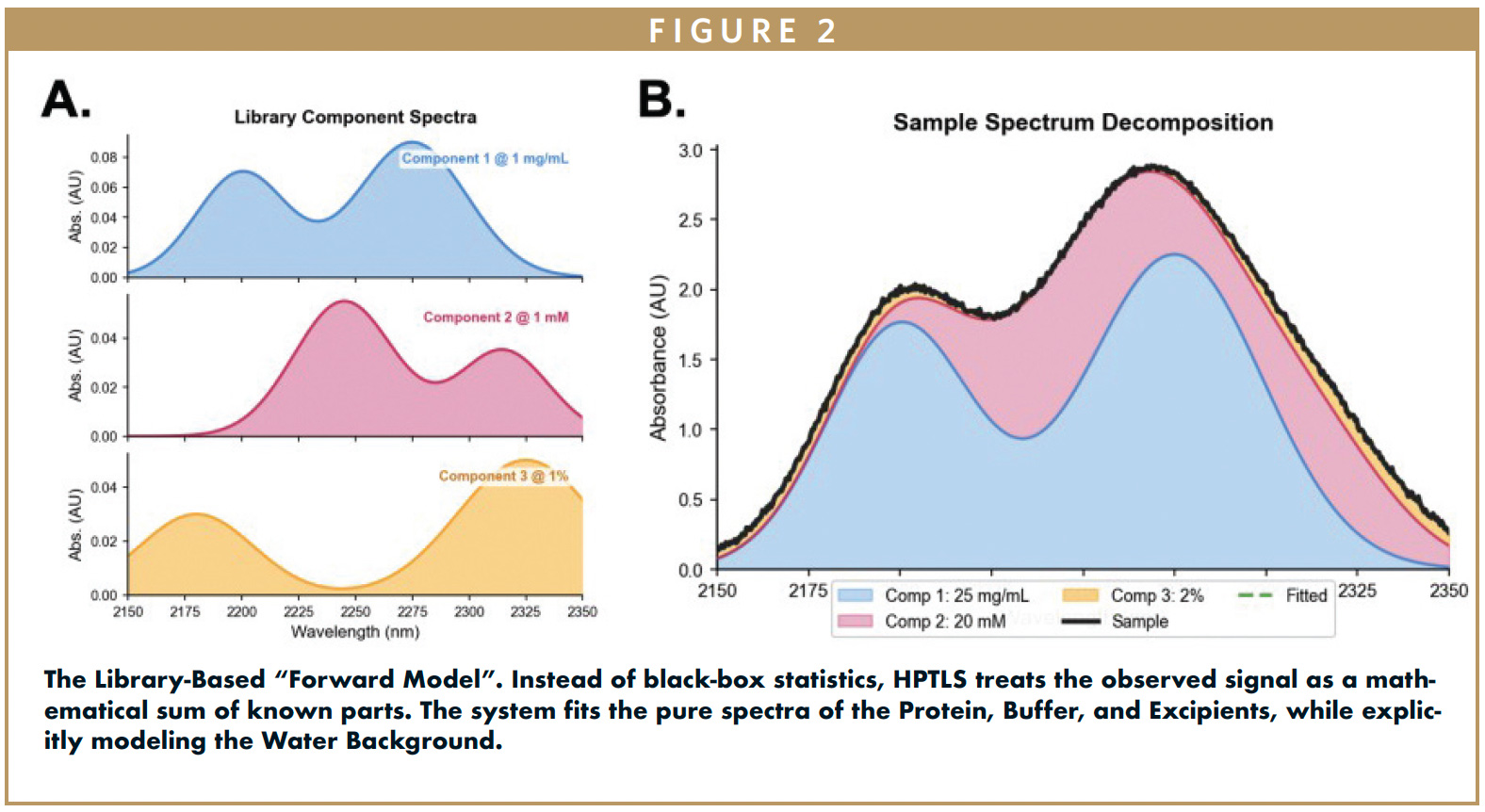
HPTLS fundamentally differs by employing a “Forward Model” or “Library-Based” approach. Instead of inferring concentration from correlation, the system mathematically reconstructs the observed spectrum using known “pure component” spectra stored in a permanent library (Figure 2).
The relationship is governed by a direct physical model based on the Beer-Lambert Law:
A(λ)total = Σ(ci · εi(λ)) + Abackground
Where:
– ci is the concentration of component i
– εi(λ) is the pure library spectrum of component i
– Abackground accounts for water, temperature and scatter
By explicitly solving for the water background and scattering effects as known variables in the equation, the system can “see through” the matrix to quantify the target analytes. This means that a single library method can work across different steps of the process without developing separate models for each matrix. For example, the same “Histidine” library spectrum is used whether the buffer is simple saline or a high-viscosity drug substance.
APPLICATIONS IN BIOPROCESS UNIT OPERATIONS
Because the HPTLS measurement is non-destructive, rapid (<1 minute), and uses a fixed 1 mm pathlength, the same method can be deployed at-line or in-line across the manufacturing workflow. This versatility allows for a unified analytical approach across upstream and downstream operations.
ROBUST EXCIPIENT QUANTIFICATION
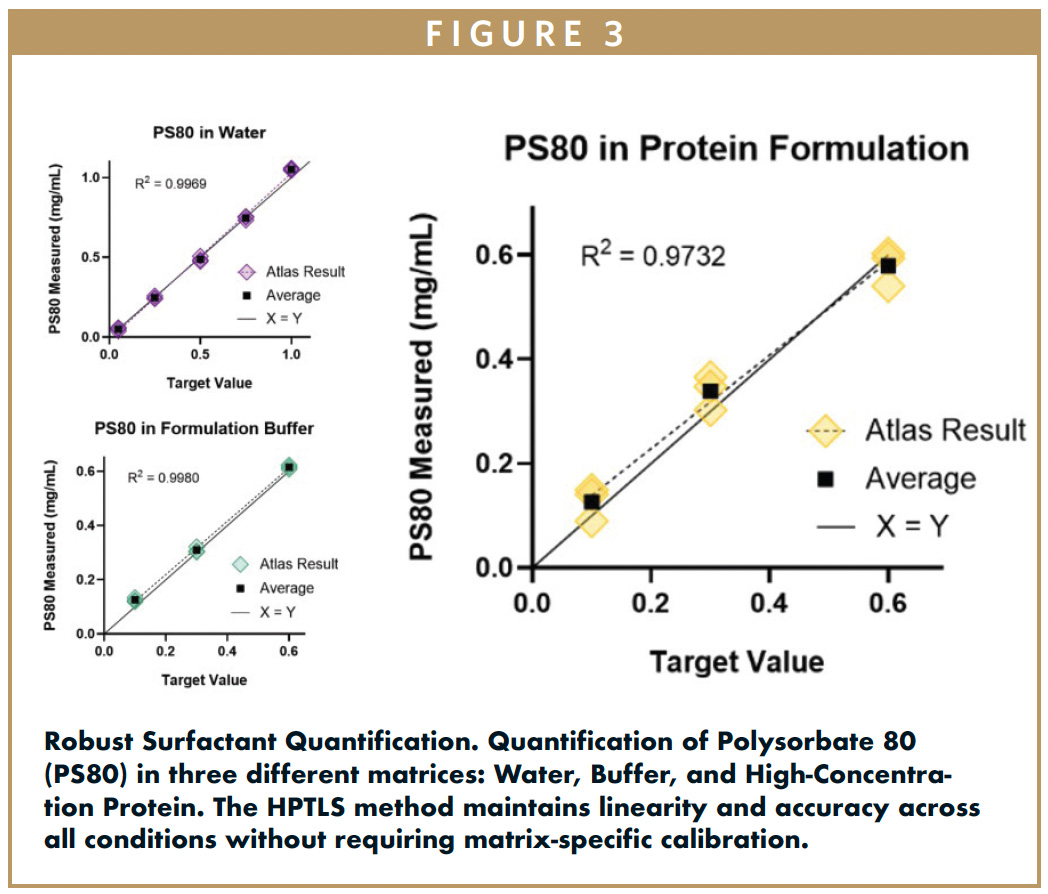
HPTLS simplifies this by deconvoluting the surfactant signal directly from the dominant protein and water background. As shown in Figure 3, the system maintains linearity for PS80 (0.1% – 1.0%) across three distinct matrices: simple water, formulation buffer, and complex protein formulation. The ability to measure the surfactant accurately in the presence of the protein – without matrix-specific calibration – demonstrates the robustness of the library-based approach. This allows formulation scientists to screen candidates rapidly without developing new assays for every buffer change.
DRUG SUBSTANCE CONCENTRATION
For Drug Substance (DS) manufacturing, tracking protein concentration up to high limits (100–200+ mg/mL) is a critical quality attribute. Conventional UV-Vis spectroscopy often struggles at these concentrations due to detector saturation, requiring analysts to use variable pathlength systems or perform manual dilutions – both of which introduce complexity and potential for error. HPTLS offers a simplified, orthogonal alternative. Because the laser can penetrate the sample effectively, the fixed 1 mm pathlength remains linear across a massive dynamic range.
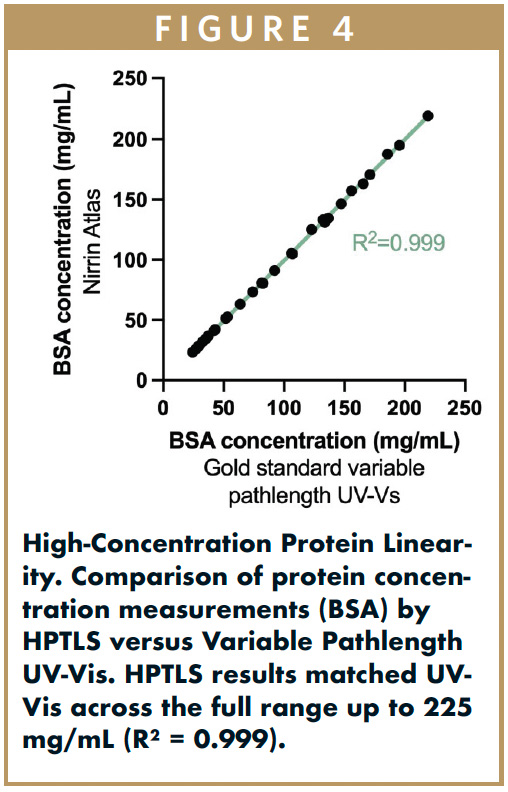
Figure 4 demonstrates the equivalence of HPTLS to variable-pathlength UV-Vis for Bovine Serum Albumin (BSA) up to 225 mg/mL. The result is a simple, dilution-free measurement that provides immediate feedback on protein concentration.
REAL-TIME PROCESS MONITORING: ULTRAFILTRATION/DIAFILTRATION (UF/DF)
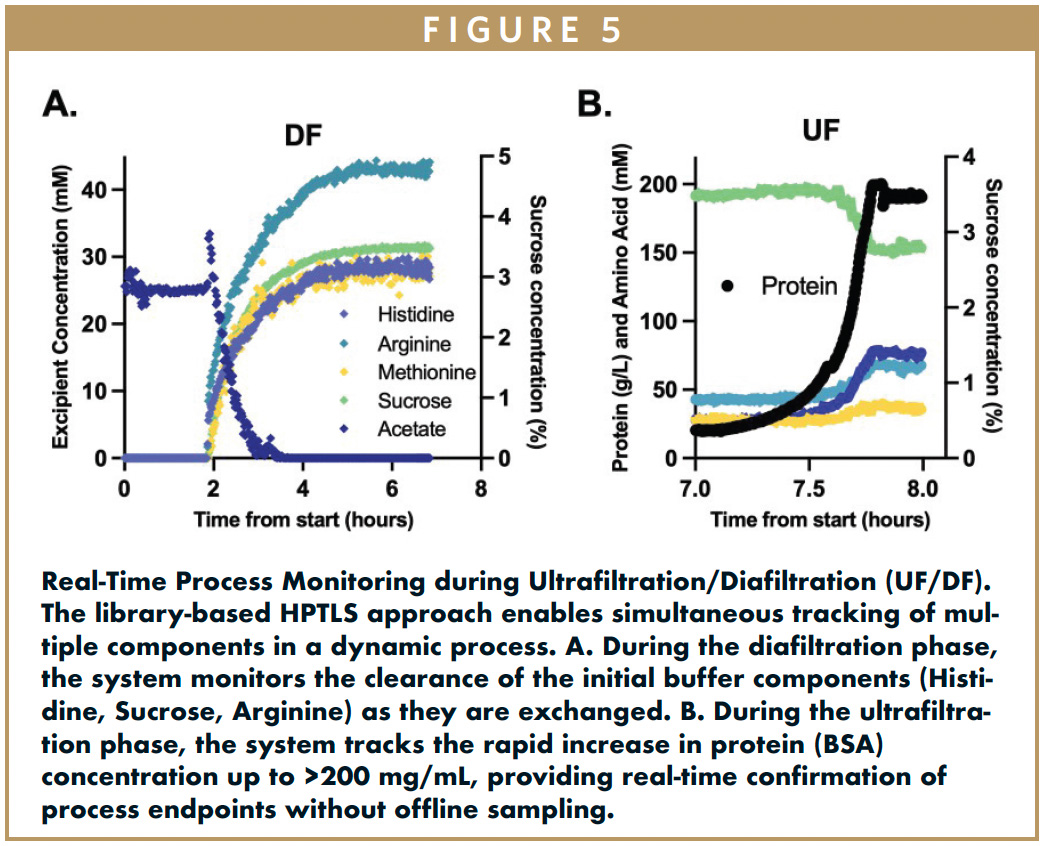
The true power of the library-based approach is realized in dynamic unit operations like Ultrafiltration/Diafiltration (UF/DF). During this process, the buffer composition changes continuously, and protein concentration rises significantly. A PLS model would likely fail as the matrix shifts so dramatically. However, the HPTLS forward model adapts dynamically. As shown in Figure 5, the system can simultaneously track multiple changing components in real time. In this example, the system demonstrates the ability to monitor the the addition of excipients (Histidine, Sucrose, Arginine) and clearence of acetate during the diafiltration exchange, along with increasing protein concentration (BSA) during the ultrafiltration step as well as the new buffer components. This capability transforms UF/DF from a fixed-time recipe to a controlled process. Instead of relying on theoretical volume calculations, operators can determine the precise moment when the concentration target is hit or when the buffer exchange is complete based on direct chemical measurement. This reduces process variability, prevents over-processing, and ensures the final formulation is within specification before the product moves to fill-finish.
SUMMARY
By shifting from statistical correlation to physical modeling, HPTLS eliminates the heavy calibration burden that has historically hindered the adoption of NIR in bioprocessing. The combination of a high-brightness tunable laser and a robust library-based algorithm allows for the direct, solvent-free quantification of proteins and excipients across a wide range of concentrations and matrices.
Whether verifying buffer composition in preparation suites, monitoring real-time exchange in UF/DF, or ensuring final excipient levels in drug product, HPTLS offers a unified solution for quantitative bioprocess control. This speed and simplicity empower manufacturers to move closer to the goal of real-time release, ultimately accelerating the delivery of therapeutics to patients.
BIOGRAPHY
 Bryan Hassell is the CEO and Founder of Nirrin Technologies. Prior to Nirrin, Bryan served as a Principal Investigator for the U.S. Department of Defense (DOD), evaluating the innovation potential of small businesses to help address national security challenges and ensure technological superiority. He held a role as an Investment Associate with Anzu Partners, a venture capital/PE firm concentrating on industrial breakthrough technologies, leading diligence on investments into their industrial and life science portfolio companies. Bryan received a Ph.D. in Applied Physics from Harvard University, where he developed an organ-on-a-chip microfluidic model of EGFR non-small cell lung cancer to explore tyrosine kinase inhibitor resistance and signaling dynamics in vitro.
Total Page Views: 678