

Optibrium Introduces Graphical Interface for QuanSA to Enhance Ligand-Based Affinity Predictions
Optibrium recently announced a new QuanSA plugin for PyMOL, providing an intuitive Graphical User Interface (GUI) for its ligand-based binding affinity prediction method, part of the Company’s BioPharmics 3D molecular modelling platform. The new interface facilitates chemists’ access to accurate affinity predictions that guide the design of potent compounds, and reduces the synthesis and testing burden in lead optimisation.
Originally developed as a command-line tool for expert computational users, QuanSA (Quantitative Surface-Field Analysis) is now accessible to the wider chemistry community as a new PyMOL plugin. The plugin’s clear visualisations identify the key interactions that drive molecular affinity, providing essential insights that enable users to optimise the potency of their molecules.
QuanSA is a differentiated and validated method that predicts the affinity of a potential drug molecule for its biological target. Its physically-motivated machine learning approach explicitly models the factors that govern molecular recognition and binding. This delivers accuracy equivalent to leading simulation-based methods such as free energy perturbation (FEP)1, but at a fraction of the computational cost and without requiring a protein structure. QuanSA enables accurate affinity predictions to be available much earlier in a project, and makes these predictions applicable to many more compounds and a broader range of targets.
The QuanSA plugin follows the recent introduction of a PyMOL interface for Surflex-Dock2, Optibrium’s molecular docking method, and reflects the company’s ongoing efforts to make sophisticated 3D modelling methods more accessible. The command-line interface will continue to be fully supported for expert users and large-scale screening applications.
Ann Cleves, VP of Application Science, BioPharmics Division, Optibrium, said: “Early-phase drug discovery relies on accurate predictions of binding affinity. QuanSA has been proven to deliver accuracy equivalent to the most advanced simulation-based methods, but at a fraction of the computational cost and even when a protein structure is not available. Putting this capability into the hands of the wider scientific community through an intuitive, visual interface is an important step. The more widely these predictions can be applied, the greater the impact they can have on drug discovery.”
Matthew Segall, Chief Executive Officer, Optibrium added: “Understanding why a molecule binds to a target, and not just how strongly, is highly valuable in lead optimisation. With the new PyMOL plugin, teams can now visualise the key interactions driving affinity alongside QuanSA’s proven predictions, giving them the insight to make better, more confident design decisions. The result is a more informed and efficient path to a pre-clinical candidate.”
The QuanSA plugin for PyMOL is available to BioPharmics license holders at no additional cost. Learn more about the new QuanSA PyMOL GUI and watch a live demo at the upcoming webinar ‘First look: Guide your compound design strategy with new visual, industry-leading affinity predictions’ on April 16th.
- Cleves, A.E., Johnson, S.R. and Jain, A.N. (2021) ‘Synergy and complementarity between focused machine learning and physics-based simulation in affinity prediction’, Journal of Chemical Information and Modeling, 61(12), pp. 5948–5966. doi:10.1021/acs.jcim.1c01382.
- https://optibrium.com/about/news/optibrium-widens-access-to-industry-leading-docking-method/
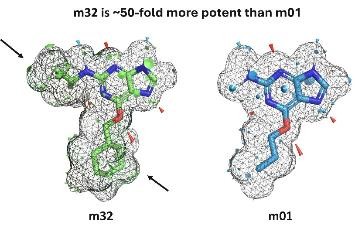
An example of the visual output provided by the new QuanSA PyMOL plugin. m32 is approximately 50 times more potent than the structurally similar m01, despite having near identical patterns of hydrogen bonding (red and blue cones). The difference is explained by additional steric contributions indicated by the surface patches highlighted by the black arrows.
Optibrium develops exceptional software and AI solutions that help scientists advance their discovery projects. Cutting-edge science, backed up by rigorous research, underpins their intuitive software for compound design, optimisation and data analysis. Optibrium’s comprehensive in silico platform improves the speed, efficiency, and productivity of the chemistry discovery process and supports a worldwide customer base, including leading pharma, biotech, agrochemical and flavouring companies and not-for-profit and academic groups. Optibrium was founded in 2009 and is headquartered in Cambridge, UK, with a US subsidiary, Optibrium Inc., based in Cambridge MA. For further information, visit www.optibrium.com.
Total Page Views: 3713